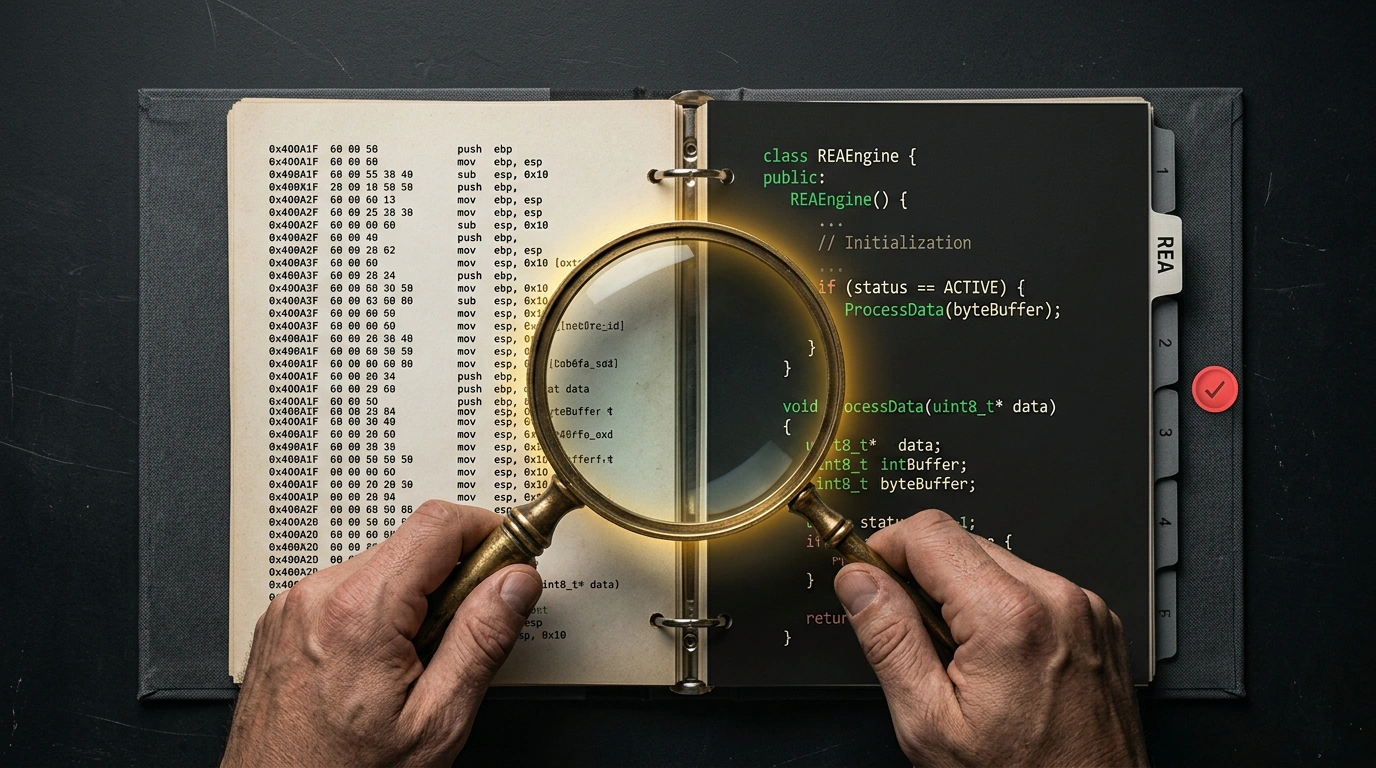
Have you ever tried opening an .exe file in a hex editor or a disassembler? If so, you probably remember that endless wall of assembly instructions: eax registers, jmp instructions, raw memory addresses, and zero human-readable function names. Historically, reverse engineering was a closed craft for specialist engineers willing to spend weeks untangling call graphs just to understand a single proprietary protocol.
In autumn 2026, however, a major shift hit the field. The open-source repository Reverse Engineer Anything (morluto/rea) racked up an astonishing 100,000 GitHub stars within days of launch. Reviewer Nate Herk and researcher Simon Willison highlighted a fundamental change: neural networks aren't just suggesting syntax anymore. They're now decompiling closed programs and classic games at scale, turning them back into readable C, Rust, or TypeScript.
We've already explored how pairing agents with the Ghidra disassembler automates logic recovery, and now that workflow is open to any developer via the Model Context Protocol (MCP).
Let's see how this setup works and why it excites hobbyists while worrying commercial software vendors.
The Architectural Bridge: Why the Agent Doesn't Hallucinate Assembly
The biggest mistake in naive attempts to decompile binaries with AI is dumping a gigabyte-sized binary straight into the prompt. The context window drowns in noise, and the model starts confidently inventing algorithms that never existed in the file.
The creators of REA took a strict engineering approach:
- Tooling layer: the agent doesn't read raw bytes directly. Instead, it drives the CLI of a professional disassembler (NSA Ghidra in headless mode, Hopper, or radare2).
- Semantic confidence tagging: while analyzing each assembly branch, the model labels every claim with strict markers:
seen— a fact directly verified by CPU instructions and symbol tables;inferred— a logical deduction based on constants and system call sequences;unknown— a gap in understanding that requires an isolated dynamic test.
- Clean-room implementation: once the agent grasps the logic of a network packet or math function, it helps write a brand-new, independent implementation in a modern language without copying original instructions.
How to Connect and Run REA
The tool ships as the open-source rea-agents npm package and plugs easily into client apps through a standard MCP server config file:
# Install the reverse-engineering CLI package
npm install -g rea-agents

# Configure MCP client connection in claude_desktop_config.json
cat <<EOF > ~/.config/claude/claude_desktop_config.json
{
  "mcpServers": {
    "rea": {
      "command": "npx",
      "args": ["-y", "rea-agents", "--headless", "--disassembler=ghidra"]
    }
  }
}
EOF
After restarting the client, the agent gains a dedicated toolset. It can request a control flow graph (CFG), trace string cross-references, and inspect memory structures.
Here's an example of automated decompilation of a compiled function from the command line:
# Autonomously decompile a legacy network handler into clean Rust code
rea-agent analyze --binary ./legacy_service.exe \
  --function "HandleClientHandshake" \
  --target-lang rust \
  --output-dir ./decoded_sources/
The model steps through cmp and je assembly instructions, spots the header magic-byte check behind them, and builds a tidy Rust match block with typed data structures.
Don't tell the utility to 'decompile the entire program at once.' Start with a specific critical function or search for text error strings. Once it finds an entry point, the agent can follow the chain of related calls on its own.
Decompiling proprietary commercial software without the copyright holder's permission violates EULA terms in most countries. Use reverse engineering strictly for auditing the security of your own products, researching interoperability formats, and preserving digital history.
A Second Life for Classic Games and the End of Traditional Obfuscation
Simon Willison rightly noted that this technology's biggest triumph right now is happening in retro gaming and game preservation. Indie developers and enthusiasts are recovering source code for classic 1990s and 2000s games whose servers went dark and studios closed long ago. With REA, old binaries compile into WebAssembly in hours, coming back to life inside modern browsers with gamepad support and high resolution.
For makers of closed-source software, though, it's a wake-up call. Traditional code obfuscation and binary packers no longer provide a reliable barrier. Reasoning models can see the mathematical logic of an algorithm right through instruction shuffling. We're entering an era where hiding architecture inside compiled code is nearly impossible.