Have you ever tried making a short explainer clip or animated timeline with popular diffusion video tools like Runway, Kling, or Sora? If so, you know the frustrating routine. You write a careful prompt asking for a company growth chart or historical milestones, wait five minutes for rendering, and end up with blurry mush where letters turn into alien scribbles, numbers double up, and chart arrows wander off on their own.
Diffusion models are great at landscapes, cinematic explosions, and fantasy characters. When you need crisp business infographics, an investor deck, or a teaching explainer, though, pixel diffusion fails badly.
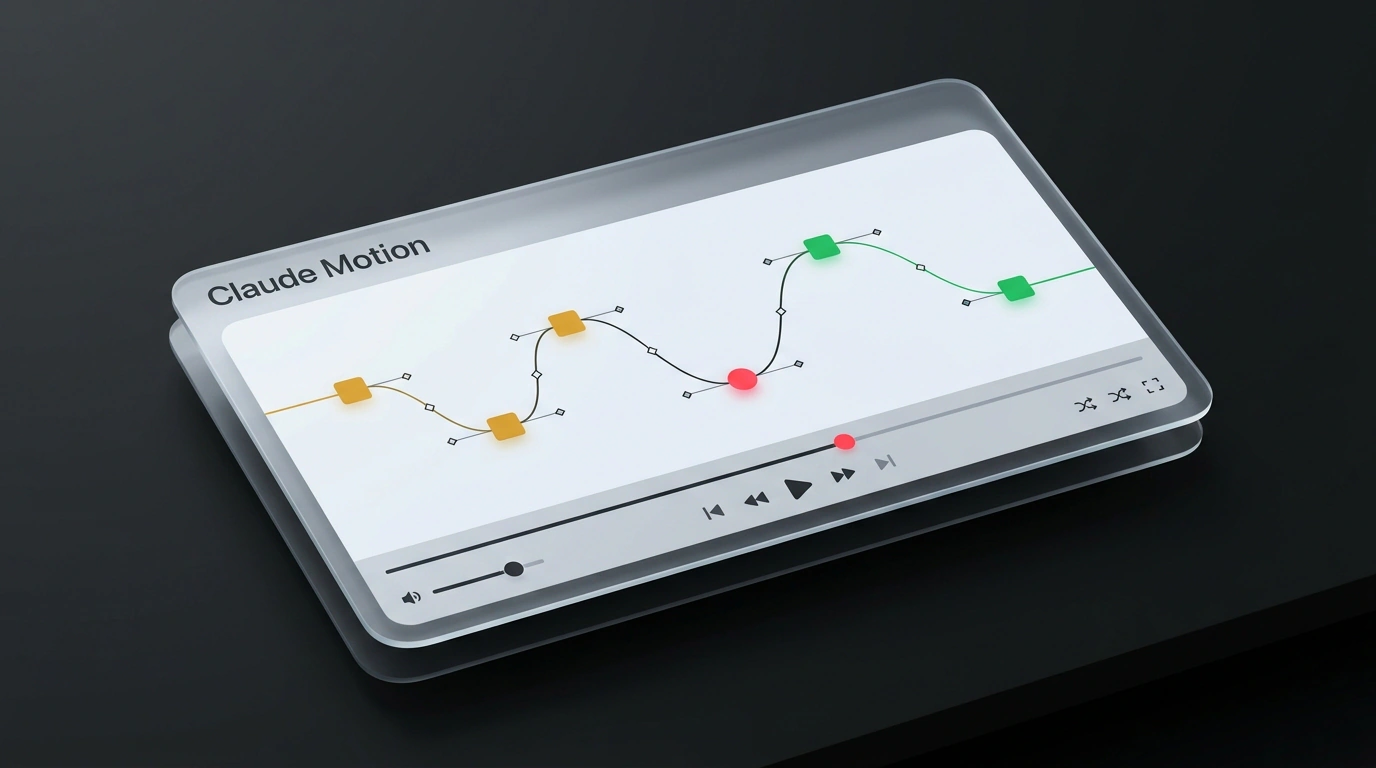
Anthropic approached the problem from the exact opposite angle. Inside Claude's interactive Artifacts panel, the company is rolling out Claude Motion (currently in beta for Team and Enterprise plans). We previously mentioned early experiments with interactive Claude Motion artifacts, and the creators behind The AI Advantage showed how it builds polished motion clips from just two text prompts—with zero timeline editing.
Let's look at why this approach changes the game for anyone producing educational or presentation content.
Code Instead of Pixels: The Anatomy of Razor-Sharp Motion
The core secret of Claude Motion is that it completely skips generating raw video streams. The model never tries to 'paint frames.' Instead, Claude acts like a pro web animator, writing clean code: SVG vector graphics, Canvas layouts, and CSS stylesheets with @keyframes.
Look at the practical difference this makes:
- Crisp typography and sharp lines: fonts, icons, and charts are rendered by the browser's vector engine. Whether on a phone screen or a giant conference-room projector, every heading stays razor-sharp with zero compression artifacts or blur.
- Instant parametric edits: suppose you generated a 30-second tech timeline, and your manager says, 'Let's slow down step three and switch the cards to our dark blue brand color.' In a pixel video model, you'd have to regenerate the whole clip and hope you don't lose the good parts. In Claude Motion, you just type: 'Slow step three down by two seconds and change the accent color to #0f2b5c.' Half a second later, the model updates the timings in code.
- Deterministic data: if your report shows profit grew by 18.4%, the bar chart rises by exactly 18.4%—not some random height guessed by a visual network.
How It Works in a Live Example
In The AI Advantage demo, the creator asked Claude to build a clear historical timeline with smooth era transitions, pop-up factoids, and a synced progress bar.
The workflow feels like a natural conversation:
- First, you describe the overall concept and structure in plain language.
- In the right-hand panel (Claude Artifacts), an interactive player launches immediately so you can play, pause, or scrub to any second.
- Once the layout and motion look right, you download the finished result as a standard high-definition MP4 file in one click.
Better yet, pro teams can export the project structure. If an in-house motion designer wants to polish the clip in Adobe After Effects or Descript, they get the underlying timing layout instead of rebuilding the animation from scratch.
When prompting Claude Motion, describe not only how objects look, but how they move: 'smooth fade-in entrance,' 'energetic bounce on card appearance,' or 'a fixed 5-second beat per point.' That helps the model choose the right Bezier curves for CSS transitions.
Claude Motion is built for short, punchy segments—the sweet spot is 15 to 60 seconds per clip. Don't try to generate a half-hour lecture in one go, or the browser artifact interface will hit memory bottlenecks while rendering overly long scenes.
What This Changes for Creators and Teams
Claude Motion shows how AI lowers barriers to specialized skills. Previously, getting a clean animated explainer meant either hiring a motion designer on a hefty budget or spending weeks learning complex editing suites.
Today, crisp, business-ready vector animation is available to anyone right inside a chat window. And because it's backed by exact mathematical code rather than random diffusion, creators get what matters most: complete control over the final result.