For a long time, the AI agent world looked like the Wild West. Every developer hacked together custom Python scripts, bolted on LangChain, and hardcoded API keys for every single service. If an external website changed its layout or headers even slightly, the whole fragile setup collapsed like a house of cards. In 2026, that ad-hoc chaos is giving way to an industrial three-layer stack that cleanly separates the runtime environment, the reasoning core, and tool-access protocols. We've already covered the core Agent OS concept and the principles of the Agentic Engineering production stack. Today, let's see how these layers click together in practice.
Starnet
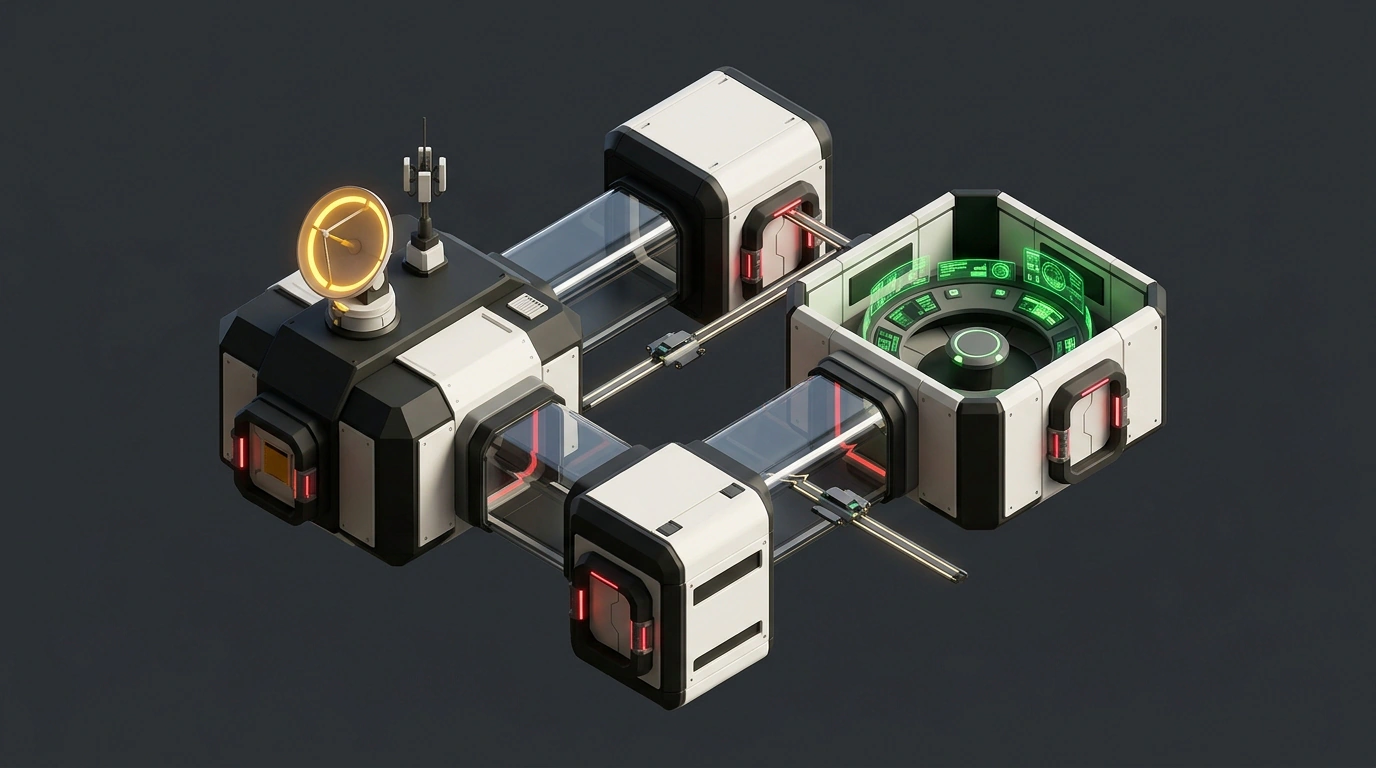
The first layer of this new architecture is an orchestration environment for multi-agent systems. StarNet AI Agent OS introduces a fresh metaphor that rethinks how we manage agent teams. Instead of dull log tables or scattered terminal windows, developers get an interactive digital 'space station.'
In this system, each room represents an isolated task context—for example, a 'web-recon lab' or a 'briefing room.' Corridors between modules define strict messaging channels, and objects inside rooms control tool permissions. Agents never step on each other's toes, can't overwrite another agent's environment variables, and pass data along clear routing rules.
Look how concise it is to schedule a night-shift analysis run in StarNet OS:
{
  "routineId": "night-shift-market-recon",
  "orchestrator": "starnet-desktop-v2",
  "agents": [
    { "role": "scout", "model": "hermes-agent-step5", "assignedRoom": "recon-lab" },
    { "role": "analyst", "model": "hermes-agent-step5", "assignedRoom": "briefing-room" }
  ],
  "toolAllowlist": ["web-audio-extractor", "web-search-engine"],
  "budgetLimitUsd": 1.50,
  "cronSchedule": "0 2 * * *"
}
You set the schedule, cap the budget at $1.50, and go to sleep. The scout gathers facts, passes them to the analyst over a secure channel, and a finished summary is waiting for you by morning.
Hermes Agent and Step 5
The second critical layer is the system's 'brain.' For a long time, people assumed autonomous reasoning required giant proprietary cloud models. Nous Research broke that monopoly by pairing its open Hermes Agent model with the specialized Step 5 runtime.
Step 5 stands out for step-by-step task decomposition with intermediate state checks:
- The model doesn't try to solve a complex problem in one giant reply.
- At each step, the agent forms a micro-hypothesis, takes one verification action, checks the environment's response, and adjusts its plan.
- All reasoning steps and session history live in open Markdown files (
MEMORY.md), so the agent keeps its context across restarts.
Better yet, the open-weights model runs on your own hardware, eliminating the risk of sudden lockouts from foreign cloud providers.
The Monad Protocol
Even the smartest agent in an ideal runtime stays helpless if it can't interact with the outside world. Here, the industry hit a practical wall: you can't manually register on thousands of sites, generate API tokens, and link credit cards for every service.
The Monad protocol, analyzed by researcher Kieran Flanagan, solves this bottleneck. Monad creates a universal economic gateway for AI agents built on the HTTP micropayments standard (x402).
Here's what a standardized tool connection manifest looks like under Monad:
{
  "$schema": "https://monad.xyz/schemas/tool-manifest-v1.json",
  "toolId": "web-audio-extractor",
  "name": "Web Captions Extractor API",
  "endpoint": "https://api.monad.xyz/tools/v1/yt/captions",
  "method": "POST",
  "pricing": {
    "costPerCallUsd": 0.002,
    "paymentProtocol": "x402"
  },
  "parameters": {
    "videoId": { "type": "string", "required": true },
    "language": { "type": "string", "default": "en" }
  }
}
The agent needs no personal keys. It calls the gateway, the x402 protocol deducts fractions of a cent ($0.002) from a single agent deposit, and the tool returns the result right away. Monad's catalog already lists over 2,400 ready-to-use tools—from extracting video captions to booking tickets and parsing social feeds.
Always set a hard spending cap (budgetLimitUsd) at the orchestrator level. If an agent gets trapped in a logic loop while parsing a broken web page, the budget limit stops execution before your balance hits zero.
When connecting tools from Monad's public registry, check the listed call price (costPerCallUsd). Some compute-heavy services charge far more than standard micropayments.
Put these three pieces together and you get a working pipeline for the future. StarNet handles process isolation and visual control, the open Hermes + Step 5 pair powers logic and reasoning, and Monad opens the door to thousands of external web services via micropayments.
The era of duct-taped bots is over. In its place stands mature modular engineering, where every piece is autonomous, swappable, and safely isolated.