Back in 2022, before ChatGPT took over every news feed, people were busy playing with image generators like Stable Diffusion to turn digital noise into blurry cats. Around the same time, a small group of researchers from Toyota Research Institute (Ben Burchfiel, Siyuan Feng, and MIT professor Russ Tedrake) teamed up with colleagues from Columbia University (Cheng Chi, Zhenjia Xu, Shuran Song) and MIT to test a bold idea. What if you could turn random noise not into pixels on a screen, but into robot arm movements in physical space?
The experiment worked. They called the method Diffusion Policy, and it proved for the first time that a robot could learn complex physical tasks straight from examples, without anyone programming every point on its path. For physical AI, that was its own "ChatGPT moment." Still, software and atoms move at very different speeds. You can push a language model to GitHub in an evening and have a million users by morning, but you can't run git clone on a robot or teleport it to the factory next door. It took nearly four years for that lab project to grow into Walden Robotics, a Cambridge-based company that spun out of Toyota Research Institute in January 2026 and came out of stealth in July with a $300 million seed round at a $1.1 billion valuation. Its backers include Toyota, Deviation Capital, NVIDIA, Boeing, Samsung Ventures, and CoreWeave Ventures.
The most interesting part of this story isn't the massive check. Looking at Walden and its co-founder Adrien Gaidon (who led machine learning at TRI for seven years and teaches at Stanford), you get a clear picture of how the Physical AI market actually works. You see why factory robots don't need legs, where truly valuable data comes from, and how a small team without hundreds of millions in the bank can break into the field.
How Robots Moved from Blind Coordinates to Learning by Example
Walk into a traditional car factory, and you will see giant welding arms that have been standing there for decades. Their design is dead simple: they are open-loop systems, which is a polite way of saying they are blind. An engineer hardcodes exact 3D coordinates in advance: move to point A, shift to point B, fire a weld. If a part is off by a centimeter or a person steps into the path, the machine won't notice and will plow straight through. That's why these robots sit behind yellow safety cages and light curtains.
Physical AI brings neural networks off the monitor and into the world of real objects. A robot powered by it watches its surroundings through cameras and sensors, understands basic scene physics, and works right alongside people in messy environments where boxes sit crooked and tools move around.
Modern robots learn in two layers. The first layer is pretraining on massive amounts of internet data: video, text, and code. Large language models (LLMs) and vision-language models (VLMs) give the machine common sense and intuitive physics. The robot learns ahead of time that a table is solid, a mug will fall if pushed off the edge, and what a human looks like. On its own, that base doesn't make the robot a useful worker, but it builds a strong foundation.
The second layer is hands-on manipulation, and that's where Diffusion Policy made the breakthrough. Earlier robot networks often tripped over a simple problem: suppose a robot can steer around a box on the left or on the right. A standard model trained on both choices would average the two paths and drive straight into the box. The diffusion approach solves this differently. It starts with random noise and cleans it up step by step into one smooth sequence of future motions, a technique called action chunking. The robot commits to one coherent route and follows it through.
In the original arXiv paper published in March 2023, the team tested the method on 12 tasks across 4 manipulation benchmarks and saw an average success gain of 46.9% over the best algorithms of the time. Today, that same idea (alongside a related method called flow matching) powers the "action head" of modern Vision-Language-Action (VLA) models that link vision, language, and motor control into one system. And in November 2026, Walden Robotics unveiled its multimodal model LBM 2.0: Sage, built for fast fine-tuning right on the shop floor. It already shows early signs of independent generalization, dodging obstacles and stringing multi-step operations together from familiar pieces.
The Goldmine of Deployment Data and Three Tight Bottlenecks
Whenever people talk about training robots, a tempting idea pops up on social media: let's record lots of videos of humans doing chores, sell the dataset to labs, and make a billion dollars in a year. In practice, that plan falls apart fast. Bought datasets help you get moving at the start and expose blind spots that take too long to reach on a factory floor. Anything you can easily scrape with a Python script or film in a living room, though, loses value almost overnight and turns into a commodity.
The real gold in robotics is deployment data: camera feeds, sensor logs, successful trajectories, and failure analyses collected directly inside active factories. You can't buy that off a price list. No major manufacturer like Toyota is going to let a startup walk into a plant and say, "Let us park our hardware here for a year to mess around and collect a dataset." You have to earn the right to stand next to the assembly line. From day one, the robot has to stay out of the crew's way, meet safety rules, and deliver measurable value.
A software engineer, a teleoperator wearing a VR headset, and a Walden Robotics mobile manipulator during training and deployment (Source: waldenrobotics.com)
To understand the whole industry, borrow a pipe metaphor from the Toyota Production System (TPS). Picture a long water pipe made of wide segments connected by narrow pinch points. No matter how much you widen a thick section, you won't get a drop more water out the end because flow is limited by the tightest choke point. Physical AI has three of these bottlenecks, and they are locked together: deployment data depends on how many robots are actually running in the field; hardware manufacturing limits the size of that fleet because every unit must be built, tested, and maintained; and compute is needed to digest the growing flood of sensor logs into smarter models.
You have to widen all three at once, in an "everything, everywhere, all at once" push. That's why major players stay vertically integrated: hardware teams, AI engineers, and deployment specialists sit side by side and fix each other's work every day.
So can a small team build a data business? Yes, as long as you don't chase the low-hanging fruit. The winning formula sits where two circles overlap: scarce access (a family workshop, contacts in a niche trade, or deep obsession with specialty coffee or jewelry making where web crawlers can't reach) and real pain points in current models (tasks robots still handle poorly). Lay the Japanese concept of ikigai on top: what you genuinely care about, what the market needs, and what people will pay for. When your dataset relies on personal access and taste, nobody can copy it easily.
Inside Walden's Robots: Wheels, Two Fingers, and a WALL-E Personality
Walden Robotics CEO Russ Tedrake's background comes with a great piece of engineering irony. He taught at MIT for twenty years, grew up in the famous Legged Locomotion Lab (which also produced Toyota's current Chief Scientist Gill Pratt), led MIT's team at the 2015 DARPA Robotics Challenge with Boston Dynamics' bipedal Atlas robot, and spent years studying complex multi-fingered hands and simulation. If anyone seemed destined to build a human-shaped android, it was him.
Yet when Walden's first commercial robot rolled out of its wooden crates in 2026, it had neither legs nor five-fingered hands. Instead, it had a sturdy wheeled base, a heavy-duty lifting column, two arms, and simple two-finger grippers. The reason fits in one word: pragmatism. Under OSHA workplace safety rules, factory floors have to be flat so human workers don't trip. Nobody needs a backflip on an assembly line. Following the rule of "strong opinions, loosely held" saves years of R&D and millions of dollars.
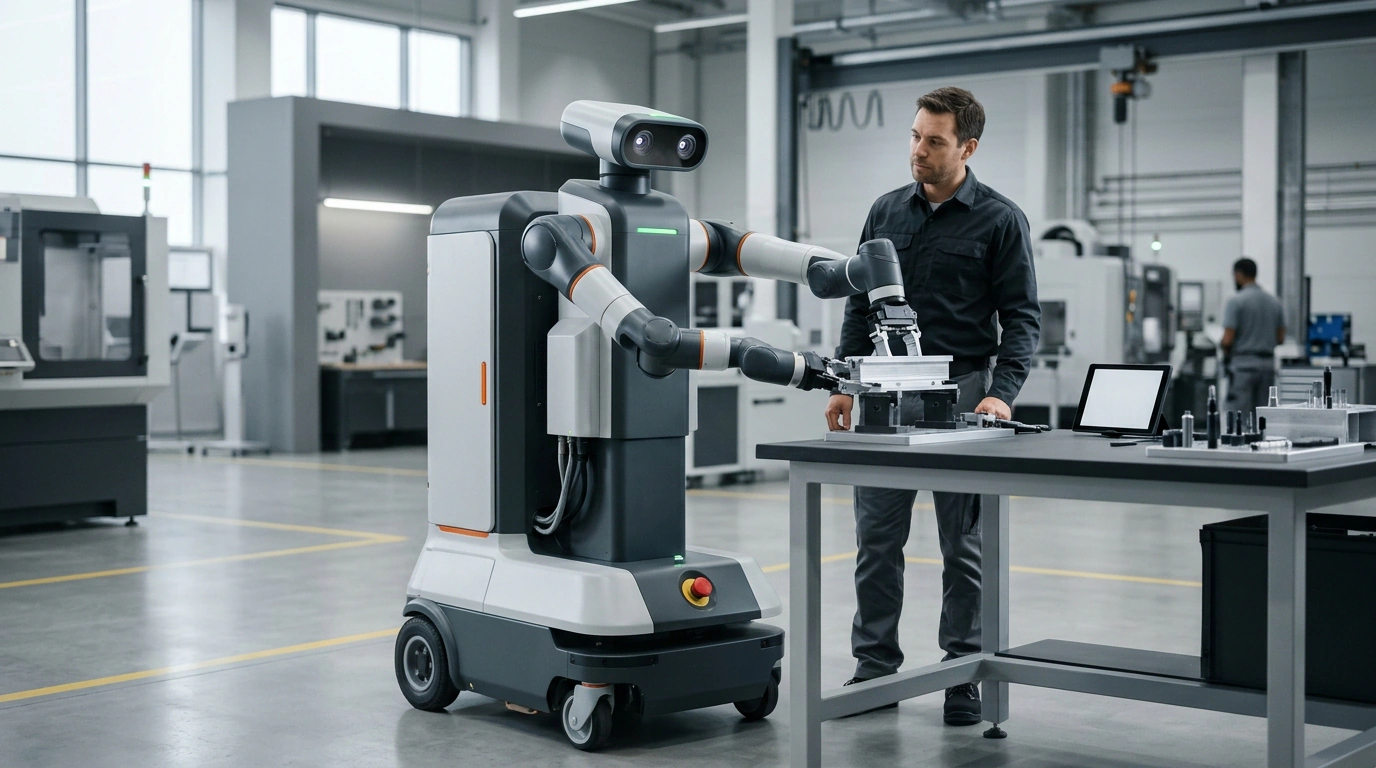
A Walden Robotics mobile industrial manipulator with friendly optics and two-finger grippers places a tool into a machine holder (Source: waldenrobotics.com)
Tedrake even has a favorite joke about finger count. He is missing the pinky finger on his own hand. When investors or engineers ask him in dead seriousness how many fingers a robot really needs, he answers without blinking, "Obviously five," and holds up his hand. People usually turn pale for a second before getting the point. A delicate mechanical hand with dozens of degrees of freedom, built like a Swiss watch, costs tens of thousands of dollars. Running three shifts a day in a real factory, it will break twice a day. Two well-engineered fingers with smart geometry handle a huge share of industrial jobs for far less money and far more uptime.
Strict safety physics also shapes how the robot moves. Adrien Gaidon spent seven years doing ML at TRI, switching between self-driving cars and robotic arms, and likes to compare the two worlds. If a Waymo robotaxi gets confused on the highway at 70 mph (about 112 km/h), it physically cannot stop on a dime. Walden's wheeled base is balanced so the robot can lean into a sharp angle (a bit like Michael Jackson in the Smooth Criminal video) and freeze in a fraction of a second, even with both arms stretched all the way out.
Appearance and motion style matter just as much. Plenty of robotics startups build grim, Terminator-looking machines and then act surprised when factory staff treat them with suspicion. Walden deliberately looked to WALL-E and Johnny 5 from Short Circuit. A white-and-orange body and an asymmetric "head" with two camera eyes give the robot a curious, helpful look, as if it's asking, "Need a hand? Want to show me how this works?" Even its motion paths are tuned to look smooth and predictable. Instead of fear, workers feel curiosity: "Wait, it can feed parts? Can it swap tools too?" These machines are already being tested across four core shop-floor and logistics tasks: Machine Tending, Tool Setting, Parts Kitting, and Assembly.
The Economics of a Robot That Gets Smarter After You Buy It
Silicon Valley has a saying from a former Tinder product chief: the best way to sell software is to sell hardware. For Physical AI, that hits the bullseye. Pure software is easy to copy, while smart hardware woven into daily factory workflows builds a deep moat. Yes, mechanical parts wear down over time, so you have to design machines that are easy to repair and manufacture without building three robots just to sell one. Unlike traditional equipment, though, the intelligence and skill set inside that machine don't go stale after purchase. They grow.
That flips traditional factory economics upside down. In the old world, a plant bought a robot as CapEx (capital expenditure): pay a huge sum upfront, put the machine on the balance sheet, write off depreciation, and wait years to break even while it repeats one stiff motion. With trainable robots, the model shifts toward a service. Customers help teach the machine new tasks and get rising returns over time, matching NVIDIA CEO Jensen Huang's line: "the more you buy, the more you save." Pricing models are shifting right along with it, moving from one-time hardware sales or per-seat fees to flexible options like pay-per-outcome, intelligence tiers, or volume of work completed.
| Parameter | Traditional Industrial Robot | Physical AI Robot (Walden Model) |
|---|---|---|
| Setup method | Hardcoded coordinates (open loop) | Learning from demonstrations and shop-floor fine-tuning |
| Working with people | Locked inside a safety cage | Works beside staff with smooth, safe emergency stops |
| Value over time | Ages from day one, repeats one task for years | Hardware wears, but intelligence and skills grow |
| Payment model | CapEx, large upfront purchase | Service, subscription, or pay-per-outcome |
| Typical task scope | One high-volume, identical operation | A bundle of small tasks with easy switching |
The real secret to fast payback lies in bundling, a business principle investor Marc Andreessen has talked about for years: you make money either by unbundling a product or by bundling small pieces together. Walk through any factory, and human work splits into three zones.
A Walden Robotics robot works alongside an engineer at a parts kitting station (Source: waldenrobotics.com)
Zone one is the company's "secret sauce": fine craftsmanship, human communication, judgment calls, and sales. That is what lets Toyota keep profit margins twice as high as many rivals. You don't automate this zone; you protect and empower the people in it. Zone two covers hard manipulation tasks nobody knew how to automate before, which Physical AI can tackle step by step in production.
Zone three is the automation gap: dozens of small, dull chores that each take up maybe 10% of a worker's day. Automating any one of them alone makes zero financial sense, just like nobody will pay $20,000 to $100,000 a year for an AI agent that only books calendar invites. Put a mobile robot on the floor that rolls from bench to bench and knocks out five or six of those small chores in a row, and the math clicks immediately. Individually they never paid off; bundled together, skipping the robot means leaving money on the table.
Six Open Niches in Physical AI Without a $300M Round
When you read headlines about massive robotics funding, it's easy to shrug and figure you can't compete without a few hundred million dollars. The physical world is huge, though, and around the big foundation-model labs sits a vast "negative space" of problems they simply don't have time to solve, even though the whole industry needs them. Venture deals from 2025 and 2026 show this clearly: right next to billion-dollar rounds for giants like Skild AI, focused infrastructure teams are raising healthy seed rounds. Enigma simplifies robot deployment, MicroAGI captures first-person data with sensor gloves, Physicl generates rare failure simulations, and Europe's Mosaico (which raised €7.5M) builds open data infrastructure.
Major and Seed Rounds in Physical AI and Infrastructure (2025–2026)
The chart shows a clear gap between companies building full-stack hardware platforms and teams solving specific links in the chain. Right now, there are six open entry points.
The first niche is scarce industry data. As noted earlier, if you have access to a real craft, factory floor, or closed domain where web datasets fail, capturing clean demonstrations and sensor logs can become a standalone business.
The second is next-generation supply chains. Henry Ford's era ran on low-mix, high-volume ("you can have a car in any color as long as it's black"). Aerospace lives at the opposite extreme: high-mix, low-volume, with custom, expensive, hand-built parts. Physical AI pushes us toward high-mix, high-volume—the era of mass personalization. Right now, the smartphone in your pocket is probably identical to the one Jensen Huang carries. Making custom physical goods at mass scale means rebuilding logistics and supply chains from scratch, and wherever complexity and geopolitics collide, big opportunities hide.
The third is software tooling, the classic "selling shovels" play. Look at Weights & Biases, started in 2017 by Lukas Biewald, Chris Van Pelt, and Shawn Lewis. Adrien Gaidon's team at TRI was their very first customer, even before OpenAI. They built a clean web tool for tracking and visualizing ML experiments without building a single robot, and CoreWeave bought W&B in 2025 for $1.7 billion. Physical AI needs those same shovels today: fleet monitoring, data pipelines, real-to-sim tools (turning real objects into safe virtual tests), and gripper design software. You don't need a robotics PhD for this, just solid engineering and a grasp of the full system.
The fourth is teleoperation for "slow" robots. Teleoperation means controlling a robot remotely via VR headsets, controllers, or motion-capture gloves to either rescue a stuck unit or record training demos. Physics tells you where this works as a standalone business. A self-driving taxi moving at 70 mph can't afford a few milliseconds of lag or a fatal mistake, so remote assistance stays tightly baked into the core product. When a robot moves slowly in a controlled space and can stop instantly, teleoperation can easily become an independent layer of the stack.
The fifth is AI insurance and liability for "vibe manufacturing." Right now, vibe manufacturing is taking off: someone describes an idea to an LLM, the model helps design the part, and a desktop 3D printer like a Bambu Lab prints it in a couple of hours. As long as people print static mugs and cable clips, nobody worries. Once hobbyists and small shops start building moving machines like a DIY transforming lawnmower, product liability becomes a real issue. Traditional insurers aren't built for those risks, leaving room for new AI-native underwriters.
The sixth is narrow vertical robots and applied roles inside the industry. You don't have to chase a do-it-all machine. Pick one clear, expensive, or personally exciting task and own that local niche: a welding robot, a barista robot, or a specialized gardening helper. And if you aren't launching a startup yet, growing robotics companies are hiring ML researchers, sharp salespeople, industrial designers, product managers, and deployment engineers.
How to Pick Your Difficulty Level and Get Started
Silicon Valley VCs spent years brushing off hardware startups with a tired joke: "It's called hardware because it's hard." There is some truth to it. In the world of atoms, parts break, factories take time, and supply chains punish sloppy planning. On the flip side, physics is consistent and predictable. Once a team has people who have shipped mass-produced hardware before (like Walden's head of hardware, who previously built massive robot fleets at Amazon Robotics), hard-won skill compounds on the second try.
The good news for any developer or founder is that in Physical AI you get to choose your own difficulty level. At the top of the pyramid sits the sci-fi dream of an AGI robot that supposedly does everything faster and cheaper than a human. Try a quick thought experiment: drop a brilliant person into someone else's office tomorrow morning. Would they crush the job on day one? No—they wouldn't even know what's next on the calendar. Not every task is bottlenecked by raw IQ; context and specialization matter enormously.
One step down is the Walden Robotics tier: a mobile robot covering a growing bundle of factory tasks. Below that sit single-purpose heavy hitters like industrial welding, where doing one job well generates huge revenue. At the base of the pyramid are niche, passion-driven markets where you don't have to fight giant corporations.
If you're coming from pure software and want to learn robotics, the biggest mistake is tinkering with one isolated piece. Robotics is like a contact team sport: you can't understand baseball by buying a ball and staring at it on your desk. You need to see the whole system first—how sensors, motion planning, control, and neural networks fit together.
- Free MIT foundation: Russ Tedrake's interactive textbook and open video lectures Robotic Manipulation: Perception, Planning, and Control (MIT courses 6.4210 and 6.4212, updated through 2026). There's plenty of math, and building on the open-source Drake framework in C++ and Python quickly gives you the full-system view.
- Core action architecture: open code, datasets, and algorithm breakdowns on the Diffusion Policy project page, the starting point behind nearly all modern VLA models.
- Find your edge: once you see the big picture, look for tasks that feel easy to you but painful for robotics engineers. That usually points straight to either a horizontal software tool (a "shovel" like Weights & Biases) or a focused vertical product.
Following this path saves months of scattered news reading. Instead of chasing every flashy demo, you start spotting the real bottlenecks that teams will actually pay to fix.
Where the Hype Is Overheated and When Robots Reach Normal Homes
Every hot market collects myths, and Physical AI is no exception. Cut through the marketing noise, and two areas look clearly overhyped right now.
First is the belief in zero-shot as a finish line. Social media loves a tidy story: train one giant model on millions of web videos, drop the robot in a factory, and watch it nail every job from minute one. In reality, zero-shot works, but it's the starting line, not the finish. Think of training wheels on a kid's bike: they help you push off without crashing on second one, yet real riding only starts after you take them off and put in the laps. In Japanese manufacturing culture, that's kaizen—continuous improvement on the job. You can't "solve robotics once and for all" just by buying another GPU cluster. The only path that works is building a machine that keeps learning every day in production.
Second is the obsession with five-fingered humanoid hands and chasing higher degrees of freedom (DoF). The industry loves simple scoreboard numbers like "24 degrees of freedom," and social feeds love viral clips of humanoids juggling or dancing. That's often where the line splits between "built for clicks" and "built for a factory shift": the more complex a hand is, the faster it ends up in the repair shop.
Conceptual diagram showing Physical AI moving from baseline zero-shot training to practical kaizen adaptation on the shop floor
What about robots for regular apartments? That picture is much cloudier than industrial automation. Sure, consumer robotics has a few bright wins. A great example is the Matic floor-washing robot vacuum, launched by former Google and Nest engineers Navneet Dalal and Mehul Nariyawala (both alumni of Tony Fadell's product school, author of Build). Robot vacuums looked stale for years until Matic shook up the category with RGB computer vision and on-device processing. Even so, messy home life pushes back: if there are puzzle pieces scattered across the floor, as in Adrien Gaidon's house, no smart vacuum can drive through. For tinkerers, Gaidon also highlights Hugging Face's programmable "Micro Duck"—a cute mini-robot with a beak that grabs small items and lets you code custom behaviors.
Look closely at every successful home robot (vacuums, mops, lawnmowers), and you'll notice they all solve navigation, not dexterous manipulation. The biggest open question in consumer robotics is still unanswered: what single household chore will be the "killer app" an ordinary family happily pays for? Since Diffusion Policy, robots can fold towels neatly, turning old sci-fi into real engineering. Still, there is a massive gap between "a robot can fold a towel" and "people will pay $20,000 for it."
Unexpected psychological barriers get in the way, too. Everyone likes the idea of a cheap Rosie from The Jetsons who cleans the house and cooks dinner. Yet one home-robotics founder ran into a visceral wall during user tests: people felt an instant wave of disgust knowing the same robot had scrubbed the toilet ten minutes before chopping salad in the kitchen. Arguments about built-in UV sterilization making the gripper cleaner than human hands didn't change a thing.
That's why the next ten years of Physical AI will unfold unevenly. Industry and infrastructure are heading into a real boom: millions of trainable robots across factories and job sites, faster megaprojects, and a new class of tools that act like an Iron Man suit for workers—amplifying human hands and taking away heavy grind. Even the name Walden comes from Henry David Thoreau's 19th-century book on self-reliance, simplicity, and purpose: machines take over dull labor so people have room for craft, taste, and original ideas. As for everyday apartments, manipulator robots will likely sneak in sideways—starting with one genuinely useful chore and slowly bundling neighboring skills into one practical package.