One agent overwrote another's file overnight. A third got stuck in a search loop and burned a week's API quota. A fourth woke up with a blank slate and asked for your rules all over again. When Claude Code, Hermes, Codex, and local models work side by side, you quickly become a full-time babysitter.
Three free tools bring order to the mess: a visual permission map, a task dispatcher with hard budgets, and shared memory in plain text files.
StarNet: a pixel space station where floor plans set agent permissions and routes
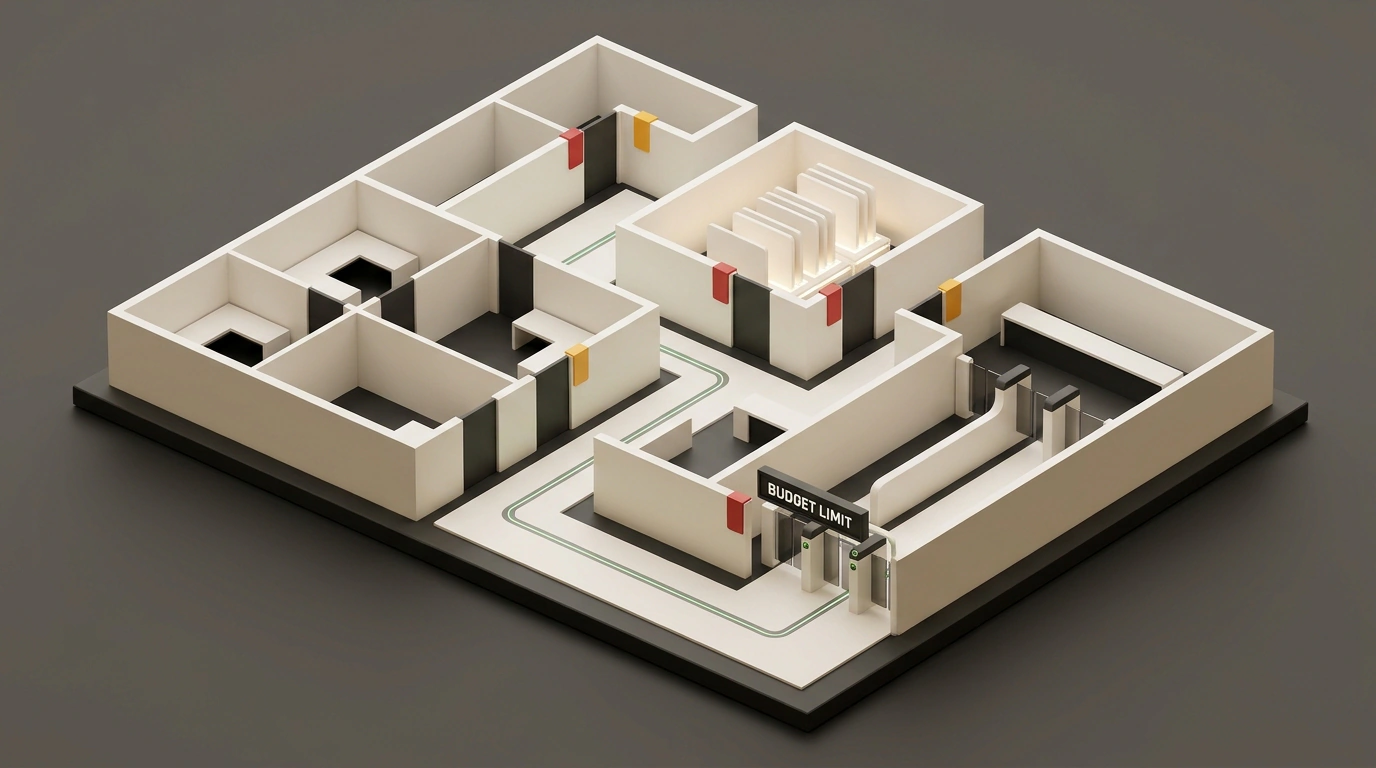
It looks like a game—why draw a space station for work agents? That skepticism fades once you see how Andrew Sims's StarNet works: the floor plan literally enforces real access permissions.
Isometric StarNet space station with rooms, corridors, and AI agent workstations (Source: github.com/androoAGI/starnet)
The app is free, runs on Windows and macOS, and follows a local-first model: memory, tasks, and logs stay on your drive. The code is open under the MIT license, while only the brand and sprites remain closed.
Each room on the map is a team with its own task zone. Corridors define allowed handoff routes and record every transfer. Items on a desk control capabilities: drop a web module on the desk and the agent gets internet access; remove it and access closes. Nothing is decorative: a busy character is actively running a model, and an outbox file physically sits on your disk.
That honesty pays off in hybrid setups. In a test run, a local Qwen 3 (8B) model via Ollama wrote 20 house-listing drafts for free without touching cloud tokens. It then cheerfully reported saving listings draft to outbox, even though the folder was empty. Claude, acting as reviewer, caught the false report right away, scored the drafts at 5.6 out of 10 on average, fixed four apartment-vs-house errors, stripped out made-up claims about "the best school," and saved a clean version with an edit table. A cheap local model grinds out drafts while a cloud reviewer catches the shortcuts.
StarNet connects Anthropic (including Claude Code), OpenAI, Google, Grok, OpenRouter, and Ollama, imports agents from Hermes, and supports MCP (Gmail, Notion, GitHub). You can approve every step manually or flip on Night Shift. When an agent lacks data, it sends one multiple-choice question to the built-in chat or to Telegram, Discord, Slack, Signal, or Matrix. The project is still young, and every character makes real LLM calls—so start with one or two agents.
Paperclip + Hermes 0.23 Hearth: org charts, scheduled heartbeats, and hard token caps
Once you pass five agents, a map isn't enough—you need a dispatcher with a board and a budget. That is what Paperclip, an open-source MIT-licensed orchestrator, does. Launched on March 2, 2026, it hit 30,000 GitHub stars in three weeks and passed 110,000 by fall. The idea is simple: each agent works like an employee, and Paperclip runs the company.
Four architectural pillars of the Paperclip AI agent orchestrator (Source: github.com/paperclipai/paperclip)
One installation runs multiple isolated "companies" on mixed engines: Hermes as CEO, Claude Code on engineering, and OpenClaw or Codex in marketing. Claimed tickets lock to their owner, so two agents never duplicate the same work.
Instead of spinning in infinite loops, agents run on "heartbeats"—waking up on a schedule or when a new ticket lands, like a night watchman. They check the board and budget, take one step, attach an artifact, and go back to sleep. Monthly caps apply per agent and per company, resetting on the first of the month; hit the ceiling, and the system pauses that worker automatically.
In one run, CEO agent Ada spotted staffing gaps on her own and hired new subordinates. New hires appeared right on the org chart, where you can pause anyone in one click—without that kill switch, an autonomous team quickly floods the board with extra tickets.
Paperclip pairs smoothly with Hermes Agent v0.23 "Hearth" from Nous Research, released November 5, 2026 (followed by security patches 0.23.1–0.23.4 fixing CVE-2026-130164). Through @paperclipai/hermes-paperclip-adapter, Paperclip calls Hermes with -q, keeps memory via --resume, and pulls in ~/.hermes/skills/. That release also added a unified gateway for terminal, browser, and messengers with shared session IDs, /rewind (or double Esc) rollback, anti-ping-pong protection for group chats, a shared prompt cache for cron jobs, and spending caps on paid tools that hold even in YOLO mode.
A shared PARA 'second brain' in Obsidian: syncing memory across Hermes, Claude Code, and Codex
One headache remains: agents still don't know what their neighbors did. Hermes stores its own lessons internally, invisible to Claude Code, Codex, and OpenClaw.
The toughest bridge is a plain folder of Markdown files in Obsidian. The app is free for personal and commercial use (the $50/year license is optional), though its source code is closed. Still, your notes sit on disk as plain text with no account required—zero vendor lock-in.
The structure builds on PARA (Projects, Areas, Resources, Archives) plus four utility folders: Inbox for unsorted items, Daily for your priorities, Memories for decisions, and Agent OS holding a single read/write protocol.
You don't have to wire each agent by hand. One "orchestrator" (Claude Code or Codex) creates the folders, writes one rule note inside the vault, and adds a startup pointer plus a nightly job for the other agents. In testing, a voice-enabled Hermes read the vault and immediately named video titles that Claude Code had worked on earlier.
Why not just dump every raw chat transcript into Obsidian? That breaks the system faster than anything else.
Never dump raw, full chat logs into the vault. The knowledge base quickly fills with noise, and models start burning tens of thousands of tokens just reading history before they begin.
The working fix is an Agent Daily Log. Once a day, each agent writes one short summary with four sections: worked on, learned, decisions, and in progress. Another agent can read that brief in under a minute. On top of that, you can layer a five-bullet morning read-only brief, a Log today now command for early wrap-ups, and a schedule check to catch broken nightly runs.