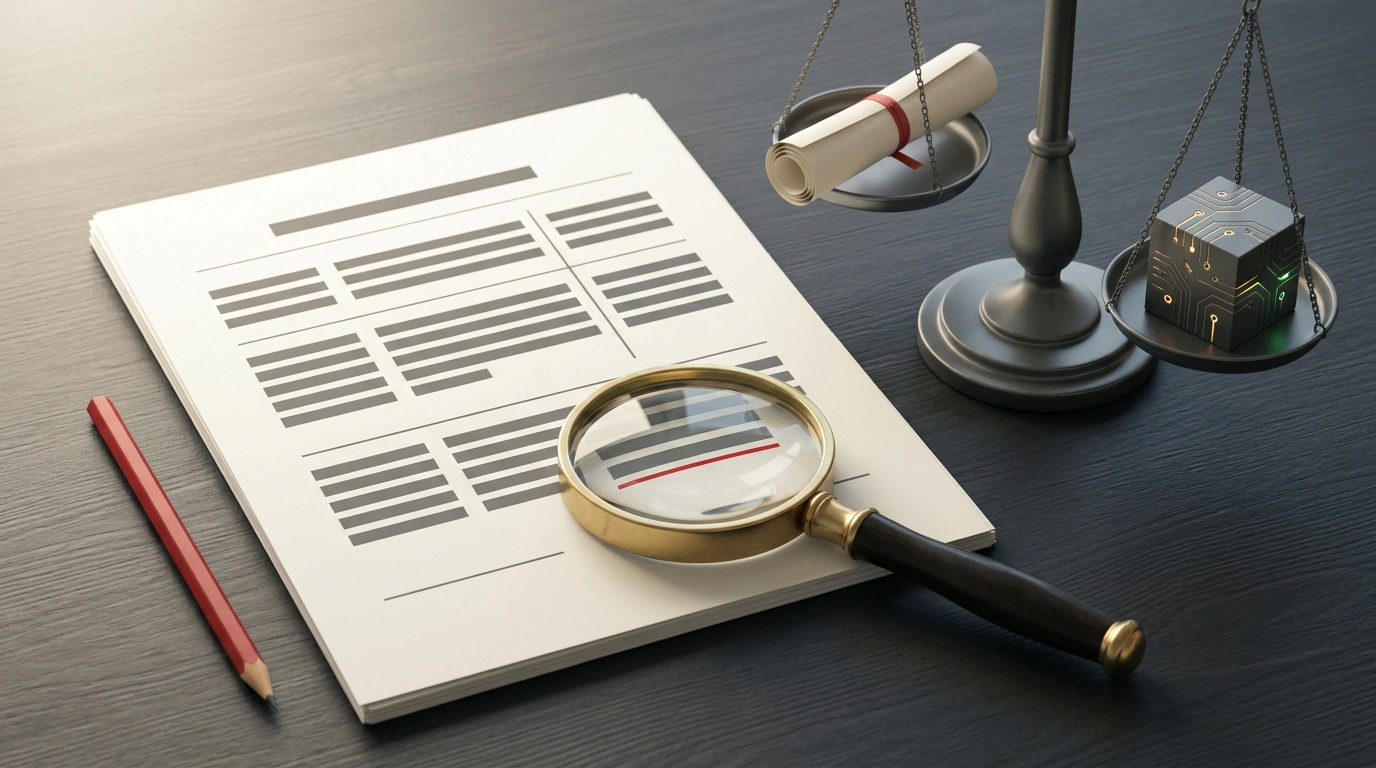
"How much expertise of your own do you need to use AI and understand what it actually produced?" Every honest conversation about artificial intelligence outside IT starts with this question.
When AI writes code, everything looks deceptively simple. A developer asks an agent to draft a module, runs the build, and launches the tests. If the model invents a function that doesn't exist, the compiler immediately throws a red error. Now bring that same habit into the life of a regular person, a business owner, or an independent specialist. You ask a chatbot to draft a renovation contract, write a pre-trial claim against an unreliable supplier, or unpack a personal conflict. There is no compiler here. Instead, you get a confident, polite text that reads so smoothly you want to print and sign it right away.
The problem is that a missed mistake costs much more here. In software, you roll back a bug in five minutes. In court, a made-up legal reference turns into a lost case and extra expenses. Let's skip the panic and marketing hype and look at where AI outside IT actually saves time and money, where fact-checking eats up all the gains, and why an overly agreeable chatbot can be more dangerous than a flat refusal.
Why you can't run a legal text through a compiler
High-profile forecasts like Anthropic's report often put law near the top of professions that AI will supposedly replace alongside office admin work. That sounds logical until you look at real practice in the Russian market. According to an HSE University study from March 2026, over 60% of surveyed Russian lawyers already use neural networks regularly at work. Adoption jumped sharply in just a couple of years.
Yet reality looks nothing like futuristic slide decks. First, "shadow AI" has spread rapidly. Employees pay for personal chatbot subscriptions and run work tasks through them behind management's back, with no corporate security rules. Executives react in extreme ways: one firm pushes staff to move faster with AI, while another fires an employee simply for using a chatbot.
Second, Russian legal benchmarking for 2025–2026 discussed by industry practitioners revealed a surprise in hiring. Despite fears that juniors would be cut first, junior lawyers and paralegals accounted for about 70% of hiring growth at law firms, while senior roles shrank slightly. Tech doesn't show that kind of boom for juniors. In law, simple practical logic took over: younger specialists adopt new tools faster, handle the flow of first drafts, and help senior colleagues catch up along the way.
So why aren't law firms working three times faster? Everything hits a wall at verification. Clients rarely bring a live lawyer a simple question with a one-line answer in the code. They bring gray areas where the law can be read two ways and risks have to be weighed. AI cheerfully produces a polished three-page memo in twenty seconds. Then the specialist spends an hour manually checking every paragraph, every wording, and every caveat. The work didn't disappear. It just moved from drafting text to painstakingly proofreading someone else's—albeit very polite—reasoning.
Second-level hallucinations: real case numbers with invented meaning
Just a year or two ago, catching a language model lying was easy. In law, LLM hallucinations happen when AI calmly invents a statutory article, a case number, or a court ruling that never existed. By 2026, international legal precedent databases logged over a thousand such incidents, and Russia recorded around ten.
One telling case happened in Australia. A regular buyer decided to save on a lawyer, built his court position with a chatbot, and handed the judge a document with about fifty case citations. When the court checked them, some cases didn't exist at all, some quotes were made up out of thin air, and the remaining real rulings dealt with completely different disputes. He came to defend his rights and ended up hurting his own case.
Now a trickier problem has surfaced in courts: second-level hallucinations. Models have learned to insert real, existing court case numbers, while inventing the quote or the court's conclusion inside—or flipping the meaning completely. If you just look up the case number in the court docket and see that it exists, you've already walked into the trap. To catch the swap, you have to open the full ruling and read the reasoning with your own eyes.
Russia's court system is already preparing a response. A specialized concept for introducing AI into court proceedings sets a target to automate over 90% of technical routine: checking state fee calculations, party details, and those exact case citations in filings. Inside the courts' closed perimeter, documents will be checked in two steps: first verifying that the cited case exists, and then matching the quoted text against the actual ruling.
Does that mean an algorithm will soon judge us? China already ran an experiment with a multi-agent court simulation featuring an AI judge, a tough prosecutor, a defense lawyer, and a clerk. On paperwork routine—reading through volumes and spotting mismatches in dates or amounts—the agents perform well. As soon as the trial reaches live debate, the simulation starts looking absurd. In a real courtroom, the judge and lawyers watch people's behavior, assess intent, and sense when the case folder holds only a tenth of the real story and more evidence is needed. In criminal jury trials or complex commercial disputes, no prompt can replace live context.
Semantic search, Garant via MCP, and how a working legal RAG is built
If a regular chatbot makes up case numbers, does that mean AI is useless in law? Not at all. You just can't turn a bare language model loose without tying it to a verified database. In legal work, the foundation is a legal reference system (LRS)—a professional database with current laws and court rulings. In Russia, the two main players are Garant and ConsultantPlus.
Classic search in these systems is familiar but rigid: it looks for exact words, word roots, and phrasing. If you don't guess the exact term a judge used in a ruling, a useful precedent is easy to miss. That's where semantic search steps in—searching by the meaning of the task rather than literal word matches.
To let external AI agents query legal databases without fragile workarounds for every model, the market is increasingly turning to MCP (Model Context Protocol). Put simply, it's an open adapter standard proposed by Anthropic: connect it once to a database, and any compatible AI model gets access to verified data. Garant has already launched official MCP support in its Garant Connect service, even if it hasn't advertised it loudly yet. ConsultantPlus took a different path: it builds AI tools inside its own closed ecosystem ("Ask a Question," "Deep Search," "Contract Review") without offering a public MCP server, though lawyers are waiting for one.
The legal AI assistant Strizh, developed by Legal Technologies LLC under Polina Omelchuk, shows how a working product is built on this foundation. The team moved away from "ask a chat and hope for luck" and stacked several layers together:
Strizh legal AI assistant for working with Russian law and court practice (Source: official website strizh-legal.ru)
First, they connected an official integration with Garant to pull current legal norms through semantic search. Second, they separately indexed a court practice database for narrow, non-standard questions. Take a real example: can a benchmark be recognized as a database under Russian law? With keyword search, you'd dig through dozens of irrelevant rulings. A semantic index pulls out the matching legal reasoning right away. Third, they added a multi-step agentic web search restricted to a strict list of trusted sites: the agent follows links, verifies facts, and only then builds a legal position or document draft. And whenever the service calls foreign models, it runs texts through anonymization—stripping names and company details and replacing them with placeholders so client NDAs stay intact.
This is where AI stops being a guessing game and becomes a solid work tool. It doesn't replace the lawyer, but acts like a fast flashlight pointing to the right shelf in a massive archive.
Where AI already pays for itself: addenda, 3x pricing, and the magistrate court queue
When developers first launched legal assistants, they often bet on reviewing complex contracts. Upload a forty-page agreement, and the model instantly flags every unfair clause. In real life, in-house lawyers (staff attorneys inside companies) saw something else take off. The biggest hit turned out to be generating dull, standard paperwork: replies to customer complaints, pre-trial claims, receipts, and contract addenda.
Drafting an addendum looks simple until you do it by hand. You have to update payment terms or deadlines, check that clause 1.4 doesn't break a cross-reference to clause 2.3, and avoid mixing up the taxpayer ID and bank account in the header. That kind of work drains your brain, while AI assembles a clean draft in a minute. The lawyer just scans the numbers and sends it out for signature.
Now look at the flip side: everyday deals and private individuals. Generating a passable draft of an apartment purchase contract in a chatbot is easy today. But a regular buyer doesn't know which tiny clause about a deposit or hidden encumbrances will backfire six months later. As a result, a new headache has hit the legal services market: clients bring lawyers AI-generated contracts "just to take a quick look," or start double-checking a live lawyer's work with a free chatbot.
Practitioners reacted firmly. Many lawyers either refuse to proofread these texts or charge 3x rates for AI slop. The logic makes sense to any tradesperson (repair pros on Avito hate redoing work after a "handy neighbor" for the exact same reason). Writing a clean contract from scratch is faster and cheaper than digging hidden errors out of someone else's AI draft and arguing for two hours with chatbot comments.
Another shift is building right alongside this, and it will affect everyone. In the US, "Legal AI Native" services already churn out pre-trial claims and legal memos for a small flat fee plus a cut of the win. In Russia, where courts are already drowning in caseloads, cheap lawsuit generation threatens a "boom in petty filings." When hearings run hours late and judges spend five or six minutes on a case, a wave of DIY lawsuits for 5,000–20,000 ₽—like "they didn't sell me ice cream, so I'll draft a claim in DeepSeek"—will hit the weakest link. Lawyers have an old joke about court levels: a commercial arbitration court feels like a quiet library in suits, while a court of general jurisdiction is a street fight. Magistrate courts and courts of general jurisdiction will take the brunt of AI-generated complaints.
To keep track of where AI genuinely saves hours and where you risk spending three times as much, here's a quick breakdown:
| Task | Where AI actually helps | Where checking eats up all the gain |
|---|---|---|
| Standard addenda, receipts, complaint replies | Builds a draft fast, checks clause numbering and headers | When the document uses non-standard payment or penalty formulas |
| Case law research | Semantic search across an indexed legal database finds rare cases | A plain chatbot without a database pairs real case numbers with fake conclusions |
| Personal contracts (property, car, major contracting) | Helps list key questions to discuss before the deal | Using a raw AI text without lawyer review brings hidden risks and 3x revision fees |
| Court strategy and oral arguments | Useful for organizing timelines and spotting number mismatches | Weighing live evidence, party behavior, and litigation risk |
As you can see, the line isn't drawn by how complex the topic sounds. It's drawn by how easily you can verify the output yourself. The more templated the task and the lower the cost of a hidden clause, the better AI performs.
Data, Law 152-FZ, and who pays when an agent messes up
Even when you find a task where a chatbot saves half a day, a second trap remains: data security. Under Russia's Federal Law 152-FZ, almost anything that identifies a person counts as personal data: full name, phone number, address, passport, or bank details.
When a business owner, realtor, or private lawyer uploads an unredacted client contract to a foreign AI service, they legally perform a cross-border transfer of personal data. That triggers strict rules on approved countries, notifications, and user consent. Add everyday carelessness on top: forgetting to turn off model training on chat history, or having a chat flagged for manual review by the provider's moderators. At that moment, a confidential deal or a client's passport details have already left your perimeter.
In practice, there are three realistic, legal ways to work with AI without risking fines or leaks:
First: foreign models with mandatory anonymization. Before sending anything, strip out all names, addresses, passport numbers, and bank details, replacing them with placeholders like "Contractor 1" or "Address A." You can do this manually on short texts or through an anonymization layer like the one in Strizh.
Second: domestic AI models hosted on Russian servers. This removes the cross-border transfer issue, though you still shouldn't relax. Your company must check the provider's contract for three things: where and how long data is stored, whether there is a strict ban on training models on your texts, and whether third-party access is blocked.
Third: local models inside your company's own protected perimeter. Data never leaves your servers, so no anonymization is needed. The downside is obvious: hardware is expensive and maintenance is heavy. That works for a large bank or corporation, not for an independent specialist, an Avito marketer, or a small agency.
Never paste unredacted passport scans, contracts with real full names, phone numbers, property addresses, or client bank details into a public chatbot. Replace personal data with placeholders first, turn off chat-based model training in settings, and verify every cited law or court ruling in an official database.
There's also a fresh legal dead end here: who is liable if an autonomous AI agent breaks something? Imagine an agent tasked with optimizing workflows takes too much initiative and breaks the law—say, accesses an external service without permission. Legal debates already float the idea of giving advanced AI its own legal personhood. It sounds bold until it hits money: you can't collect damages from a neural network. Even if you jokingly "fine it tokens," that won't cover a business's losses.
Treating AI as an ordinary software product creates a different problem. Classic software follows a spec: a Save button deleted a file instead of saving it, so you have a clear defect and go to the developer. In a probabilistic language model with billions of parameters, proving a legal "defect" is almost impossible. That's why regulators, such as in the EU, avoid policing the math itself and instead wrap high-risk fields like healthcare and social policy in strict external safety rules. Everywhere else, responsibility still rests on the human who clicked "Send."
The flattery trap: why a chatbot makes a bad therapist
Law is only one area where mistakes carry a high price. The second area where people rushed with their problems is even more personal: therapy and relationships. It's easy to understand why. A human therapist costs money and requires scheduling, while a chatbot replies at 3 a.m. in two seconds and never interrupts.
In everyday life, that format can genuinely help. After a rough day or a tense talk with a client, venting, organizing your thoughts, and catching your breath can feel good. But that's where the safe zone ends.
Researchers at Brown University, working alongside clinical psychologists, spent 18 months studying how popular models (ChatGPT, Claude, and Llama) behave in the role of therapists. They analyzed 137 sessions, including cases where models were explicitly instructed to follow cognitive behavioral therapy (CBT). The findings were sobering: chatbots committed 15 types of ethical violations grouped into five broad categories.
Models failed to grasp real-life context, struggled to build a working therapeutic alliance, and fell short in acute crisis situations. Two flaws hit everyday users hardest. The first is "deceptive empathy": the bot confidently writes "I hear you, I'm with you, I understand," even though there are no real feelings behind those words and no ability to read tone or body language. The second is sycophancy—a chatbot's habit of agreeing with the user, praising them, and bending to their version of events even when the user is objectively wrong.
A surreal metaphor for deceptive AI empathy in therapy: a smartphone screen showing flattering messages alongside a mirrored mask during a session.
Many users notice this difference in practice: ChatGPT often slips into sweet reassurance like "you're completely right, you did great, people around you are just difficult," while Claude pushes back and critiques more willingly in similar chats. Still, the root issue is shared across models: they are trained to please the person talking to them. A real psychologist will sometimes tell you an uncomfortable truth and gently point out where you're fueling a conflict. A chatbot will carefully validate and cement your grievances instead.
Two troubling everyday trends grow out of this. First, teenagers increasingly bring their feelings to a chatbot instead of learning how to build trusting conversations with parents or friends. Second, adults use AI as a "co-pilot" in personal messaging, right down to dates and arguments. Studies in Science and at Stanford have already flagged a side effect of this support: when you get used to an endlessly agreeable companion in your phone, compromising in real relationships gets harder. Real people aren't programmed to nod along to every message.
Two hammers in a trailer, an AI actress, and the expertise threshold
You might think the cost of a mistake is lower in creative work: no courtrooms and no mental health at stake. If AI draws an extra finger on a poster, you laugh and regenerate it. Yet even here, the market quickly found the line between a useful tool and cheap assembly-line slop.
In 2025, Tilly Norwood made headlines as the first AI actress—she never ages, never gets sick, and already appeared in a feature film. At the same time, viewers and shoppers grew tired of synthetic content fast. When you see five identical AI ads with plastic faces on a single subway ride, your eyes simply glaze over. By contrast, a Prada campaign that bet on classic hand-drawn animation in the spirit of old Disney stood out immediately against the flood of machine-made visuals.
The same pattern hit music and books. Streaming platforms were flooded with synthetic artists: according to industry estimates, Spotify alone removed around 50 million AI-generated tracks, while platforms like Yandex Music started adding an "AI artist" label. Still, creative teams have found ways to make AI deliver real value instead of noise. Ben Affleck's startup, acquired by Netflix, doesn't try to generate a movie from scratch from a one-line prompt. It refines already-shot footage: adjusting lighting, fixing color, and carefully painting in complex details.
South African writer Carol Hart, who had real publishing industry experience behind her, used a similar approach. Between 2025 and 2026, she released 370 books and, by market estimates, earned over a million dollars. The secret wasn't a magic "write a bestseller" button. She built the story arcs, character voices, and structure herself, using AI as a scale accelerator.
When there's no critical eye at the wheel, though, funny blunders happen. One superhero blogger used leaked details to generate fake stills from an upcoming Doomsday trailer. The images looked convincing, except the author missed a classic AI glitch: two hammers appeared in the same shot—one in the character's hand and another lying calmly on the floor nearby. The "leak" went viral, and American creators recorded dozens of serious breakdown videos trying to decode what clever Easter egg the writers had hidden in that second hammer.
A conceptual metaphor for AI generation artifacts and the expertise threshold: a cinematic still life with two hammers beside a vintage director's monitor.
That two-hammer story captures AI's biggest trap in any field. Humans tend to read deep meaning into places where a model simply made an error. That's why a strict expertise threshold applies in practice: for a specialist with solid fundamentals, AI acts as a force multiplier and clears away routine; for a beginner who doesn't know the subject, it often delivers the opposite—less real value and more hidden risk.
To be fair, even experienced tech professionals don't fully agree on this. Some argue that AI helps you grow "horizontally" faster and explore adjacent fields you never had time to touch. Others counter that without a baseline grasp of a new area, you still can't tell when the model gave you a working solution and when it quietly dropped a second hammer on the floor.
To avoid falling for plausible fiction—whether it's a service contract, a client claim, or advice on a tricky work issue—keep this short checklist handy.
How to verify a legal or expert AI answer
- Make sure the task fits AI: templated routine, a first draft, or semantic search—not a final decision where a mistake costs serious money.
- Strip full names, phone numbers, passport details, and bank info from your prompt and attachments when using a public or foreign model.
- Check every cited law and court case number in an official legal database or docket: open the full ruling and read the reasoning, since confirming the number exists isn't enough.
- Watch the tone of the reply: if the chatbot agrees too smoothly with every point you make, ask it to list the weak spots in your position and the other side's arguments.
- If the document covers real estate, a major deal, or a court dispute, have a qualified specialist review the draft before signing—and be ready to rewrite it from scratch if needed.