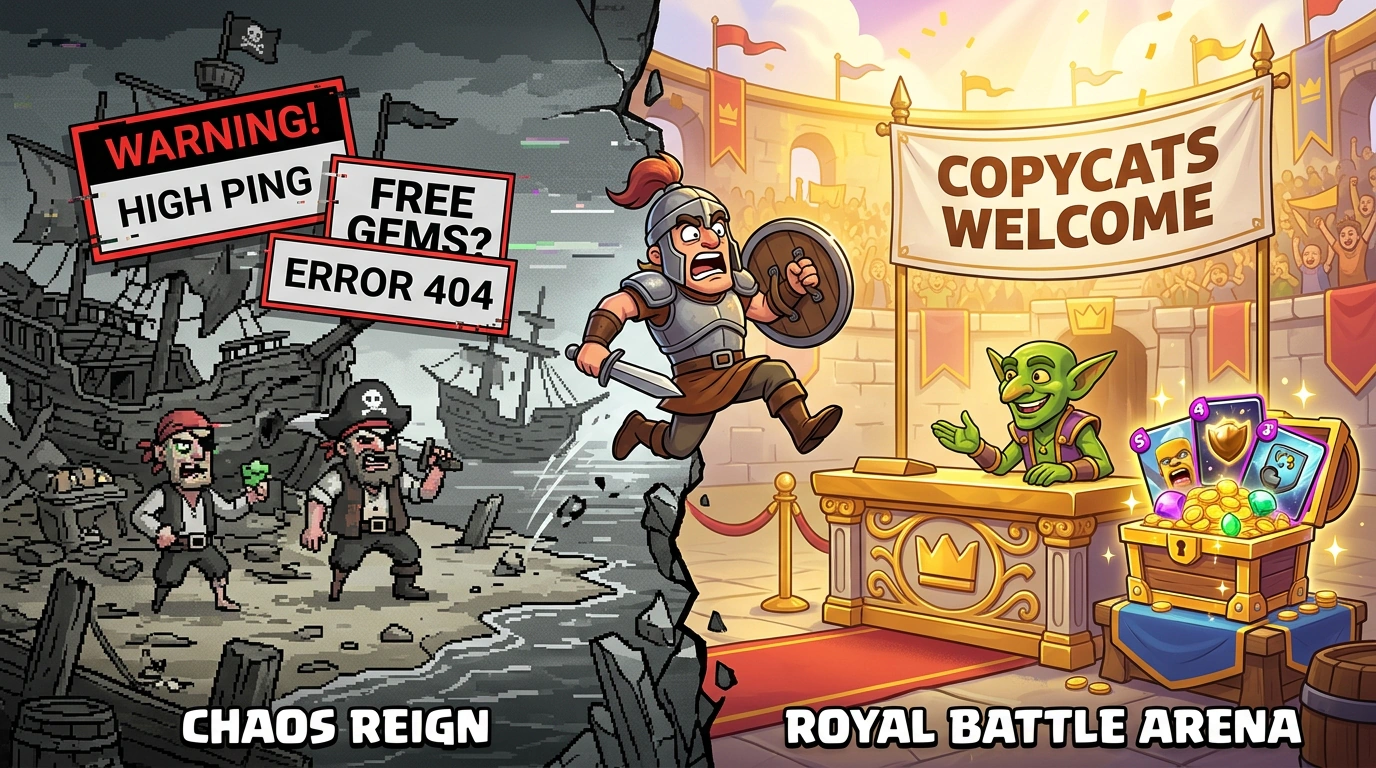
Launching a hit digital product inevitably attracts an army of imitators. For ten years, the developers of the iconic mobile strategy game Clash Royale watched dozens of shameless clones pop up on the App Store and Google Play. These copycats lifted the card-duel and tower-destruction mechanics wholesale, riding on the original brand's success.
Most corporations respond by calling their legal teams and filing endless copyright takedowns. Supercell, partnering with creative agency DAVID New York, took a completely different route. Instead of lawsuits, they launched a bold campaign called 'Copycats Welcome'.
The Clone Problem: Why Lawsuits Lose to Creativity
Legal battles in mobile gaming often feel like fighting windmills. While one studio shuts down by court order, three new clones appear with swapped textures. Even worse, lawsuits do not solve the marketing problem: they do not bring players back to your game.
The creative team looked at player psychology instead. Someone who downloaded a cheap knockoff like Bash Royale or Space Royale already knows the genre rules and enjoys the core loop. That makes them an ideal warm audience—the kind a publisher normally spends hundreds of dollars to reach on paid ad networks.
The main barrier stopping them from switching was the fear of losing hard-earned progress, a bias known in economics as the Sunk Cost Fallacy. Players hate walking away from hundreds of hours and upgraded characters, even when the clone is ugly and packed with annoying banner ads.
Guerrilla Tactics: Stepping Straight Into the Competitor's Turf
To deliver the message, marketers turned to guerrilla marketing. Instead of broad TV commercials, they targeted the exact spots where clone players gathered:
- ran targeted ads inside dedicated Reddit communities for copycat games;
- teamed up with popular esports creators from Tribe Gaming to post funny YouTube and TikTok videos comparing absurd knockoffs with the original;
- released a viral animated short where familiar Clash Royale heroes (the Barbarian and the Archer) accidentally teleport into low-budget clone worlds and beg viewers to rescue them from ad hell.
The Sunk Cost Trick: A Clever Landing Page Conversion Hack
The campaign centered on a promo site at copycatswelcome.com. It greeted visitors with the mock-serious look of an official 'progress exchange program'.
The very first survey question set a playful tone: 'Are you playing a low-quality Clash Royale knockoff?' There were only three answers: 'Yes, unfortunately', 'Yes, sadly', and 'Yes, regrettably'. Next, the site asked detailed questions about hours played, current level, and saved virtual gold. It gave the impression of running a precise mathematical formula to calculate compensation.
Here was the brilliant conversion hack: there was no actual data verification or technical transfer of save files from rival servers. Every user who filled out the form received the exact same generous reward from Supercell: 50,000 gold, 200 cards, and an Epic Chest. Players felt their effort was recognized and rewarded, which instantly removed the mental barrier to leaving the clone behind.
Cannes Triumph and the Flip Side of Viral Generosity
The results beat every expectation. In just five days (from April 9 to April 14, 2026), over 2.3 million players joined the promotion. The campaign won the Grand Prix at Cannes Lions 2026 in the Entertainment Lions for Gaming category, and DAVID New York was named Entertainment Agency of the Year.
Still, such open-handed generosity had a downside. Because there was no verification check, existing Clash Royale players shared the link everywhere, turning the promo into a free resource giveaway for the current player base. Supercell chose not to share the 30-day retention numbers for those newly acquired users.
Even so, the campaign earned its place in marketing textbooks as a masterclass in winning over a competitor's audience. Instead of hostility and takedowns, the brand offered honest humor and compensated players for their time.