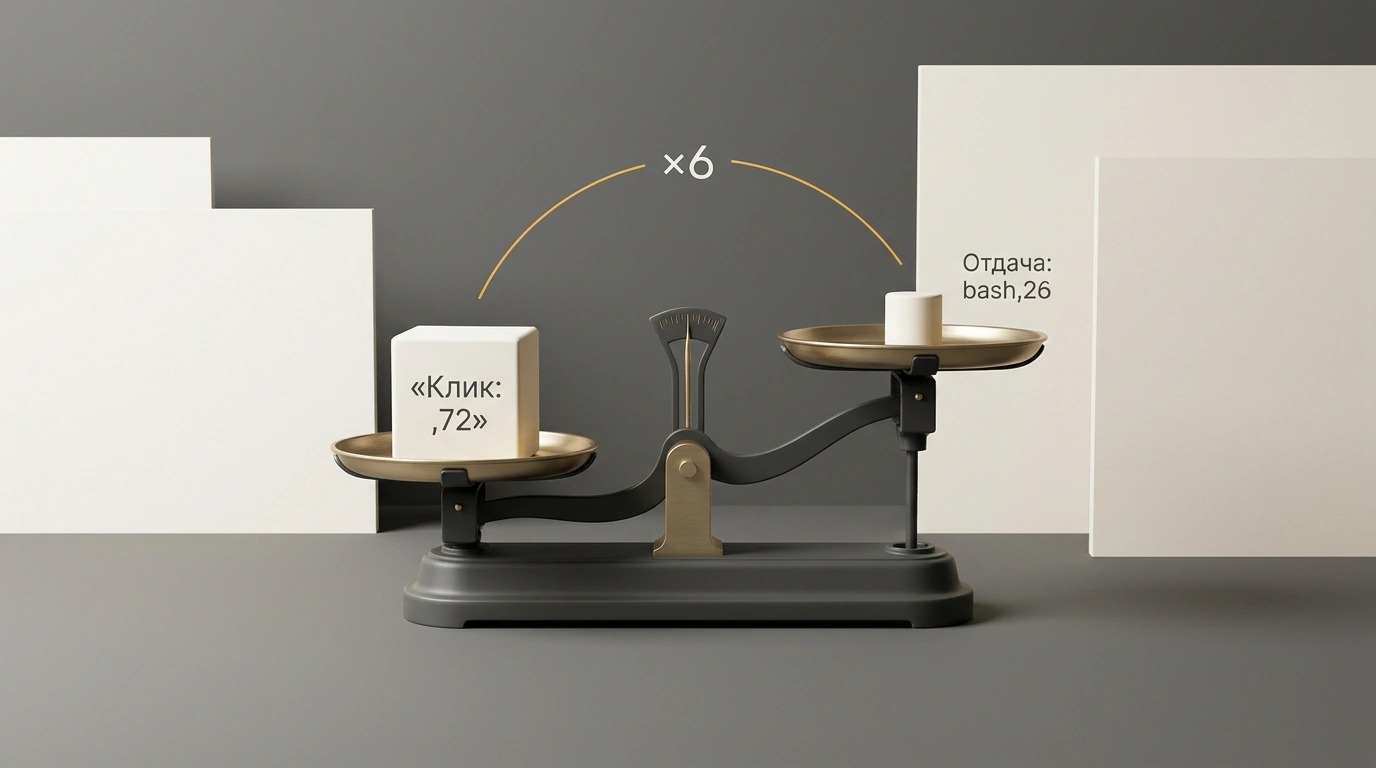
There is an old saying in advertising: enter a new auction first while competitors are asleep, and you'll buy cheap traffic for pennies. With ChatGPT, that logic broke on the very first benchmark. The largest publicly known advertiser paid $1.72 per click there, even though actual sales return put a fair click value at around $0.26. That's overpaying more than sixfold right at the channel's launch.
This picture emerged from the first independent study covering 1,898 online stores with $16 billion in annual revenue. The chatbot itself can send buyers, yet paid ads sitting beneath its answers are currently losing money.
How the First Independent Benchmark of 1,898 Stores Was Built
Researchers Maximilian Kaiser and Christian Schulze (October 2026 preprint v1, SSRN DOI 10.2139/ssrn.7682618) didn't rely on OpenAI's own slide decks. They used external store analytics from Grips Intelligence. The company provided the dataset free of charge and didn't interfere with the math, though Kaiser serves as its scientific advisor.
The sample is substantial: 60 weeks of observation (June 2025 – August 2026), roughly 10 billion user sessions, and 22.4 million free clicks from ChatGPT to 1,898 stores. The paid panel covered 387 advertiser sites, with 102 stores tracked across the full funnel down to orders, average order value, and revenue.
The study's main strength is its staggered rollout design with a control group. OpenAI turned on ads in nine countries, led by the US, while EU countries remained ad-free. That let researchers cleanly separate ad effects from seasonal sales and the AI's overall growth.
What Happened to Free Chat Traffic After Banners Launched
Before ads went live, it was natural to worry that banners would hurt trust in AI answers and tank sales from free links. Reality proved trickier.
In the first 13 weeks after ads appeared, free click volume from ChatGPT dropped by 5.9%. Adjusting for faster ChatGPT growth in North America compared to Europe, the dip was 7.2–8.4%. Some traffic really did fall away.
Trends in organic ChatGPT referrals and conversion rates before and after ad launch (Source: Kaiser & Schulze study, ecommerceresearch.org)
Yet the quality of the remaining organic traffic held steady. Before banners, free referrals converted at 2.21%, and afterward shifted by a statistically insignificant -0.02 percentage points (p = 0.648). People who trusted the model's advice inside the answer kept buying just as willingly.
Paid Click Math: Why the Auction Is Already Overheated
In paid traffic, a sharp gap opens up compared to familiar search. To compare channels with different basket sizes and conversion rates, analysts calculate revenue per session (RPS), the average revenue generated by one visit. In the US, a paid click from ChatGPT brought a store $0.89, while a Google Search click delivered $2.45. That is a 64% gap — nearly three times worse for the chatbot.
Purchase conversion dropped even harder: 0.37% versus 1.17% in Google Search. Out of 87 US stores running ads in both channels at the same time, 73 didn't record a single sale from ChatGPT.
Share of US Online Stores With Sales From ChatGPT Ads
Among the few stores that did get orders, almost every one earned less from chat ads than from search ads. And it isn't because ChatGPT lacks buyers: organic traffic from the exact same chat converts at 2.21% and keeps people on site longer than direct traffic.
The clue sits in visitor behavior across six metrics measured relative to direct traffic (users typing the site URL directly).
Comparison of paid ChatGPT traffic against other ad channels across six metrics relative to direct traffic (Source: Kaiser & Schulze study, ecommerceresearch.org)
Here is how a user behaves after clicking an ad card below an AI answer:
| Metric vs direct traffic | ChatGPT organic | ChatGPT paid ads | Google paid search |
|---|---|---|---|
| Bounce rate | Significantly lower than direct | Only channel higher than direct (+0.46 log-odds) | Significantly lower than direct |
| Pages per session | Higher than direct | 1.4 fewer pages per visit | Higher than direct |
| Session duration | 95–110 sec longer | 105 sec shorter than direct | 95–110 sec longer |
| Average order value (AOV) | Roughly $35 lower | Roughly $78 lower | On par with direct |
It creates a "consolation prize" effect. When you ask ChatGPT for advice, you want the answer inside the conversation: a brand named in the recommendation text gets a warm click. Meanwhile, the paid block sits off to the side after the answer is already delivered, or while you're still casually browsing. As a result, the clicker hits "back" almost right away (high bounce rate, meaning instant exits with no action), views fewer product pages, and even when buying, spends noticeably less.
Measured by Google Search economics, the break-even CPC (maximum click price without losing return) in ChatGPT is around $0.26. The large advertiser paying $1.72 reflects big brands bidding up a brand-new auction with test budgets just for the novelty.
This math hurts OpenAI too. The company estimates annual ad revenue at roughly $1 billion — about $1 per free user per year against a serving cost near $5. Text banners cover only a fifth of free-tier costs. OpenAI can't simply hike bids when advertisers are already overpaying sixfold. The platform needs more engaging formats.
Banners Next to Images and a Safe Test Framework
That explains OpenAI's new US experiment: ad cards that appear while ChatGPT generates an image for you. Ask the AI to sketch a living room design, and right beside the render a labeled banner pops up featuring a specific sofa you can buy immediately.
The test runs with a limited group of US advertisers and appears only on Free and Go tiers (paid Plus, Pro, and Enterprise plans stay ad-free). OpenAI states that the banner is separate from the image and doesn't influence model responses. With 1.2 billion weekly users, the logic is clear: catch users while they are actively picturing a purchase, not after they've finished reading a text summary. At the same time, standard text ads are opening in the US in self-serve beta on a cost-per-click auction model.
Early upbeat numbers are already coming from OpenAI partners. Analytics platform Triple Whale shared a case for leather goods brand Portland Leather: 93 out of 100 visitors from ChatGPT ads were new to the site. Keep a cool head here. First, that measurement came from an ad partner of the platform, not an independent audit. Second, new-visit share is an upper-funnel reach metric that says nothing about whether those orders actually paid off.
If you sell products people "try on with their eyes" (apparel, furniture, decor, food, or travel), testing a new channel with a big budget right now is risky. A smart test relies on tightly limiting your variables.
Safe test rule: one product, one month, one number
- Pick one bestseller that sells steadily in other channels so you test the platform, not the offer.
- Set a one-month budget your business can comfortably write off as an experiment cost (auction billing is per click).
- Lock in one primary metric: CAC (customer acquisition cost, or ad spend divided by new orders).
- Compare your final ChatGPT CAC directly against your current CAC in Google Search or paid social.
If after one month your customer acquisition cost lands near your usual search numbers, you can carefully scale to other visual products. If you see the same multi-fold overpayment found in the big benchmark, you shut the test down on time, protect your margin, and wait for the auction to cool off.