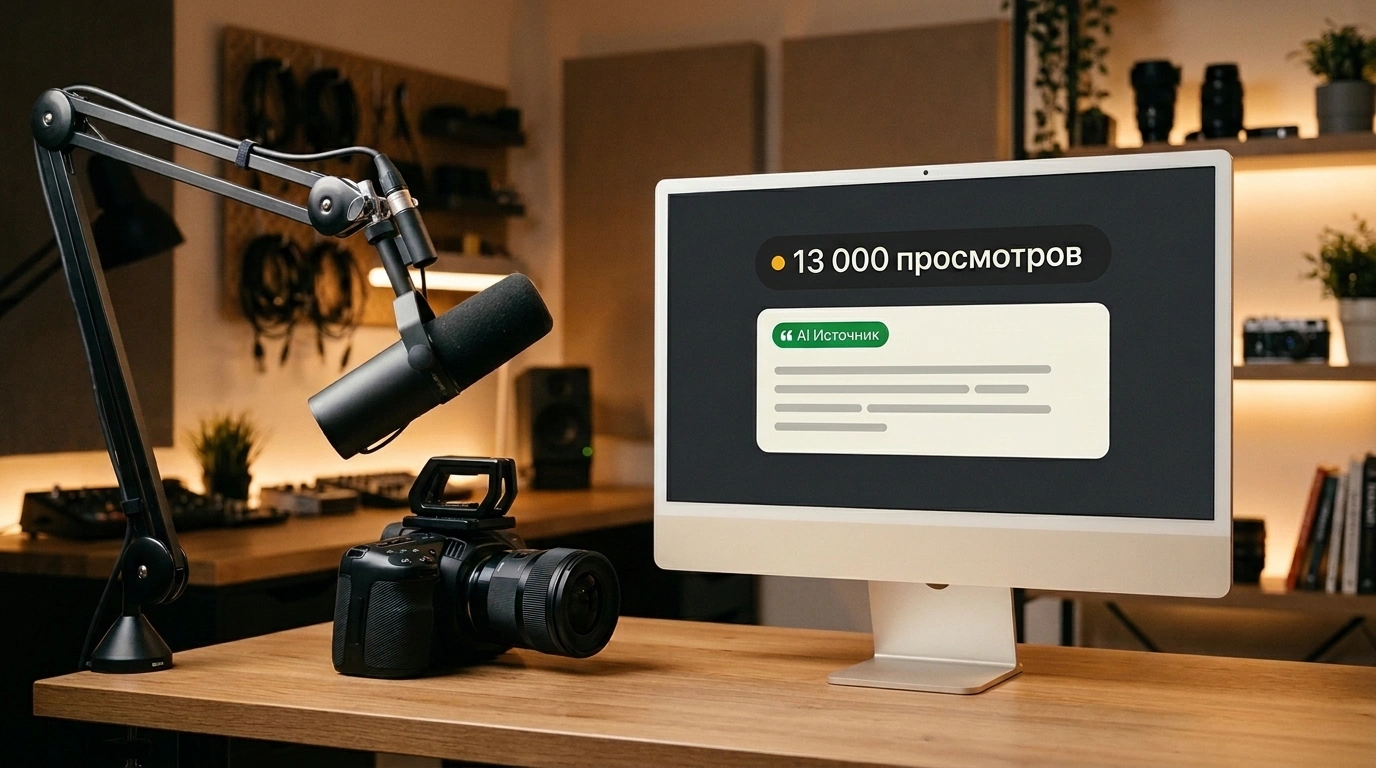
Why would a major brand like Canon pay for a sponsored YouTube review that gets just 13,000 views, when two years ago marketers wouldn't even open a media kit unless it promised half a million views in the first month?
People increasingly choose products and software not from ten blue links on Google, but by asking detailed questions in ChatGPT, Claude, Gemini, or Perplexity. AI doesn't care about first-week hype; it wants a clear breakdown from an independent creator. That shift is breaking the old economics of influencer buying.
Why AI Cites YouTube and Distrusts Company Blogs
Over the past two years, text blogs have been hit hard by Google AI Overviews: users read the summary above search results and close the tab. SEO has evolved into Search Everywhere Optimization (alongside AEO and GEO, optimizing for answer engines and generative search), where the goal is getting your brand cited inside AI answers and voice queries.
YouTube turned out differently. Industry benchmarks show it has become one of the top citation sources for AI, overtaking Reddit on how-to and recommendation queries. The lead is sharpest across Google's ecosystem (AI Overviews, AI Mode, Gemini) and Perplexity. Reddit remains strong on personal-experience questions, while ChatGPT and Claude pull heavily from web pages and documentation, yet in product reviews and tutorials video holds up far better than articles.
Brands quickly hit a wall: when a company fills its own blog with SEO articles, models recognize a biased source. Algorithmic trust kicks in two to four steps away from the brand. When an outside expert calmly explains a camera or SaaS tool, AI pulls in those arguments much more willingly.
This approach has two clear limits. It works primarily for educational, review, and expert channels rather than pure entertainment shows. Also, YouTube itself is testing Ask Studio, a feature that stitches one answer from multiple creators' videos, leaving open who gets final attribution.
Where Keywords Still Work on YouTube and How Semantic IDs Fit In
Old-school tag stuffing really is dead, yet keywords themselves are alive because demand is alive. Buyers still search for "wireless noise-canceling headphones" or "team task tracker" — they just speak those queries out loud more often.
YouTube's signal hierarchy today is straightforward. The strongest signal is the spoken script, meaning the transcript: algorithms and LLMs read what you actually say on camera first. Second comes the title. Third is the description, which recent tests confirm acts as a light but real reinforcing signal. Tags affect almost nothing.
A video's performance rests on two steps: a clear topic, title, and thumbnail earn the click, and then viewer satisfaction decides the rest. If people get their answer and watch through, the system pushes the video to similar viewers.
Under the hood, recommendation tech explains why subscriber counts no longer guarantee reach. Google Research detailed YouTube's move to Semantic IDs. Previously, a video had an arbitrary numeric ID, and the system needed viewing history to understand it. Now the algorithm takes the title, description, transcript, audio, and frames, and compresses them via an RQ-VAE model into a "meaning passport" of hierarchical tokens. Think of it as replacing a blank barcode with a detailed library card listing topic, shelf, and difficulty level.
This passport solves the cold-start problem. In Google A/B tests, updated Semantic IDs lifted Shorts click-through rate by around 5%, and in long-form video they upended old channel hierarchies. A brand-new account with zero audience can take off on its very first upload, while a channel with 5 million subscribers can easily stall at 50 views if it misses its semantic lane.
Search Timestamps: Turning a 15-Minute Video Into an AI Answer Library
Language models don't usually cite Shorts; they prefer structured 10–20 minute videos with enough depth to answer a question completely.
Video skeleton showing a 15-minute runtime, five logical chapter timestamps, and search query labels.
The main lever for these videos is YouTube Chapters, standard timestamped sections in the description. They work like aisle signs in a hardware store: a shopper doesn't wander for half an hour looking for one wall anchor, they walk straight to the right aisle. AI uses chapters the exact same way as a map to extract the precise slice of an answer.
It's best to design chapters before filming, moving from an outline into the script. After recording, run your section titles through AI and rewrite each chapter around a narrow search sub-query. Instead of a generic "Headphone Review," use branches like "Best lightweight Bluetooth headphones" — naming the category without spoiling a specific model like Sony AX900 right in the table of contents. One 15-minute video turns into a collection of bite-sized answers for both viewers and AI.
How to structure an educational YouTube video for AI search
- Map out 5–7 logical chapters before recording so the script flows cleanly.
- Say category, product, and use-case names out loud in the script instead of hiding them in tags.
- Aim for 10–20 minutes of dense, practical detail when the topic calls for comparisons or step-by-step guides.
- Rewrite YouTube Chapter titles around narrow search sub-queries without spoiling the exact model name.
- Support the topic with a couple of natural paragraphs in the description without mechanical keyword stuffing.
The Economics of 13,000 Views: What Sponsors Actually Pay For
Educational channel Think Media has millions of subscribers, yet its narrow gear and B2B software reviews often get 13,000 to 32,000 views. Promising a client half a million views in 30 days on topics like those is impossible, yet Canon and SaaS brands renew contracts with them year after year.
Sponsors here pay for three things. First is a hybrid of UGC and reputation: a typical UGC creator can show a product naturally, but lacks a recognized name, while an established channel pairs live footage with years of trust. Second is the long tail over a 30-day sprint: the video stays in search for years and surfaces in AI answers right when a buyer is comparing options. Third is status: companies spend five-, six-, and seven-figure annual budgets partnering with the top three or four voices in a niche so they can showcase those partnerships at conferences and internal meetings.
Time in the game compounds here. Plenty of creators who covered sponsorships two or three years ago have already pivoted to calling themselves "AI gurus." Sticking to one topic over a ten-year horizon builds a trust credit nobody can copy in a month.
| Evaluation criterion | Old sponsorship model | AI-search era model |
|---|---|---|
| Primary KPI | Views in the first 30 days | Long-term visibility in YouTube search and AI answers |
| Creator selection | Large subscriber base | Narrow expertise, niche trust, and video structure |
| Format | Broad entertainment videos | 10–20 minute educational reviews with chapters |
| Role of content | One-off integration in an episode | Multi-year asset plus cutdowns for owned channels |
| Touchpoint moment | Cold brand introduction | Answer right at the moment of comparing solutions |
Marketers should update their briefs: cutting a specialized channel over a modest view forecast hands hot search intent straight to competitors. And creators don't need to apologize for smaller numbers when they can show a video's multi-year shelf life.
New Deal Rules: Brand-Owned Content, Paid Usage Rights, and Skill Audits
When value shifts from subscriber count to breakdown quality, two practical deal structures enter negotiations.
The first is brand-owned content (O&O, owned and operated). A creator checks YouTube results and ChatGPT or Claude answers for a company's core queries. If the brand is missing, the creator pitches a series of educational videos for the client's own channel, site, newsletter, and social feeds. Pricing here has nothing to do with the size of the creator's personal channel.
The second is paid usage rights. In narrow B2B niches, organic reach is modest, so a brand buys the right to run the video or cutdowns as paid ads, or asks for an alternate cut for its own channel. Watch out for a common contract trap: the phrase in perpetuity. New creators sign it without looking and end up seeing their face in someone else's ad targeting for years for one flat fee. Always cap the term, platforms, and number of cutdowns before signing instead of selling your likeness "for the next 10,000 years."
In negotiations, remember that one creator is a production studio in a box. Most companies lack in-house staff, gear, and platform instincts, while an agency charges five or six figures for a stiffer result.
A realistic way to price yourself is a "10-to-20-tool audit," modeled on baseball's five-tool player. A home-studio creator combines camera operator, lighting tech, editor, hook writer, teacher, and recognizable on-camera presence. List your skills and rate each honestly from 1 to 10. If your "9" is dry analytics, don't force yourself to play a comedian: lean on your strengths and gradually bring up weak spots like visual polish.
Clients increasingly push back in talks with one question: "Why pay a creator when we can generate an AI avatar?" The answer circles back to the start. A synthetic avatar can read a script, yet it will never provide those two to four steps of independent distance, reputation, and trust that make both humans and AI listen to a review.