Open the Ozon app, search for "winter boots," and tap the first product card. It feels like you just picked an item. In reality, an internal auction fired in that split second: the seller paid the marketplace for visibility, and that money landed in the ad revenue column.
Add up millions of those clicks across July–September 2026, and you get a number that redraws Russia's digital map. According to Q3 2026 reports from the five largest ecosystems (Ozon, Yandex, VK, MTS AdTech, and X5 Media), combined ad revenue hit 348 billion rubles, up 39% year over year. Ozon passed Yandex to take first place for the first time.
It sounds like an ad boom. Pull Ozon out of the basket, though, and the picture cools fast: the other four platforms combined grew just 11%. That is basically cost inflation, not surging demand.
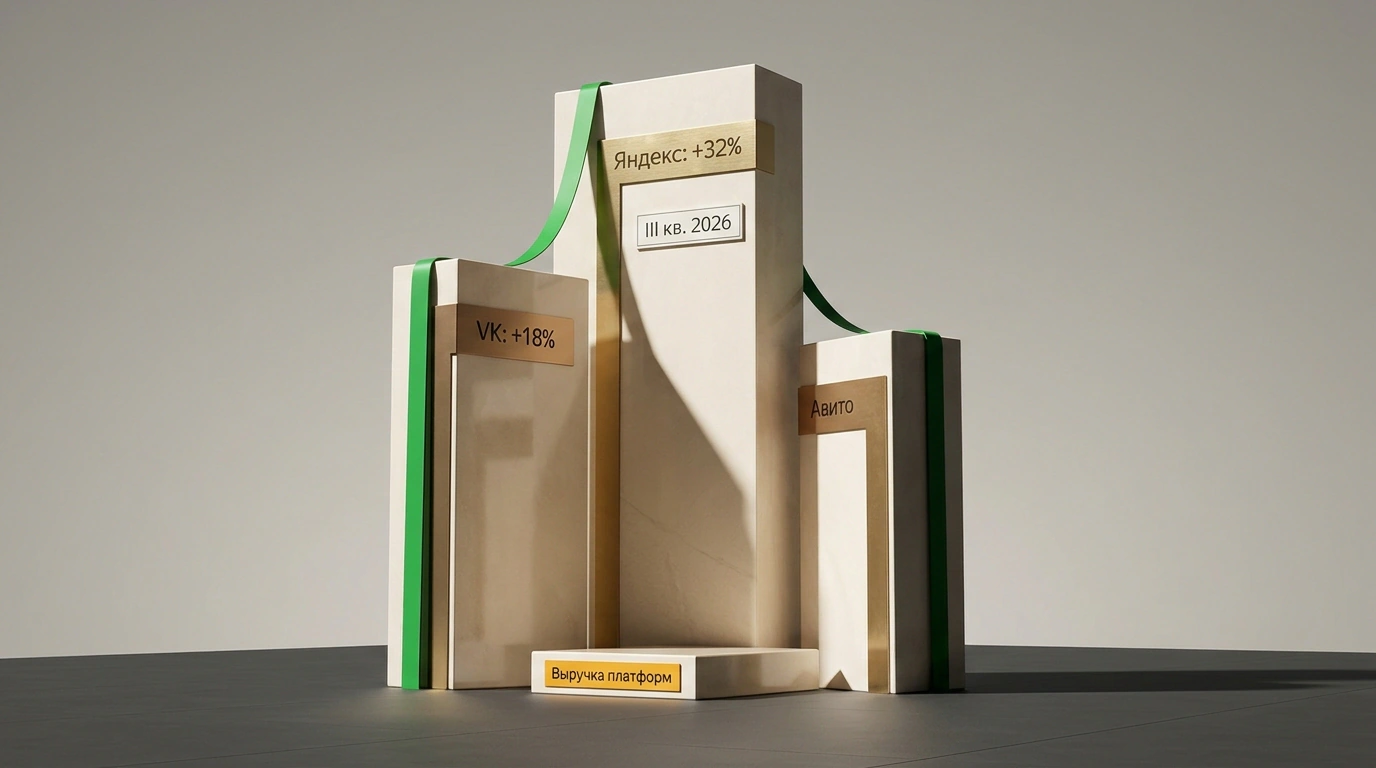
Q3 2026 Ad Revenue of Russia’s Five Largest Platforms
The chart shows the scale gap immediately: the top two take the lion's share of spend, while the trailing three sit far behind. The real catch lies elsewhere — we are stacking completely different types of budgets into one pile.
Retail Media as a Paid Shelf: Where Ozon and X5 Media Money Comes From
Start with the asterisk next to the leader. Ozon's public IFRS statements don't break out a top-level "advertising" line: total group revenue for Q3 reached 421.2 billion rubles (+63% YoY), adjusted EBITDA hit 93 billion, and net profit came to 3.7 billion rubles after a 30.1 billion reserve for drone-attack damage across 11 logistics facilities. Roughly 155 billion rubles is the estimated revenue from marketplace advertising and marketing services, doubling in a year.
Trading volume fueled that jump. GMV (gross merchandise value, the total value of all goods sold on the platform including services rather than the company's own revenue) grew to 1.6 trillion rubles (+42% YoY), while orders jumped 76% to 1.2 billion. More buyers and transactions meant sellers fighting harder for top search spots.
That exposes the difference from classic digital ads. In search or paid social, you keep a choice: if unit economics break and lead cost spikes, you pause the campaign and move budget elsewhere. On a marketplace, you don't have that luxury. Without paid boosts, even a good product at a fair price sinks to page ten. Paying for retail media (ads inside shopping platforms baked directly into the purchase path) becomes a variable commission for shelf access. That's why it grows faster than GMV: sellers have to hand over a bigger slice of margin just to stay visible.
X5 Media runs on a similar mechanic, only offline. The network's quarterly ad revenue rose 20% YoY after rapid gains of +45% in Q1 and +55% in Q2. Growth cooled against a high prior-year base (8.2 billion rubles in Q3 2025), yet ads still outpace the retailer's overall revenue growth (+13%) nearly twofold. The company operates over 86,000 digital screens (+18% YoY) reaching 83.9 million shoppers.
It sounds like a giant media holding until you look inside the register: about 80% of that money comes from Pyaterochka and Perekrestok's own suppliers. This is trade marketing — budgets from food and household goods makers paying extra for prominent checkout screens. Outside advertisers remain a minority. Comparing those budgets to buying website traffic is like confusing store entrance shelf rent with a highway billboard.
Classic Digital Under Pressure: Yandex, VK, and the Drop Inside MTS AdTech
Once you set shelf fees aside, you feel the market's real temperature right away. The cleanest thermometer here is Yandex. Its ad revenue rose 9% in Q3 (and 379 billion rubles over nine months of 2026, +10%). That is the quietest pace in the top five, showing how businesses behave without marketplace lock-in.
Inside Yandex, spending split unevenly. Small and mid-sized businesses hit the brakes, while select verticals held up: Entertainment grew 37%, IT rose 22%, and Healthcare & Pharma climbed 21.4%. Foreign advertisers also added a noticeable boost, with nine-month budgets up 62%.
At first glance, VK looks livelier: +18% in Q3 on total holding revenue of 47 billion rubles (+21%). Growth accelerated for a second straight quarter after +4% in Q1 and +14% in Q2. Break that money down by client size, though, and the broad-recovery story falls apart. Large enterprises drove all the acceleration, lifting spend by 29% to 18 billion rubles. Meanwhile, small and mid-sized businesses shrank from 43% of revenue in Q1 to 36% in Q3. Smaller firms are struggling to match auction bids and giving way to big brands.
VK Ads platform, one of the five largest players in Russia's digital ad market in Q3 2026 (Source: ads.vk.ru)
The sharpest contrast between headline and reality sits inside MTS AdTech. On the surface, it looks solid: +15% in Q3 (53.3 billion rubles over nine months, +11.4%). Dig deeper, and two businesses moving in opposite directions sit under one roof.
A2P messaging (automated business-to-consumer SMS, push notifications, and messenger blasts) pulled the whole number up, bringing 13.3 billion rubles (+38% YoY). Meanwhile, actual ad-tech products (MTS DSP, Telegram Ads, Buzzoola, Getblogger, MTS Ads Premium Video, Segmento DSP, and Mediascout) dropped 18.2% to 5.4 billion rubles. That unit slid back two years: even in Q3 2024, it earned 5.5 billion rubles. One direct cause was restrictions around Telegram, where MTS held a Russian ad-reselling contract. When SMS verification codes and media buys sit in one revenue line, the headline easily hides a real slump.
Where Money Still Grows and How to Read This Before 2027
Even in a cooling market, several formats are climbing steadily. Because they start from a small base, they don't flip the headline numbers yet.
At Yandex, new formats grew 72%: DOOH (digital screens in streets and malls), CTV (ads on internet-connected Smart TVs), and messenger placements. Among small businesses, Yandex Maps stayed a bright spot (+12.5%): a local cafe, clinic, or auto shop prefers paying where a customer is already building a route and ready to walk in within fifteen minutes.
VK shows a similar trend. In-stream video ads (clips inside video content, including Smart TV) brought 2.7 billion rubles (+48% YoY). That's roughly 10% of the holding's ad pot, yet it grows several times faster than the core. Social commerce has hit 3.4 billion rubles in turnover since launch, with 1.6 billion going to creators. Early revenue also arrived from the MAX messenger: from July through October, business services and ads there brought over 700 million rubles, around 2% of VK's ad income.
| Platform | YoY trend | Main growth driver | Main risk or skew |
|---|---|---|---|
| Ozon | 2x | GMV growth (+42%) and orders (+76%) | Promotion turned into a mandatory shelf fee |
| Yandex | +9% | New formats (+72%), foreign buyers (+62%), Maps | Restrained demand from small businesses |
| VK | +18% | Large enterprises (+29%), Smart TV & video (+48%), MAX | SMB share fell from 43% to 36% in six months |
| MTS AdTech | +15% | A2P messaging (+38%) | Ad-tech unit dropped 18.2% below 2024 levels |
| X5 Media | +20% | Screen network expansion (+18%) and 83.9M reach | ~80% of revenue is supplier trade marketing |
If you're drafting a 2027 marketing plan right now, this snapshot strips away false hopes. Ad spend is pooling inside giant platforms while head-to-head auction competition gets pricier.
Bake marketplace promotion into product cost of goods alongside logistics and buyout rates, not into discretionary marketing — without it, your shelf disappears. In classic digital, small businesses do better leaning into local intent like Yandex Maps where buyers are ready to act, rather than elbowing national brands in overheated auctions. Keep a small test budget for fast-growing, low-base formats like digital out-of-home screens, Smart TV, and fresh inventory in messengers like MAX before every rival crowds in.