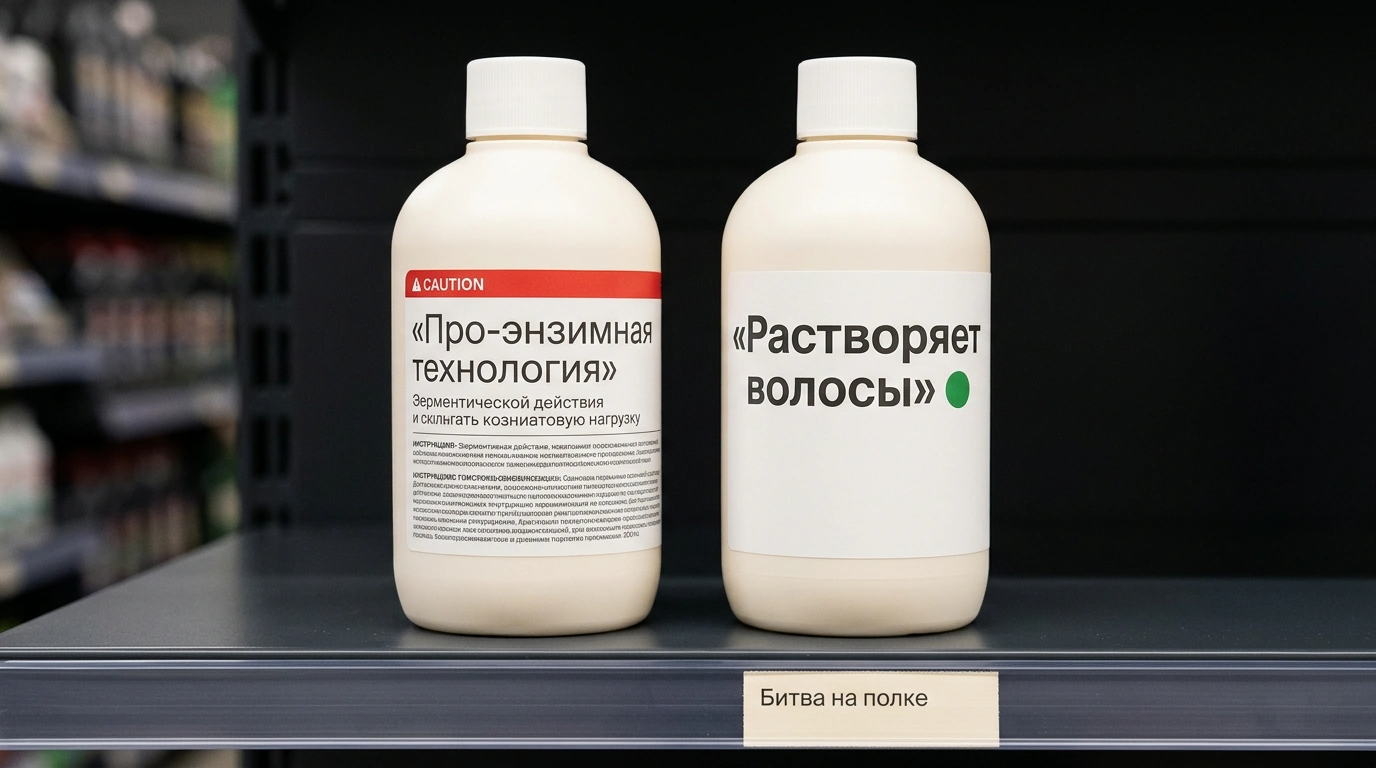
You're standing in a supermarket in front of the drain-cleaner shelf, and mental fatigue is already ticking up. Thirty-seven bottles stare back with tiny print promising "pro enzyme technology." You burn thirty seconds translating chemical jargon into plain language, ready to give up. Then your eyes catch two simple words on the bottle next to it: "dissolves hair." Your hand grabs the bottle before your eyes even check the price.
Zero Cognitive Load and the Three-Second Rule
That invisible mental tax for decoding text is called cognitive load. Picture a subway turnstile that asks you to solve a math equation in your head instead of tapping your card: within three seconds, people walk over to the next gate. Packaging and ad offers work the exact same way — any word forcing the brain to translate from "smart" to human slows down the purchase.
The rule is simple: clever wordplay wins advertising awards, while zero cognitive load rings the cash register. "Dissolves hair" hits an everyday headache directly. Buyers don't care about enzymes; they just want shower water to drain. Marketplaces and landing pages work the same way: while one seller touts an "innovative matrix," another names the exact problem the product solves and takes the order.
'Little Raspberry,' '2,720 Peppercorns,' and Vitamin C: Three Levers Against Skepticism
Food and drink brands have it tougher: label copy is boxed in by strict food regulations and inspections where one wrong claim brings a fine. Breaking past dry copy like "Black Pepper" is hard, so brands pull three verbal levers.
The first is diminutives — warm, affectionate words like "malinka" (little raspberry), "zyornyshki" (little grains), and "butylochka" (little bottle). That suffix instantly signals warmth and safety. Cultural theorist Sianne Ngai, in Our Aesthetic Categories: Zany, Cute, Interesting (2012), explains "cuteness" as a working engine of consumption: a small, vulnerable object invites you to pick it up, tucking a commercial transaction behind a feeling of care. That's the same reason popular AI tools adopt fluffy mascots — they calm anxiety around complex tech.
Kidult culture amplifies this effect, as adults facing uncertainty gravitate toward toys, naive design, and childhood imagery. In Russia, this tone was cemented by private-label brands (STM) from major delivery services like Yandex Lavka, Samokat, and VkusVill. Huge warehouses and algorithms sit behind them, yet the box speaks like a friendly corner grocer: "we squeezed," "we picked," "we made this for you." People trust a warm voice far faster than faceless infrastructure.
The second lever is hyper-specificity and imagined labor. Printing "4 lemons" pictures hand-crafted work, as if someone squeezed the juice in a kitchen. "There are 2,720 peppercorns in here" stops the eye with one instant question: "Wait, who counted them?" Attention is captured, and food labeling rules stay intact.
The third lever is removing guilt at checkout. In Coca-Cola's experience, adding a short "with Vitamin C" note on Fanta bottles lifted sales noticeably. The soda didn't magically turn healthy, yet parents buying a sweet drink for their kids felt less guilty.
When 'Cuteness' Turns Into a Corporate Mask
Sweet talk has a breaking point. A brand wants an adult buyer's money, yet talks to them like a kindergarten teacher. This looks especially funny in baby goods and dog food: an adult pays the bill while the label coos as if a puppy holds the wallet. When one delivery brand called a bottle a "little bottle," it felt warm. Once dozens of rivals copy-pasted "little berries" and "little grains," the intimacy vanished — leaving behind a fake corporate mask.
| Shelf goal | Technique | Example | Overuse risk |
|---|---|---|---|
| Explain value instantly | Zero cognitive load | 'Dissolves hair' instead of 'pro enzyme technology' | Overly narrow claim cuts off adjacent uses |
| Lower brand skepticism | Diminutives & friendly voice | 'Little raspberry,' 'we squeezed for you' in private labels | Cookie-cutter baby talk triggers annoyance |
| Catch attention legally | Hyper-specificity & handcraft | '4 lemons,' '2,720 peppercorns inside' | Unbelievable numbers kill trust |
| Remove checkout hesitation | Guilt relief | 'With Vitamin C' tag on Fanta | Forced health claims draw eye-rolls |
Strip smart-sounding jargon off your packaging or website hero screen and leave a phrase a buyer grasps in three seconds without a dictionary. And before adding cute suffixes, read your offer out loud to an adult friend: if it makes you cringe, it'll flop on the shelf the exact same way.