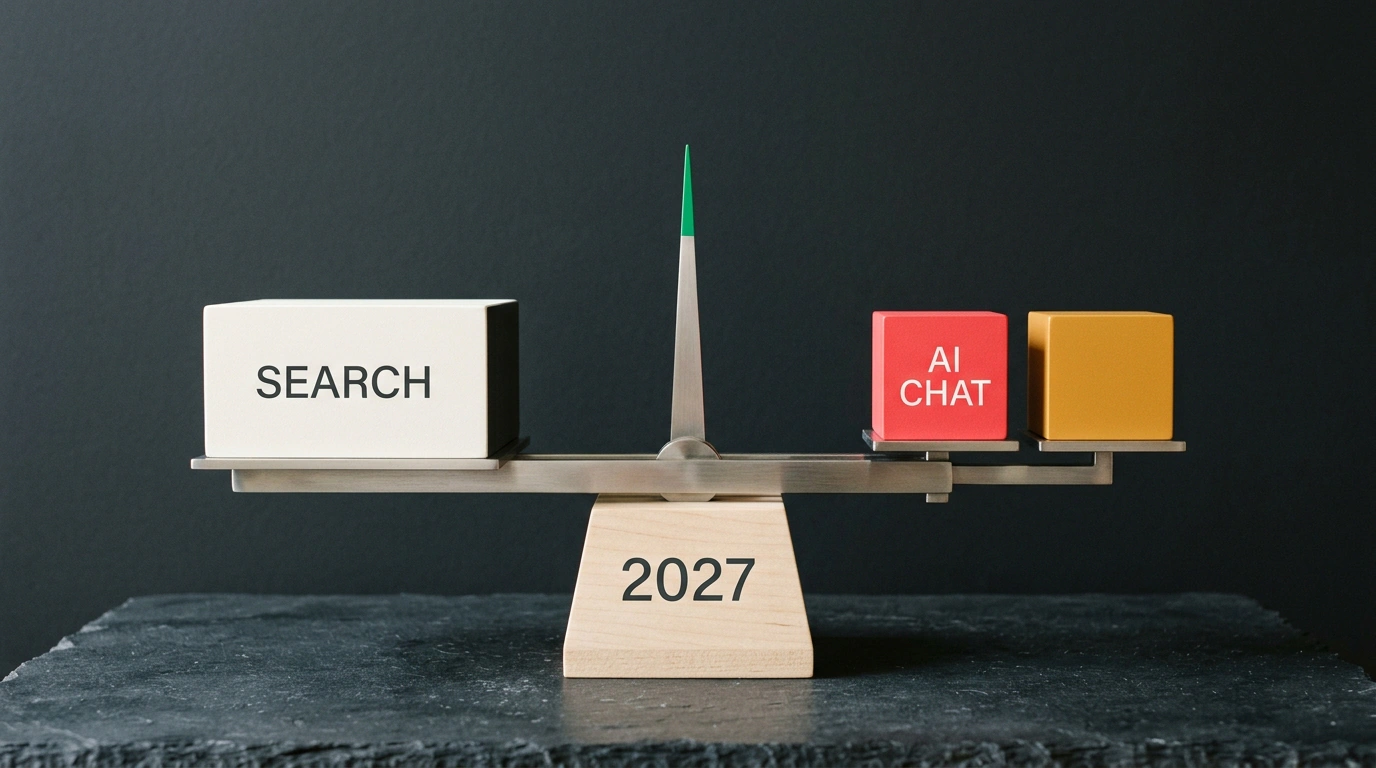
As 2027 budget planning approaches, any marketer or business owner selling to international markets faces an awkward fork in the road. Path one: leave your money in familiar Google Search and Meta targeting, where auctions are overcrowded and CPC creeps up every quarter. Path two: chase the hype and pour a big slice of budget into new AI chat ad platforms to grab early wins before competitors wake up.
Both extremes hurt your bottom line. Ignore AI platforms completely, and you risk missing the shift as buyers start choosing products inside chat windows. Split your money blindly down the middle, and your first few months will burn cash on empty clicks with zero leads.
Cold math helps cut through the noise. We have two fresh datasets from late 2026: stats from agency NP Digital (managing over $1B in ad spend) and real ChatGPT Ads test results from OneSpot covering June–November 2026. Let's break down how 2027's three major ad platforms work, where real sales happen versus raw hype, and how to run your first ChatGPT test without wasting money.
Three Very Different Beasts Under One Label
When conference speakers say 'AI advertising', they usually lump three totally different products together. Each has its own ad mechanics and funnel role.
Google works off what a user types right now. Ads appear inside AI Overviews and the conversational Google AI Mode. You capture existing demand at the exact moment someone searches for a solution.
Meta bets on who is behind the screen. Here, AI replaces the media buyer: the algorithm picks the audience, chooses the feed placement, and increasingly adjusts the creatives itself. You use this channel to create demand among people who weren't thinking about your product this morning.
ChatGPT Ads tries to blend both. A sponsored block appears below the AI answer and is visually separated from the response text. The algorithm matches ads to the current conversation topic and, if personalization is enabled, pulls signals from past chats.
It's already too late to dismiss AI chats. In post-purchase surveys run by NP Digital across 85 companies, 16% of buyers first discovered a brand through AI tools like ChatGPT or Gemini. People genuinely use chats to shop: they lay out their full problem, budget, constraints, and options they've already ruled out.
According to OpenAI, roughly three-quarters of commercial queries in ChatGPT happen right at the evaluation stage—when users browse products, compare alternatives, and weigh specific options. Direct transactions and post-purchase questions make up a much smaller share.
Purchase Journey Stages for Commercial Queries in ChatGPT
This breakdown sets the tone for chat ads. Anyone reading an ad below an AI response has already stated their pain point and is comparing choices. A loud banner saying 'Best Service on the Market' will flop here. They need comparison points: how you differ from rivals, what it costs, and why they should trust you.
One note on geography: all three platforms (Google AI Mode, ChatGPT Ads, and Meta) target companies selling internationally. To run ChatGPT Ads directly via OpenAI Ads Manager, you need a legal entity and billing account in one of 89 supported countries. Businesses selling abroad from restricted regions enter through foreign entities or partner ad accounts.
Google AI Mode: When Your Website Becomes the Targeting
Google AI Mode is a conversational search experience for complex, multi-step questions and comparisons. By May 2026, its audience passed 1 billion monthly users. The scale is massive, yet getting ads into it breaks old PPC habits.
Google Ads has no 'AI Mode' campaign type. You can't check a box to 'show only in conversational search', and Google doesn't break out a clean standalone report for that placement. Ads flow into AI results automatically from active campaigns: Performance Max, Shopping, and standard Search using Broad Match—especially when AI Max for Search is turned on.
You no longer buy a specific line on a results page. The algorithm decides whether your site deserves to appear in the answer.
Google AI Mode interface in Google Search showing ads pulled from Search, Shopping, and Performance Max campaigns (Source: blog.google)
The biggest trap hides inside the AI Max for Search add-on. This AI optimization suite expands keyword matching, rewrites ad copy, and enables Final URL Expansion by default—automatically picking which landing page on your site matches a user's question.
That sounds handy until you look at a typical mid-sized business website. Under this setup, your website itself becomes part of the targeting. Google's AI reads your pages to figure out what you sell, writes ads from that text, and decides where to drop paid clicks. If your service page says vague fluff like 'we deliver comprehensive solutions with an individual approach', the AI gets garbage in. It matches irrelevant queries, writes bland ads, and dumps paid traffic onto an old blog post or a careers page with no lead form.
Before turning on AI Max, experienced teams clean up their site in three steps. First, rewrite every core service page so both humans and bots see three things above the fold: who the product is for, what specific problem it solves, and where you operate. Second, use Final URL Expansion exclusions to block all non-converting sections: blog posts, careers, empty regional pages, and legal terms. Third, launch AI Max alongside your existing Search campaign as a controlled test instead of flipping a switch on the whole account.
For online stores, Google is also testing Direct Offers—essentially a built-in AI salesperson. Retailers upload a special offer like a discount or bundle, and the algorithm decides when in a chat to show that discount to a hesitant shopper to close the order. Revenue on your chart might jump, but revenue and profit aren't the same thing. Without strict caps on discount size, the algorithm will happily give away your margin just to hit a pretty conversion count.
ChatGPT Ads Across 89 Countries: Harsh Early-Stage Numbers
On October 21, 2026, OpenAI opened its ad platform to 26 more countries, bringing ChatGPT Ads to 89 markets. Hype around the launch was huge, but early live numbers quickly cool expectations.
Per NP Digital data, ads below ChatGPT answers average a 0.7% click-through rate (CTR). By comparison, classic search ads on Google and Microsoft average around 6.7% CTR—nearly ten times higher. OneSpot's test campaigns from June to November 2026 saw a similar range, from 0.65% to 1.30%.
Comparison of click-through rates in search versus conversational AI using measuring vessels
This traffic isn't cheap either. OpenAI suggests starting bids of $3–5 per click, and OneSpot's early launches averaged $3.30–3.60 per click—right in line with crowded Google Search auctions. Refining prompts and ad copy can bring CPC down over time, but the entry ticket stings.
In four head-to-head tests where the same advertisers ran identical offers on Google and ChatGPT simultaneously, Google Search won on conversions 4 out of 4 times. Keep the sample size in mind: four tests are an early signal, not a final verdict for all of 2027. The product is young, and its formats are still evolving. Also, CTR alone only shows whether an ad catches eyes, and CPC means nothing without context. Social feeds and search draw plenty of accidental clicks from browsers who aren't ready to buy, while ChatGPT shows ads under answers to users already weighing options. Judge the channel by cost per qualified lead (CPA/CPL), not cost per click.
Even more tricky is a catch that hits B2B hardest.
Ads show only to adult users on the free tier and the basic Go plan. Subscribers on Plus, Pro, Business, Enterprise, and Education never see ad blocks below answers. If you sell enterprise software, consulting, or industrial gear, most directors and department heads use paid work accounts. Your paid ads simply cannot reach them.
That creates a sharp divide: buying ad space below a ChatGPT answer and getting your brand inside the organic answer are two completely different channels. In B2B, organic visibility inside AI answers is often the only way to reach paying decision-makers.
Meanwhile, Microsoft claims ads in Copilot outperform its own traditional search on clicks and conversions. Take platform press releases with healthy skepticism. When a network grades its own new ad format, it's like a student giving themselves an A+. It's worth a small test budget, not blind trust or your main spend.
Meta and Automation: Why One Fresh Hook Beats All Bid Tweaks
If Google forces you to clean up your site and ChatGPT demands conversational scenarios, Meta simply takes the steering wheel away from the marketer.
In Advantage+ campaigns for sales, app installs, and leads, the algorithm decides who sees your ad, on which placement, and in what format mix. In October 2026 at Advertising Week New York, Meta pushed further. It began testing agentic features in Meta Business AI Assistant: the assistant can plan a campaign in chat, draft copy and visuals, adjust targeting, and tweak budgets, leaving the human to just click approve. Advantage+ Creative improved automatic video assembly from static cards, and the updated Ads Creative Studio lets teams take one shot video and test new hooks, audio tracks, and links at scale without reshooting.
Few manual levers remain in the ad manager. When the machine controls bids and audiences, creative becomes the only serious lever left in your hands.
NP Digital tested this across 50 companies running ads on Google and Meta. The pattern is stark: systematic work on the ads themselves moves both CTR and acquisition cost several times more than any bid tuning.
Impact of Creative Changes vs. Bid Changes on Ad Metrics (50 Companies)
Seeing a gap like that makes it funny to watch teams argue for weeks over two-cent bid steps while running the same three banners for six months. You need to feed fresh variations into campaigns regularly, not just at launch.
Just don't confuse real creative updates with cosmetic tweaks. Changing a button from blue to green isn't a new variation. To the algorithm and the user's eye, it's the same ad. A real variation means a fresh concept, a new hook in the first three seconds, a different customer pain point, or a new person on camera. Ads Creative Studio saves real money here by letting you remix openings and voiceovers without booking another shoot day.
Full automation has a dark side too. AI loves easy wins. Left unchecked, it quickly finds people who already know your brand, bought from you before, or were going to order this week anyway. Your dashboard shows a gorgeous ROAS, the marketer gets a bonus, and zero new customers actually enter the business.
In fall 2026, Meta rolled out a safeguard: Customer Lifecycle Strategy. When your goal is new customer acquisition, you tag the campaign accordingly and the system prompts you to exclude your existing customer list. Always verify those exclusions manually before launch. Otherwise, you'll pay ad fees for sales you could have closed with a free email or push notification.
First Test in ChatGPT Ads: Four Checks Before Launch
Suppose your business sells in one of the 89 supported markets, fits a mass or Free/Go audience, and you decide to test ChatGPT Ads. The #1 mistake that burns almost every first launch is importing habits from Google Ads, Yandex Direct, or social targeting.
ChatGPT targeting is surprisingly bare-bones. You get country (in the US, you can narrow to state, DMA, or ZIP code), platform (iOS, Android, or web), custom email/phone lists (with a steep minimum of 25,000 matches), and contextual prompts. There are no interest segments, age, gender, look-alikes, negative prompts, or even manual language selection. The system picks ad language from three signals: user location, interface language, and current chat language. An English app menu won't guarantee a user sees your English ad if they're chatting in Spanish.
To avoid paying for random clicks, fix four bottlenecks before your first test goes live.
First, write prompts as real-life situations, not keyword lists. You can add up to 2,000 free-text contextual prompts per ad group. There's no exact-match keyword logic here—the model looks for semantic fit with the conversation. Copy-pasting dry search terms like 'German courses' or 'dog grooming' will drop your ad into dozens of off-topic chats where someone just wants two phrases translated or is reading about dog breeds.
A prompt should read like a real brief in a customer's own words. Picture a mobile dog-grooming van owner. Instead of 'dog grooming', a strong prompt looks like: 'owner of an anxious rescue dog that panics at salons and needs at-home grooming'. That's how people talk to ChatGPT—they share city, budget, age, fears, and constraints. Split ad groups by one rule: 'one group, one decision stage'. Someone exploring a problem and someone comparing two specific German schools need different ads. Remember: set geography in campaign settings, not inside prompt text, and you cannot exclude topics via prompts.
Second, open your site to OpenAI's bot and proofread everything before submitting. Moderation takes one to 24 hours and reviews your ad together with its landing page. To avoid wasting days on preventable rejections, check the basics: the page loads over HTTPS, the URL is under 2,048 characters, and your site explicitly allows OAI-AdsBot. If robots.txt or a firewall blocks that bot, your ad gets rejected immediately. Don't worry about leaking content into training: OpenAI states OAI-AdsBot data is used only for safety and policy checks, not base model training. OpenAI also recommends allowing OAI-SearchBot for indexing and product images.
Your landing page must show the exact same offer promised in the ad. Visually, creatives cannot mimic the ChatGPT interface or use OpenAI logos without written permission. Any copy or image edit after launch creates a new ad version and restarts moderation, so proofread everything up front.
Check your category rules too. As of November 2026, adult content, alcohol, tobacco, gambling, crypto, payday loans, and investments are banned. Finance, healthcare, and legal services require licenses, while jobs and real estate face restrictions. Policies and country lists change quietly, so review OpenAI's current ad policies before every launch.
Third, install your pixel and don't mess up locked fields. The ad manager offers three objectives: impressions, clicks, and conversions. Billing is per click under all three, but optimization differs. Without an OAIQ pixel or server-side Conversions API setup, the Conversions objective stays locked, leaving the algorithm hunting for 'clickers' instead of buyers. Attribution windows are short—just 24 to 48 hours—so longer sales cycles will miss some conversions.
The nastiest quirk in OpenAI's UI is the list of settings that lock permanently once a campaign is created. You cannot change account currency, time zone, bid type, campaign mode, budget type (daily vs. lifetime), or the chosen conversion event. You can't move an ad group to another campaign either. One typo at setup means deleting the campaign, rebuilding it, and starting data collection from scratch.
Pre-Launch Checklist for Your First ChatGPT Ads Test
- Verify your niche and target countries against OpenAI's current ad policies on launch day.
- Allow
OAI-AdsBot(andOAI-SearchBotif needed) on your site, serve over HTTPS, and keep URLs under 2,048 characters. - Match the landing page offer word-for-word to the ad, and ensure creatives don't mimic ChatGPT's UI.
- Install and verify the
OAIQpixel or Conversions API to unlock Conversions optimization. - Lock down uneditable brief parameters before creation: currency, time zone, budget type, bid type, and conversion event.
- Write contextual prompts as real decision scenarios with customer constraints rather than search keywords.
Test Budget and Troubleshooting Your First Few Weeks
The fourth check before launch is an adequate budget and patience. The minimum in a USD ChatGPT Ads account is $25 per day per campaign (limits vary in other currencies). Running a three-day test for $100 makes no sense: the system won't have time to learn this new targeting format. Based on OneSpot's tests, a realistic budget for a proper test is $1,500–4,000 over roughly 90 days.
To see how all three platforms stack up side by side, here's a quick comparison of their mechanics and limits.
| Platform | What Drives Delivery | Main Growth Lever | Key Limitation | Role in 2027 Budget |
|---|---|---|---|---|
| Google AI Mode (via Search / PMax / Shopping) | User query + site content (Final URL Expansion) | Clear service pages and strict URL exclusions | No dedicated campaign or standalone AI Mode report | Core channel for capturing existing demand |
| Meta Advantage+ | User profile & behavior + AI media buying | Steady stream of fresh creative concepts and hooks | Risk of wasting spend on existing buyers without exclusions | Core channel for creating new demand |
| ChatGPT Ads | Current chat meaning (contextual prompts) + session history | Scenario-based prompts and tight landing-page offer match | Shown only on Free and Go tiers (weak B2B reach), early CTR ~0.7% | Test channel (10–15% of budget) |
Once your ChatGPT campaign is live, treat the first two to three weeks as calm diagnostics. Follow one iron rule: change one setting at a time. Rewrite prompts, headlines, and your landing page in the same evening, and by Friday you won't know what broke or boosted performance.
If you get zero impressions, check moderation status first and confirm your server lets OAI-AdsBot in. If everything is clean technically, your prompts describe a scenario too rare for real users to ask about.
If clicks roll in with zero leads, inspect your prompt list. Most likely, your phrasing is too broad and your ad shows in adjacent but irrelevant chats. The second common culprit is an expectation gap: your ad promised a calculator and pricing, while the landing page dropped users on a generic homepage.
If leads appear in your CRM while the ad dashboard shows zeros, test your OAIQ pixel or Conversions API firing and remember the short 24–48 hour attribution window.
How to Split Your 2027 Budget Without Being Fooled by Dashboards
There's no single winning platform for 2027. Handing a third of your budget to each channel in the name of 'diversification' is one of the fastest ways to blow a quarterly target. Agencies managing major budgets stick to four simple allocation rules.
First, keep most of your spend where demand is already proven. If people actively Google your solution, Google Search stays your foundation. If your product is new and needs demand creation, Meta leads. Small businesses shouldn't scatter money on AI chat experiments until these two core engines run smoothly.
Second, cap tests of new AI channels like ChatGPT Ads and Microsoft Copilot at 10–15% of your budget. On a $20,000 monthly spend, that's $2,000–3,000 for experiments—enough to gather real data without hurting cash flow if a test flops.
Third, a new channel earns more budget only after proving incremental sales—orders that wouldn't have happened without those ads. This is where glossy case studies fall apart. AI campaigns excel at scooping up people who already know your brand and search you by name. The dashboard glows green while overall revenue stalls. When NP Digital tests Google AI Max for a client, they strictly exclude branded queries from both the test and control groups, then compare net-new qualified customers rather than raw in-platform conversions. It isn't 100% lab-pure, but it blocks the easiest way algorithms inflate their own credit.
Fourth, review numbers weekly (or monthly at minimum) and move money ruthlessly toward what works.
There's one more budget imbalance few teams notice during annual planning. In the same NP Digital study of 50 companies on Google and Meta, a clear gap appeared in how PPC budgets were structured. Companies with ROAS under 2.5x poured 92% of their budget straight into buying traffic and left a symbolic 0.3% for conversion rate optimization (CRO). Teams hitting over 2.5x ROAS spent differently: they gave a smaller share directly to ad networks and invested noticeably more into making every bought click convert better—creatives, analytics, tools, and landing-page CRO.
PPC Budget Split for Companies with ROAS Above 2.5x
In 2027, access to AI tools won't be a competitive edge anymore. You and the bidder next to you will have the same AI Max buttons, the same Advantage+, and the same OpenAI Ads Manager. What hits your bottom line is what you feed those algorithms: clear service pages for Google, real-world scenario briefs for ChatGPT, and a steady flow of distinct, fresh creatives for Meta.