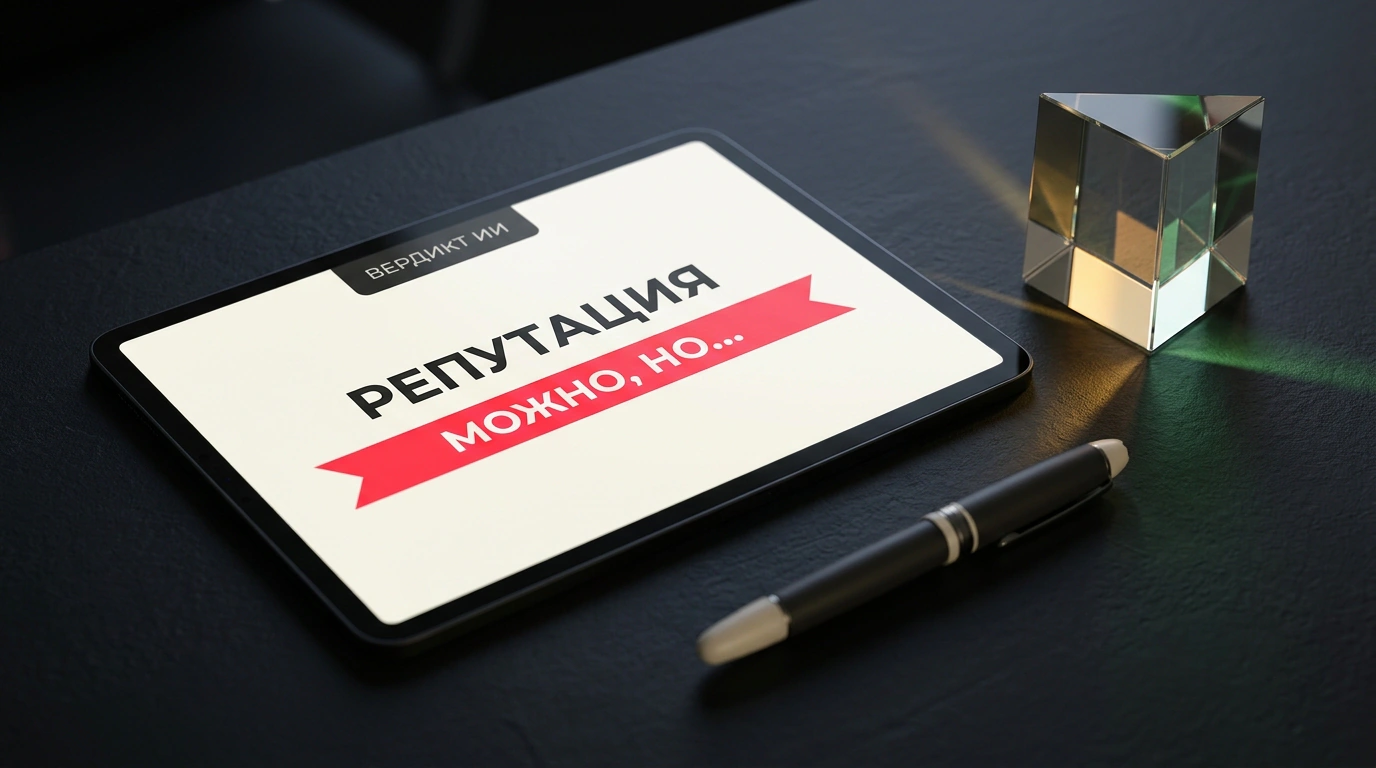
Picture a typical B2B deal. Your ad worked, the prospect clicked through, read the landing page, opened your proposal, and is about to dial your sales rep. One step before calling, they open search or an AI chat and type a simple question: 'should I work with company N'.
Three seconds later, a neat paragraph appears on screen. It doesn't feature your polished offer, homepage case studies, or sales promises. Instead, it gives a 'you can work with them, but…' verdict—mixing a couple of polite lines with a three-year-old complaint from a former manager, an odd reading of your balance sheet, or a link to a competitor's review. You paid for the click, warmed up the lead, and nearly closed the deal—only to lose the buyer over a short summary you never even saw.
You can't buy your way out of this bottom-of-funnel checkpoint with an auction bid. The AI builds its answer from scratch using whatever already sits publicly online about your company. And this filter is no longer niche: according to VCIOM, the share of Russian internet users turning to AI at least weekly rose from 51% to 58%, with about 78% having tried AI tools over the past year.
Why One AI Paragraph Replaces Ten Browser Tabs
Just a couple of years ago, a buyer facing a serious purchase opened ten tabs: official site, review portals, forums, comparison blogs, and rival price lists. Today, that research marathon often shrinks into a single chat window. Users ask in plain language and get a ready summary where your company lands on the shortlist, picks up a cautious caveat, or doesn't show up at all.
A survey by research center Anketolog among residents of Russia's million-plus cities shows how fast this habit turned into a direct revenue factor.
How Residents of Major Russian Cities Use AI Search When Shopping
The picture is stark. Buyers know full well that AI makes mistakes and mixes up facts, yet they still trust it for initial screening and will walk away after a negative summary. In B2B, the stakes are even higher because deal sizes are larger and choosing the wrong vendor hurts more.
Moscow agency RUPR proved this clearly in a test run on November 24–25, 2026. They fed the exact same prompt—'is it worth working with company name'—into Yandex's AI across eight real B2B firms in logistics, corporate training, CRM, 1C/ERP integration, instrument manufacturing, industrial automation, and marketing. The sample mixed major players and small firms, run once from Moscow with no manipulation.
The result was sobering: eight times out of eight, the AI answered using the 'you can work with them, but…' formula. Not a single unconditional 'yes'. Every summary followed the same script: a 'pros' block followed immediately by a 'what to watch out for' block. Even when the model opened with a compliment, the caveat landed in the very same sentence: 'they have a solid reputation, though like any partner, there are nuances'.
Of course, eight firms in a single run is a diagnostic snapshot, not a nationwide census. Still, the underlying mechanic is crystal clear. AI acts like a cautious analyst hedging its bets: it looks for balance and actively hunts for a 'fly in the ointment' so it doesn't sound like a brochure. The real question for your business is: which texts feed your 'pros' block, and who is writing your 'but'?
Who Writes Your 'But': How Employee Reviews and Balance Sheets Outweigh Your Website
Most founders think logically: we built a new site, listed guarantees, added client letters, and cleaned up two weird map reviews—so our reputation is fine. In practice, that breaks against how AI search actually works.
A model doesn't invent descriptions from thin air, nor does it sit in a newsroom holding a calendar. It has no editor and no sense of recency. It stitches an answer from every prominent public source that directly addresses the query: business media, Telegram channels, map reviews, forums, directories, marketplaces, and public registries. If an old angry comment or awkward phrasing is well-indexed and echoed on a few sites, the model treats it just like yesterday's news.
Artistic risograph illustrating how a language model verifies a brand through external reviews
In that eight-company B2B test, researchers traced every source Yandex AI used to build the 'watch out' and 'pros' sections. The breakdown is eye-opening.
| AI Answer Block | Where AI Pulled Facts | Frequency & Effect Across 8 B2B Firms |
|---|---|---|
| 'What to watch out for' | Employee reviews on job sites | Appeared in 6 of 8 answers; in 2 cases, replaced the entire client brief |
| 'What to watch out for' | Tax & financial filings in registries | For a small firm with no press, a 15.1% asset drop was read as asset sell-off risk |
| 'What to watch out for' | Customer reviews on directories | Produced hedging lines like 'some clients note…' |
| 'What to watch out for' | Reviews on competitor websites | In 1 of 8 answers, 'consider alternatives' came straight from a rival's page |
| 'Why work with them' | Articles in business & trade media | Found for only 2 of 8—the only ones earning clear praise up front |
| 'Why work with them' | Company's own corporate website | Cited for 4 of 8, but never produced positive praise on its own |
The most painful finding is employee reviews. In six out of eight answers, the AI explicitly warned prospective buyers about staff complaints found online. In two cases, it even misread the intent—interpreting 'is it worth working with company X' as 'working at company X' and handing a B2B buyer a summary built entirely from HR review sites.
For one major integrator, the model went further and gave the buyer financial advice based on staff complaints: suggesting they dig deeper into the partner's overall financial stability instead of trusting public image. The wall between your employer brand and your sales pipeline has vanished. A disgruntled former employee from three years ago now sits right inside the meeting room with your next client.
Second is the accounting detective work. One small firm had zero press coverage. Unfazed, the AI ran its own background check via public registries: noting 65.3% revenue growth in 2025, 21.8% profit growth, and a clean supplier record. Sounds great—until the model spotted a 15.1% drop in assets and issued a warning that it might signal asset liquidation. Maybe the firm simply paid off a loan, sold an old machine, or leased equipment—but since nothing explained it publicly, the AI invented the worst-case scenario.
The 'pros' block tells the mirror story. Half the firms had their corporate site cited, yet that site alone never convinced the AI to praise them: models treat your website as self-promotion needing outside proof. Clear praise like 'strong reputation confirmed by clients' went only to the two firms with independent business press coverage. For the other six, the 'pros' were cobbled together from directories, dry balance sheets, and those same staff reviews.
Three practical rules follow, echoed by Brand Analytics executive director Marina Popova. First, AI reputation no longer belongs solely to PR or SERM: product, support, HR, and marketing shape it daily. Second, watching only news sites or two big review portals leaves blind spots models happily exploit. Third, repetition wins: when the same point about your brand appears across multiple sites, it becomes the AI's official truth.
Belarus Banks Case: How Five Models Split One Market
While the eight-firm test shows what happens when a buyer checks your name directly, another fresh study looks earlier in the funnel: who does AI recommend when a user doesn't know any brand names yet?
On November 18, 2026, agency GUSAROV and finance portal Myfin.by ran 40 unbranded user questions through five AI models: ChatGPT with search, Claude with search, Gemini (via search API), DeepSeek (via search API), and Google AI Overview. (Alice wasn't included.) Questions covered eight practical topics: deposits, loans, mortgages, cards, currency transfers, reliability/service, business banking, and investments. Out of 200 attempts, 199 returned valid answers (Google skipped one AI Overview).
Overall, Belarusbank dominated with mentions in 63% of answers (126 of 199) and ranked #1 49 times—twice as often as its closest rivals. On housing questions, it appeared in 15 of 15 answers; on reliability, 18 of 19. Behind it clustered MTBank (47%, #1 19 times), Priorbank (46%, #1 11 times), Alfa-Bank (45%, #1 21 times), and Belagroprombank (42%, #1 11 times).
On broad questions, AI acts like a cautious banker: asked about safety or mortgages, it names the country's biggest player. Drop down to specific products, however, and the giant's monopoly cracks.
For cards, MTBank led with 90% mentions (Alfa-Bank got 70%). For loans, Belinvestbank took #1 (57%, vs. 53% for Belarusbank and Alfa-Bank). Sber Bank led currency transfers (52%). MTBank reclaimed #1 in business banking (66% vs. Belarusbank's 63% and Priorbank's 60%). BelVEB dominated investments and bonds (75%). Best of all was deposits: Paritetbank, sitting 13th overall with 25% mentions, vaulted to #1 on deposits at 68%.
For any business outside banking, that's a golden rule: fighting giants for abstract 'best in industry' status is pointless. AI ties brands to specific tasks and products. Nail a narrow use case in detail, and you beat market leaders right where buyers are ready to pay.
Differences between models were just as striking. In a larger GUSAROV study of 34,576 answers across Belarusian industries, 90% of queries shared zero common companies across different AI models. Banking has only ~20 players, so overlap was higher: models named at least one common bank in 27 of 40 questions. Yet at #1, all five models agreed on just 3 of 40 questions. ChatGPT and Claude favored Belarusbank first, while Google AI Overview put Alfa-Bank #1 slightly more often (9 vs. 8).
List lengths vary too: Google AI Overview names 7.4 banks per answer on average, Claude with search gives 6.9, and ChatGPT with search trims to 3.9. Breaking into a four-line list is much harder, though buyer attention isn't diluted across ten rivals.
Their 'source diets' also diverge. Across 185 answers showing citations, sources broke down clearly.
Website Types Cited by AI Models for Belarusian Bank Answers
Russian domains made up just 4% of links—models read local sources for local markets. The top individual 'textbook' was myfin.by itself, cited in 48% of linked answers (88 of 185). Look at the model split, though: Claude cited myfin.by in 35 of 37 answers, Google AI Overview in 25 of 39, while ChatGPT with search cited it zero times—relying directly on bank websites in 18 of 29 linked replies. Betting solely on one aggregator or solely on your own site leaves you invisible to part of the market.
Finally, the test exposed stale data. In 64% of answers (127 of 199, and 85% in Google AI Overview), models confidently quoted specific deposit, loan, and cashback rates. Six answers even revived bank names dead for years: 'BPS-Sberbank' (renamed Sber Bank in 2021) and 'Bank Moscow-Minsk' (rebranded to Dabrabyt back in 2019). Twice, AI seriously quoted an old BPS-Sberbank refinancing rate from an external article as a live offer.
GUSAROV co-founder Andrey Gusarov's takeaway applies to any niche: stop hiding pricing, terms, and specs inside PDFs and images. Keep them as plain HTML text on product pages, update directory listings, and clean up old brand names in third-party articles—otherwise buyers arrive expecting a five-year-old discount.
Citation Isn't Selection: Why AI Links to You—and Recommends Your Rival
Here's the trickiest trap in GEO (Generative Engine Optimization—shaping content and external footprint for generative AI answers). Many teams now track 'AI visibility' and celebrate when their blog pops up in footnotes under ChatGPT or Google AI Overview. Feels like a win.
In reality, being cited and being chosen are two different outcomes. Marketer Neil Patel and SEO specialist Cyrus Shepard (founder of Zyppy) call this the 'citation trap'. An AI can pull an exact definition, comparison table, or market stat from your site, add a neat footnote link, and in the very next paragraph recommend buying from your competitor. You worked as a free encyclopedia while someone else took the sale.
A single blended 'visibility score' pushed by new analytics tools lumps everything together and hides where your funnel breaks. To fix the right step, Patel splits AI funnels into three separate layers.
Infographic blueprint of the gap between being cited by AI and being chosen as a brand
| AI Funnel Level | What Actually Happened | If the Next Level Is Zero—Where's the Break? |
|---|---|---|
| 1. Cited | Your page helped AI build factual context | Weak offer positioning and lack of external brand consensus |
| 2. Recommended / Shortlisted | Model explicitly named your brand as a buying option | Friction in site UX, pricing, or the product itself |
| 3. Valuable Action | Buyer requested a quote, booked a demo, or paid | If leads arrive but don't close—lead qualification or sales handoff is broken |
Look how cleanly that table diagnoses issues.
If you're cited but left off the shortlist, technical tags are rarely the culprit. Both Cyrus Shepard's research and Google confirm that trendy files like llms.txt deliver no measurable boost in recommendations. AI skips you because it sees a helpful publisher, not a proven vendor. You lack external consensus (entity corroboration)—independent third-party proof that you solve that specific problem best.
If you make the shortlist but get no leads, stop rewriting articles for AI. Open your site as a buyer: unclear pricing, a broken form, slow loading, or a weaker offer than the rival ranked one line above you. If leads arrive and sales drops them, GEO isn't your problem—fix qualification and response speed.
Even then, decisions rarely end inside an AI chat. A recent scene in a public Telegram group for robot-vacuum owners nailed this. A buyer asked AI to compare models. The model narrowed it down to two options roughly 30,000 rubles apart. Before paying, the buyer jumped into the community chat with one specific question: does the pricier vacuum handle long hair without tangling?
There's the new buying loop in pure form. AI built the shortlist. A human verified the deciding detail with real owners in a chat. Tomorrow, those chat replies get indexed and become the exact training material AI uses to build the next buyer's shortlist. Brands blind to live community discussions never even learn which argument actually closes deals.
AI Reputation Metrics: Tracking Today and Tomorrow
To avoid guessing or measuring 'internet averages', Brand Analytics analysts split reputation monitoring into two tiers. Tier one is live AI results today: what buyers actually see right now. Tier two is tomorrow's info-field map: the raw material AI will pull from in one to six months.
You can't manually edit tier one, so you must systematically shape tier two.
| Monitoring Tier | Metric | What It Shows in Practice |
|---|---|---|
| Live AI Results | Brand mention share | How visible your company is across target category questions |
| Live AI Results | Mention sentiment | Whether AI praises you, lists neutrally, or adds a 'but' |
| Live AI Results | Co-mentioned competitors | Who you're compared against and who takes spot #1 |
| Live AI Results | Cited sources | Which sites AI trusts in your niche (your top outreach targets) |
| Tomorrow's Info-Field | Share of Voice | How loudly you're discussed publicly versus competitors |
| Tomorrow's Info-Field | Aspect sentiment trends | Which specifics (price, delivery, support) are rising or falling |
| Tomorrow's Info-Field | Source type breakdown | Where brand talk happens and which channels are your blind spots |
| Tomorrow's Info-Field | Recurring phrases | Which labels stick as 'common wisdom' and enter AI answers first |
| Tomorrow's Info-Field | Key-message penetration | Whether your core USPs reach external sites or stay trapped on your site |
Pay special attention to aspect sentiment and recurring phrases.
A headline stat like '70% positive' is nearly useless in practice. It easily hides a fatal flaw: customers love your product quality, yet one in five curses your delivery or returns. AI won't average that into a B+. It pulls delivery complaints straight into a dedicated 'what to watch out for' paragraph. Splitting mentions by aspect (product, price, timelines, service, workplace) shows which screw actually came loose.
Same with recurring phrases. If three separate people on a forum, Telegram channel, and review site complain about 'rigid contracts and slow approvals', that phrase quickly becomes AI's standard label for you. Catching it early in public chatter costs far less than fighting an entrenched AI verdict for six months.
By 2026, specialized Russian tools have grown around this—platforms like Brand Analytics track semantic AI metrics and Share of AI Voice, while tools like Demis Group's NeuroRank and Pixel Tools' AI-visibility modules measure live outputs. Still, you can start without pricey software—just a spreadsheet and two hours.
Action Plan: A Two-Hour Audit, Alerts, and Honest Timelines
Good news: your first audit doesn't require a team of analysts. Bad news: cosmetic blog posts won't fool AI if real operational issues stay broken. Here's a practical five-step plan.
Step 1. Run a baseline AI results audit. List 15–20 real buyer questions split across four types:
- branded ('brand reviews', 'should I work with brand', 'is brand trustworthy');
- category ('best product for task', 'which vendor to choose for…');
- comparison ('brand vs competitor');
- problem ('why product fails', 'how to get a refund from brand').
Open a logged-out browser window so search history doesn't skew results, and test the models your audience actually uses: Alice AI / Yandex AI, GigaChat, plus global tools like ChatGPT, Claude, or Google AI Overviews. Since answers vary per run, ask each key question two or three times.
Log everything in a table: question, model, brand mentioned (yes/no), pros, 'buts', rivals listed, and—most valuable—every cited source. Those exact sites write your verdict today. Repeat monthly and after major PR events.
Step 2. Separate fixing the 'but' from building the 'pros'. Many teams burn cash here by trying to bury operational problems under sponsored articles. It doesn't work.
Fix the 'but' inside your business. Missed deadlines, late payroll, or chaotic management can't be papered over with press releases—old and new reviews will keep leaking into AI answers. Fix root causes, and post calm, factual replies to public reviews so your side and resolution sit right next to every complaint.
One B2B detail: public registry numbers. If assets, profit, or revenue dipped in annual filings for healthy reasons (selling old equipment, paying off debt, shifting volume to a new entity), explain it publicly in a news post, interview, or case study. Otherwise AI reads raw filings and invents an alarming story.
Build the 'pros' externally. Publish real case studies with numbers, expert columns, and coverage in the exact business and trade outlets AI already cites in your category.
Step 3. Clean up your website's technical foundation.
Your site can't replace outside press, but it supplies models with accurate product and pricing facts. Per Google Search Central (AI Features and Your Website), getting into AI Overviews requires no secret meta tags, plugins, or special AI files. Standard search hygiene is enough: pages are indexable, eligible for snippets, and all key pricing, specs, and tables sit in plain HTML text—not locked inside PDFs or flat images.
Official Google Search Central documentation on AI features and AI Overviews (Source: developers.google.com)
Check today: can a standard crawler read your prices, delivery terms, and service list without downloading files or clicking ten hidden tabs? If not, AI will pull your terms from a five-year-old third-party directory.
Step 4. Set up early crisis alerts. The longer fresh negative feedback sits unanswered, the more reposts, summaries, and comments it gathers. Within a week, one-sided claims spread across multiple sites—and AI treats them as fact.
Set clear alert thresholds in your monitoring tool (such as a 20%+ hourly spike in negative brand mentions or a critical trade article) and route alerts into a dedicated chat for ORM, PR, and support. Assign an owner and response SLA for each scenario so alerts don't turn into noise. Your goal isn't 'erasing the internet'—it's placing your factual version and solution beside the complaint fast.
Step 5. Vet vendors and ignore magic timelines. AI hype spawned plenty of agencies promising to 'fix AI results and erase negativity in two weeks'. Tellingly, on November 24, 2026, asking Yandex AI itself to 'recommend a reputation agency' produced a sharp list of red flags: walk away if an agency guarantees total removal of negative reviews, skips a pre-contract audit, or refuses measurable KPIs.
Nobody can edit an AI answer directly; models rebuild it live from public sources. Nobody can honestly promise an exact date when wording will flip—new articles, cases, and review replies must be indexed first and outweigh older signals. Your only reliable compass is re-running the same questions monthly in a clean window and comparing what feeds your 'pros' and 'buts' today versus last month.
Baseline Audit Checklist for Your Brand's AI Reputation
- Collect 15–20 real buyer questions across four types: branded, category, comparison, and problem queries.
- Run each query 2–3 times in logged-out windows across key audience models (Alice AI, GigaChat, ChatGPT, Claude, Google AI Overviews).
- Log every cited source and tag what feeds the 'pros' block versus what creates the 'but'.
- Audit employee reviews, directory listings, and public financial filings for unexplained drops.
- Confirm pricing, terms, and specs sit in plain HTML text on your site, and update old names/prices on trade portals.
- Set up negative-spike alerts in a dedicated team chat and schedule a monthly repeat audit using the same table.