'To make something great, you don't need money. You need time.' Director and editor Max Joseph throws that line straight at an industry used to throwing budgets at video marketing and demanding uploads like clockwork every Tuesday and Thursday.
It sounds like a pretty slogan from someone who's never answered to a brand for KPIs. Except Joseph and Casey Neistat actually shot and edited Nike's 'Make It Count' in 2012. Their budget was laughable by corporate standards—roughly what a sportswear giant spends on catering for a normal shoot. The video hit 33 million organic views, outlasted the gadget it advertised by a decade and a half, and convinced big brands that YouTubers could handle real ad dollars.
The funny twist? Almost no brand or creator today would dare repeat that stunt. YouTube algorithms, rigid content calendars, and fear of losing reach have pushed the market onto a conveyor belt where everyone makes the same video. Looking behind the scenes of 'Make It Count' shows how chasing the algorithm breaks creativity, why honest chaos beats polished production, and how creators and marketers can escape the template.
The One-Box Trap: Why Algorithms Box Creators In Faster Than Hollywood
The problem facing every second YouTuber or in-house brand producer today is actually older than the internet. Hollywood and ad agencies ran on labels for decades. Direct one great car commercial? Congrats—for the next five years you're 'the car guy'. Make a hit thriller? Studios only send you horror scripts.
In film and music, a rare few broke that mold: Steven Soderbergh, Spike Jonze, Danny Boyle, David Bowie, or Beck jumped genres freely and kept surprising audiences. For most people, switching sandboxes meant resetting to zero. Step outside your lane, and the industry forgets where to put you.
Still, you used to get time to experiment and build skills before getting labeled. YouTube's recommendation engine sped that conveyor belt up to max. Today, a young creator or brand gets boxed in after a single viral hit.
The mechanics are brutally simple. You upload a video and it catches fire. Immediately, algorithmic sameness—where the system showers traffic on clones of one winning format while throttling any detour—starts writing your content calendar. Want to keep your views? Make the exact same video with two tweaked details. Then another. And another.
Welcome to the hamster wheel. To keep the algorithm fed, videos have to be cheap and fast enough to ship every week without fail. Gradually, creators stop inventing and become machine operators. YouTube filmmaker Shafer Nickel wrote in an essay on how algorithms dull taste: a painter makes a painting, a musician writes a song, and a modern storyteller's product has become an ad slot.
A Tubefilter creator survey shows just how deep this fixation runs.
How Creators View Performance Metrics on Their Videos (Tubefilter, 2025)
Over two-thirds of creators live glued to retention curves and CTR charts in YouTube Studio. Once stats become your boss, risk evaporates from your work. Brands and creators copy proven thumbnails, pacing, and titles. Short-term, that yields steady numbers. Long-term, it turns feeds into gray noise where nobody remembers the creator or the product.
Max Joseph spent his whole career fighting that kind of pigeonholing. He co-hosted MTV's Catfish, directed the Hollywood feature We Are Your Friends with Zac Efron, worked on HBO docs, launched a Netflix series with Nick Kroll, and still posted personal films on YouTube. He paid for that freedom with less momentum in any single lane—yet that exact 'wrong' temperament led him to the decade's biggest viral ad in 2011.
Hare, Tortoise, and the Nike Brief: Breaking Every Shoot Rule
'Make It Count' began when Casey Neistat saw Joseph's short film about artist John Baldessari. Hooked by the editing, Neistat called the then-unknown director to cut three web videos launching the Nike FuelBand fitness tracker.
Joseph was skeptical at first. He knew Neistat by reputation as a New York eccentric in dark sunglasses with a big ego. Within two videos, he realized the bravado hid rare instinct—and that they worked as perfect opposites.
Joseph compares their duo to the tortoise and the hare; Neistat even nicknamed him 'Slowmax'. Casey shoots from the hip, hates second takes, edits linearly, and almost never reworks a video's opening. Max is the opposite: a perfectionist willing to test dozens of cuts until a scene clicks into rhythm. Funny enough, when watching someone else edit, Neistat turned into a demanding client pushing Joseph endlessly.
Director and Make It Count co-creator Max Joseph (Source: Wikimedia Commons, CC BY 4.0)
The first culture shock hit while making those early Nike videos. It was 4:55 PM, dusk settling over New York. Neistat glanced out the window and said, 'Let's go shoot a scene right now.' Joseph, a veteran of eight years in LA ad shoots, froze. Where's the crew? Lighting? City permits? Neistat just grabbed a Canon 5D and dragged him onto the street. No approvals, no gear trucks. Just walk out and shoot.
Lesson one for marketers: traditional ads often die in pre-production. By the time an agency approves storyboards, books locations, and clears jacket colors with legal, every spark of life has drained out.
The first two FuelBand spots did well, and on Joseph's 30th birthday, the phone rang again. Nike greenlit the third and final chapter—with the smallest budget of the trilogy, roughly $50,000 by Joseph's estimate. That's about what a big brand spends on coffee and sandwiches for a standard commercial crew.
Neistat's pitch fit in one sentence: 'Can you fly out in five days? We're going around the world—pick some cities.' Joseph packed a backpack, flew to New York, took the subway to Neistat's studio, and thirty minutes later they were racing back to the airport.
A Broken Lens, a Forgotten Band, and Three Months in the Edit
They had no script. Thirty minutes before boarding, they scribbled two rough ideas in a Moleskine: film Casey running left-to-right across the frame in every country, do handstands, and cut it into one continuous flow. Neistat also wanted heavy voiceover packed with his bio and motivational quotes, which Joseph fought fiercely, calling it 'a high-school yearbook'.
Their gear was equally casual: two basic Canon cameras (a point-and-shoot and an entry-level Rebel DSLR) plus a cheap pistol-grip tripod. Zero lens caps—Neistat didn't believe in them.
Disaster struck on shot one in Paris. Joseph set up their 'good' camera by the Eiffel Tower, the tripod wobbled, the camera hit the pavement, and the lens cracked. On a normal commercial shoot, panic erupts, someone calls the producer, and the day halts. Neistat got mad for two seconds, shrugged, and called: keep moving.
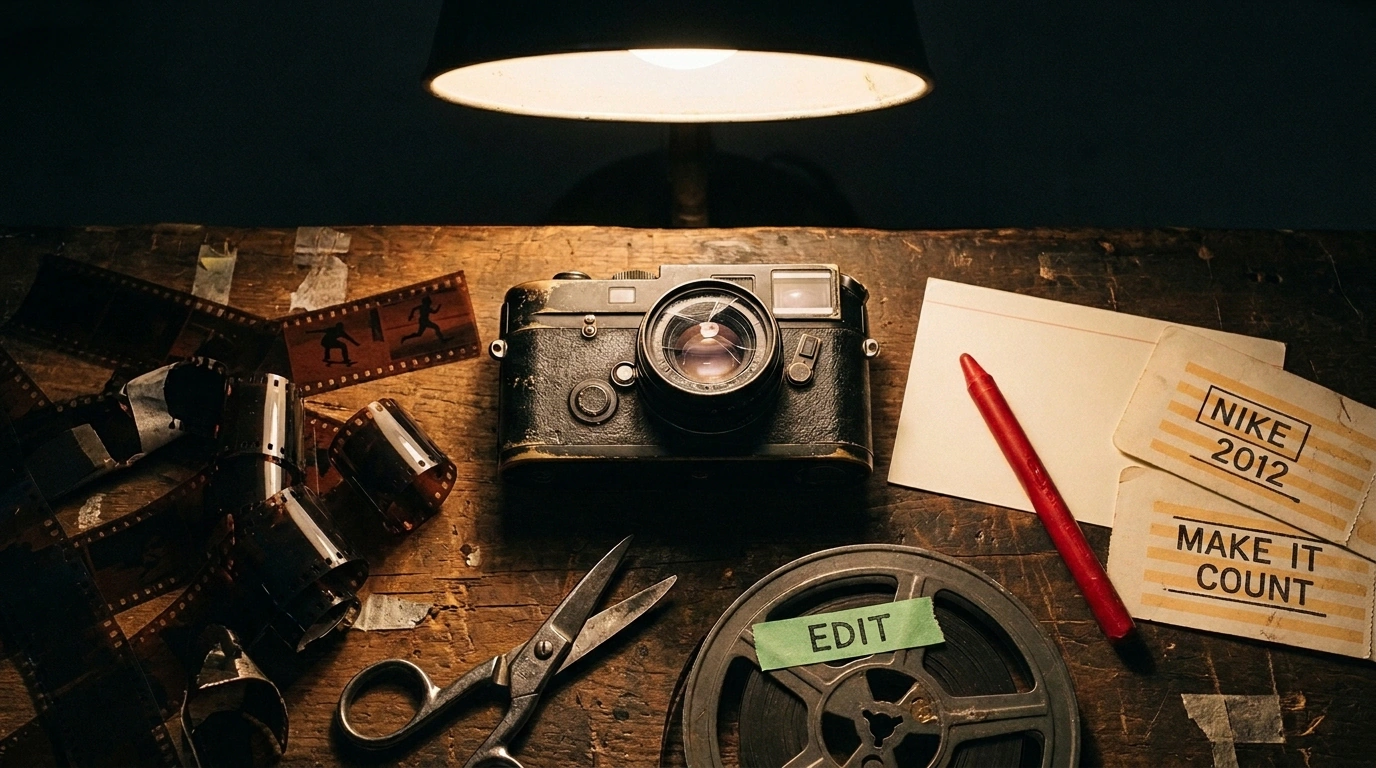
Still life of Max Joseph's director luggage with a Moleskine notebook and film camera
Even wilder than the cracked glass: the Nike FuelBand itself—the whole reason Nike paid for the trip—didn't arrive by courier before takeoff. Any agency would have rebooked flights. Neistat said they already had tickets and weren't waiting, so they flew off to shoot a gadget ad without the gadget.
For ten days they raced around the globe until the money ran out, mostly sleeping on planes. Somewhere in that sleep-deprived blur, something no creative brief could plan happened. On a bus in Africa right after Victoria Falls in Zambia, a realization hit Joseph. For years he had collected rare music, saving one 'golden' track for the finale of his future feature film. Sitting on that rattling bus, he knew: put that song in Neistat's video, and a fun travel clip turns into an emotional bomb.
He wrestled with himself, even testing decoy tracks in the edit to throw Casey off the scent. No luck. He ended up 'robbing' his own future movie for the job in front of him. Creators hit this dilemma constantly: hoarding best ideas for some 'perfect' future project leaves today's work flat. Firing your best shot right now feels scary, yet that's what breaks through indifference.
Days later on a ferry in Thailand, half-delirious from exhaustion, Joseph asked Neistat on camera if he grasped how absurd this was—nobody in history pulled stunts like this and called it work. Neistat didn't blink: right here on this boat is the work, and it's going to work. For the first time, they felt physically that filmmaking no longer required a hundred-person army. Two people could make a movie the way a writer writes a book.
The hardest part began back home. The finished video runs just 4 minutes and 37 seconds. Joseph edited it every single day for three months. Meanwhile, restless Neistat shot and dropped three or four other films solo—including The Surprise in South Africa—nearly driving his partner crazy.
Those three months forged the video's editing rhythm: a tight pulse of cuts, music, and pauses holding viewers to the last second with zero sag. Joseph talked Neistat into cutting almost all voiceover, letting footage, music, and title cards carry the story.
Then came Nike's hard deadline. After another all-nighter, nerves were frayed—if Nike rejected it, three months of life vanished. Before sending the file, Joseph went home to sleep three hours. Instead of sleeping, Neistat walked into a tattoo shop and got 'Do More' inked on his arm. That fresh shot made the final cut.
Nike's reaction was both funny and predictable. Execs loved the energy—then asked the obvious question: 'Wait, where's the FuelBand? He's not even wearing a Nike jacket, and there's no sneaker close-up!' Credit to Nike's marketers: instead of chopping up the film, they simply asked if anything could be added. So after the fact, they shot the opening unboxing scene with Life is a sport. Make it count plus a shot of Casey walking down stairs.
Big Bang of the Creator Economy: Why Honest Risk Beats Glossy Production
The video hit YouTube on April 9, 2012 and landed like a sonic boom. It spread everywhere and racked up 33 million views. Want proof of its staying power? Check the comments fourteen years later. Food creator Nick DiGiovanni (50M subscribers) admits he still rewatches it regularly. In May 2026, a viewer wrote that this exact video pushed him to quit law and start his own business.
Funny footnote for brand managers: Nike killed the FuelBand line years ago. The gadget is gone, yet the ad still builds brand love.
People call this the 'Big Bang' of the creator economy—where independent creators build personal media around their names and monetize audience attention directly without TV networks or studios. Before spring 2012, corporations viewed YouTube as an amateur bin of cat videos. After 'Make It Count', advertisers realized one guy with a cheap camera could earn reach and genuine affection millions on TV couldn't buy.
Timing helped too. In 2012, video gear was democratizing, young people devoured Tim Ferriss's The 4-Hour Workweek, and early mobile startups were booming in San Francisco. People badly wanted to believe life didn't have to mean 9-to-5 office cubicles. The film struck a cultural nerve.
Still, honesty won the day. Everything on screen genuinely happened to real people. That birthed the gold standard of native integration—advertising woven so naturally into a creator's voice and story that viewers watch by choice and send it to friends.
Comparing traditional ad shoots with how this film came together makes the contrast clear.
| Production Factor | Classic Ad Production | The 'Make It Count' Approach |
|---|---|---|
| On-set crew | Full film crew, agency, brand reps | Two people: on-camera creator and editor |
| Gear & lighting | Cinema cameras, lighting rigs, grip trucks | Two basic Canon cameras without lens caps and a cheap tripod |
| Location permits | Official permits in every country and rigid call sheets | Spontaneous street shooting with zero permits or schedule |
| Product on screen | Strict brand guidelines, logo close-ups from second one | Gadget forgotten at takeoff; unboxing shot after editing |
| Budget & time | Millions on production, rushed post-production | Catering-sized budget, paired with long, patient editing |
| Video lifespan | Hits media-plan KPIs for two weeks, then forgotten | Decades of organic views and cult status |
When twenty approvers aren't hovering on set, a creator's hands are free. Spot an interesting stranger—film them and put them in. Drop a camera—make it part of the story. Viewers feel that raw energy immediately and forgive the lack of studio gloss. Meanwhile, audiences spot fake actor enthusiasm from a mile away and skip in two seconds.
Surprisingly, Neistat and Joseph never opened an ad agency together afterward. Neistat had just split professionally from his brother and didn't want another creative marriage, while Joseph returned to LA and made another viral hit, Follow the Frog, the same way. Worse, the commercial rep firm handling Joseph eventually dropped 'Make It Count' from his reel: clients wanted the 'frontman' Casey, not the 'bass player' at the edit desk. That contrast pushed Joseph toward a harsh truth about money and time.
Time Over Budget: Attention Economics and Making Things 'Just Because'
Strip away the travel romance, and 'Make It Count' had one secret resource people rarely mention: time. Three months cutting a four-minute video. On another standout project, a doc on DFA Records, Joseph spent six months editing.
He could only afford that luxury because TV paid his bills. Hosting Catfish covered rent, keeping YouTube free for pure experimentation without chasing weekly payouts. And time is the exact thing algorithms squeeze hardest today.
In film and documentaries, you shoot briefly and spend months in the edit bay finding the pulse and cutting fat. In today's creator economy, it flips: miss uploads to do deep work, and the platform cuts your reach while sponsors walk to steadier channels.
Joseph doesn't romanticize 'big Hollywood' either. He learned firsthand when his Zac Efron movie flopped at the box office despite looking like a sure hit on paper. That bomb cured his illusions. You can't control box office or view counts. The only thing you truly control is how you spend your workday.
In traditional film and big agencies, that workday is flipped upside down.
How a Workday Is Spent: Hollywood vs. Indie YouTube
In studio systems, you spend nearly all day knocking on walls, sending emails, begging producers to read scripts, and waiting on approvals—all for a tiny window to actually shoot. On YouTube, it reverses: you call the shots and spend 90% of your day on the craft itself.
That creates the core tension haunting creators and marketers alike: where does art end and a reliable media business begin? At one end sits pure experimentation with zero commercial strings. Joseph tells a story about his friend Brandon Wade, a rare talent who drew hyper-realistic sketches, shot killer photos, and built concert visuals for the world's biggest commercial rapper. One day Wade quit showbiz for a boring data-entry job. Why? It paid rent quietly while keeping his head clear for art free of client compromises.
At the other end sits the scheduled media machine: upload every Wednesday, sponsor read in every episode, steady income. Misery starts when someone tries straddling both and hates that their weekly upload isn't a masterpiece.
While surfing together, Neistat often told Joseph: 'You're leaving money on the table.' With his charm and on-camera chops, Max could have launched a daily vlog and made millions like Casey. Yet that pace nearly broke Neistat's life—daily uploads burn out even 'cyborgs' like him. Asked why he rarely drops albums or tours, musician Frank Ocean once gave a sober answer: you just have to be okay making less money.
Out of that comes tinkering—playing freely with ideas and tools without an instant monetization plan. Joseph has a blunter name for it: doing something 'just because it feels exciting'. Once in New York, Neistat opened his studio door wearing safety goggles and holding a soldering iron, trying to make a tiny Chinese LCD screen play Star Wars. Asked 'Is this for a new video?', he looked genuinely puzzled: 'No, I just felt like it.' Joseph spent hours generating Google Veo clips the exact same way for an abstract music video nobody paid him to make.
To a CFO, that 'useless messing around' looks like wasted hours. In truth, it's the only real R&D lab in content. Breakthrough formats never hatch in quarterly content-plan meetings—they come out of side experiments.
Playing the Long Game: Rules for Creators and Brand Marketers
How do you apply this philosophy when you still have bills to pay and don't want to become a clone of the channel next door? Joseph's career and recent market shifts point to a few clear rules.
Trade frequency for depth wherever economics allow. If a channel or brand media hub drops seven forgettable clips a week for one strong piece a month, visuals, writing, and editing leap forward. Algorithms like consistency, sure, yet people remember and share rare work built with real time. Even on crowded YouTube today, weird long-form pieces still break out—Joseph's own 37-minute video essay on bookstores hit 6 million views with zero clickbait.
Stop treating YouTube like a temporary stepping stone. Film and ad folks still view online video as a rung toward 'real' TV, streaming, or big deals. Having played in all those sandboxes, Joseph says bluntly: an independent creator channel is the best place on earth to make things right now. Nowhere else offers that speed to reach viewers or that creative control.
Separate 'media' from 'art' inside one team. If you already run a channel or content desk, don't demand a masterpiece every Tuesday. Most posts are solid media keeping rhythm, answering buyer questions, and paying bills. Just stop lumping everything together—carve out space for occasional 'big swings' where you take real risks. Over time, a great producer shifts from a lone carpenter carving every joint to an orchestra conductor building a system where talented people have room to move.
Expect a boomerang effect. Bold original work outside current trends rarely pays back in week one. When you try new genres, the market needs time to read your voice. Sometimes it takes ten or fifteen years—until a new generation of creators and marketers who were blown away by your work as teens grow up to run the industry and invite you back. That's what happened with 'Make It Count': film students who watched it at their parents' dinner tables grew up to run media companies and brought its makers back to share how it happened.
For brand marketers buying creator integrations, the whole story boils down to one rule. When you hire a distinctive creator, don't force them to read a stiff script packed with five USPs and a box close-up at second three. You're buying their taste, their audience's trust, and their time. Give them freedom to tell an honest story—and people might still watch your ad long after the product itself is discontinued.
Checklist for Brands and Creators Before Launching a Native Integration
- Check why this specific creator is here: if any other influencer could swap in without losing meaning, the idea is too generic.
- Budget time for editing and polish alongside shooting: the best moments often emerge in the edit bay, not the brief.
- Strip excess approvals off the shoot: fewer controllers on set preserve the raw reactions viewers love.
- Leave room for happy accidents: don't fear real hiccups, mistakes, and honest emotion over sterile polish.
- Measure impact beyond week one: great brand content pays off long-term through shares, word of mouth, and reputation.
Use this checklist as a filter before your next shoot or RFP: if the brief leaves nothing behind except a shot list of mandatory logo close-ups, you're better off buying standard display banners and not wasting good talent.