In February 2026, nine months before Grand Theft Auto VI launched, Norwegian electronics retailer Komplett made a wild promise: any family whose baby was born on November 19 would get the new game free. Six months later in Penza, fuel-equipment factory Benza went further—officially promising staff an extra day off on launch day so people could sit down at their consoles instead of pretending to work at lathes and desks.
Sounds absurd? Not at all. That's pure attention math. While marketers argue how to beat banner blindness and lower CPC, one video game release rearranged millions of adults' schedules in 24 hours. Better yet, the sharpest campaigns around GTA 6 had zero official Rockstar Games contract and skipped lazy 'We're waiting too!' graphics. Brands baked the date, aesthetic, and player habits straight into their products, food delivery, and work calendars.
Let's unpack how a game that spent thirty years mocking ads and corporations became 2026's biggest marketing stage, which six mechanics actually drove reach and sales, and where smart homage ends and cheap hype-chasing begins.
How Ad Satire Became 2026's Biggest Marketing Stage
The whole saga started in 1997 as a fairly simple top-down 2D game. Everything flipped in 2001 when GTA III moved into a 3D open world. Instead of scripted corridors, players got a living city to follow the story or just cruise at night chasing chaos. The British Film Institute (BFI) later called GTA III a genre landmark an entire generation of studios chased.
Graphics and freedom alone don't sustain thirty years of hype, though. Rockstar brewed a rare mix: interactivity, cinematic storytelling, and sharp social satire. Inside the game, billboards, TV screens, and radio stations constantly parody real life—political spin, celebrity worship, media hype, mindless consumerism. For decades, the series mocked the exact ad tricks big corporations use today.
That cultural weight built massive brand equity. Per YouTube Culture & Trends, franchise videos topped 900 billion views, and GTA V hasn't left YouTube's top-10 most-watched games once since 2013. Publisher Take-Two Interactive reports over 475 million total copies sold across the series, more than 230 million from GTA V alone.
In Russia, nostalgia added another layer. In a 2022 VK Play poll, one in four respondents called GTA their childhood favorite, and a year later GTA V topped MTS Bank's favorite-games ranking at 24%. From 2013 to 2024, M.Video-Eldorado sold 482,000 physical discs—beaten only by FIFA. Even 11 years post-launch, GTA V stayed on PS4/PS5 disc charts. And an old bootleg translation gifted the Russian internet the immortal word 'Potracheno' ('Wasted'), understood even by people who've never touched a controller.
So when GTA VI finally dropped on November 19, 2026 after a 13-year wait, the market shook. Headlines covered its record $3.79B opening day (including pre-orders—Sensor Tower counted 14.94 million worth ~$1.45B three days prior; GTA V took three days to hit its first billion). For marketers, live viewer behavior on night one was even wilder.
Circana measured 56% of active Xbox users worldwide and 61% of US PS5 owners booting the game on launch day, with average sessions stretching past eight hours. Twitch peaked at 3.31 million concurrent viewers—breaking Valorant's old record by over 4.5x, per Streams Charts. Even adjacent industries felt the drain: an hour after launch, US Pornhub traffic dipped 15.5%.
Here lies the core lesson for any business. A brand hits peak power when audiences invent their own rituals around it. As branding agency A.LAB notes, Rockstar merely gave the excuse—fans turned the date into a personal holiday, throwing farewell parties for the old city, marathoning past games, and messaging building chats for quiet hours.
One ad flight can't buy that devotion. It compounds over years of great product, kept promises, and rare, surgical media moments. Even the right to delay a release has to be earned: silence alone doesn't build hype—who stays silent and what people expect from them does.
Official Grand Theft Auto VI poster featuring the lead characters against neon Vice City (Source: Rockstar Games)
How Rockstar Brought Vice City to Real Streets Before Launch
Rockstar's own rollout is a textbook on heating demand for years without burning out fans. The studio dripped out drops, turning each into a standalone media event.
Trailer one landed in December 2023 and passed 93 million YouTube views in 24 hours. Trailer two arrived in May 2025 to keep the pulse alive. In August 2026, a 27-minute gameplay preview hit Netflix, drawing 31.1 million views in four days. Finally, the official PS5 Launch Trailer dropped October 15, 2026—pulling double duty as both game reveal and premiere of Justice's track 'Flower in a Hurricane' featuring Tame Impala, SZA, and King Gizzard & The Lizard Wizard.
In launch year, Rockstar raised the stakes by pulling fictional Vice City off screens onto real streets. A global outdoor campaign with neon art, murals, and wrapped buses rolled across the US, Europe, Australia, Hong Kong, and Tokyo.
Major partners got distinct roles instead of boring corner logos:
- Spotify ran billboards in New York, LA, and Miami, then dropped the official game playlist.
- YouTube announced a 24-hour launch-day livestream with creators and gameplay.
- London department store Selfridges opened a pop-up with apparel, merch, and a real car rebuilt as the iconic Grotti sports car.
The climax hit Miami itself—the real city Vice City is based on. Miami-Dade County and Rockstar launched a $3.9M official campaign. Huge 'Welcome to Vice City' lettering topped Kaseya Center, ads lined the port and airport, and at a Miami Heat theme night, fictional burger joints Burger Shot and Cluckin' Bell opened as real food stands.
The bonfire's glow reached bystanders too. Nike and Travis Scott dropped custom Air Force sneakers. Russian rapper Big Baby Tape teased his track 'Nike' in front of Rockstar posters—sending fans dissecting pixels behind him to bet whether he made the GTA VI soundtrack.
Neon facade of the Colony Hotel on Ocean Drive in Miami Beach — one of Vice City's real architectural inspirations (Source: Wikimedia Commons)
Six Working Mechanics: Riding a Mega-Release Without a License
Obviously, few brands have $3.9M for a Rockstar deal—especially in Russia, where Take-Two halted official sales in 2022. Yet practice proved that strong brand activations (interactive projects pulling customers into action around your brand) rarely require a license.
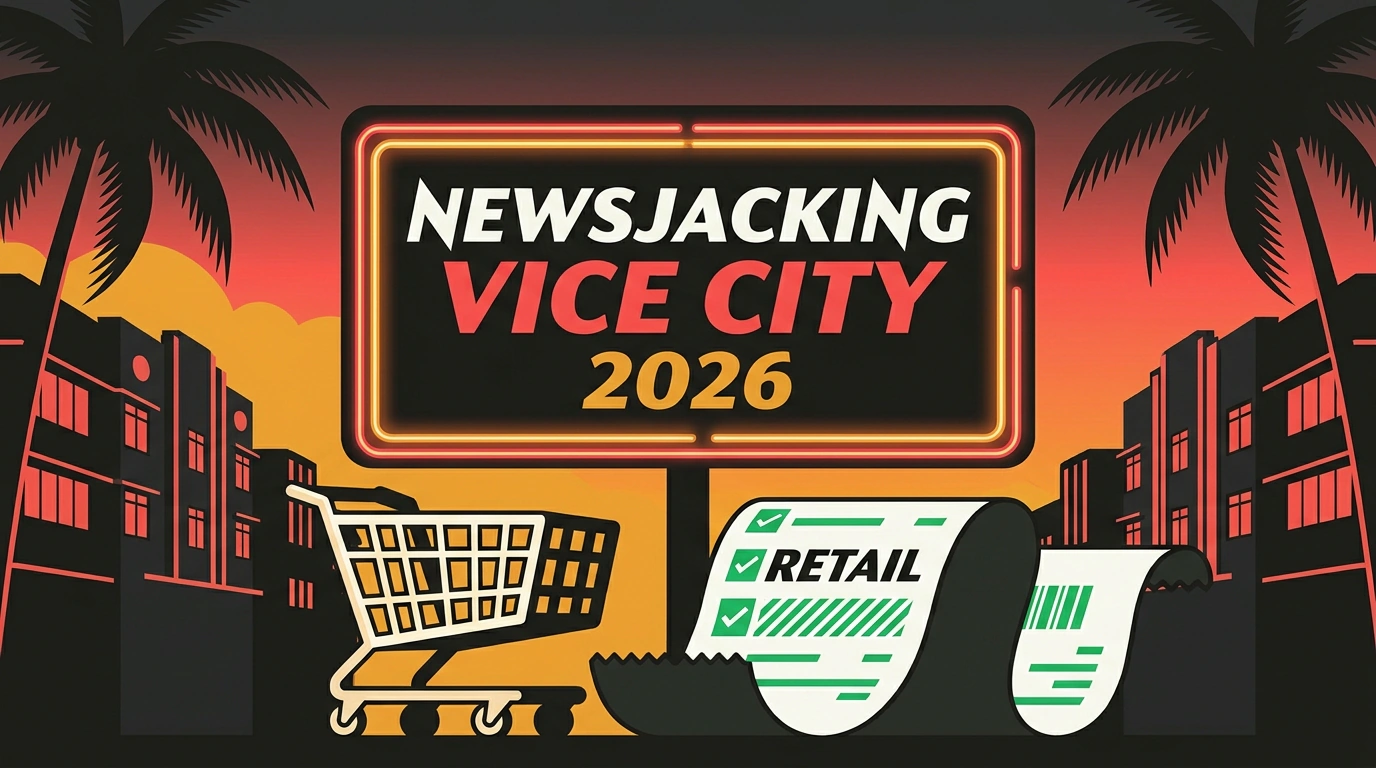
Enter newsjacking—plugging your brand quickly into a massive external news hook to capture organic attention. Rookies usually slap pink-and-teal gradients on a post, write 'Happy Launch Day!', and wonder why only 12 coworkers liked it. That graphic connects neither to their product nor to a player's actual evening.
Agency Goose Gaming analyzed GTA 6 campaigns and distilled six repeatable mechanics. Best of all, none are tied to Vice City—you can adapt every one to the next huge game, movie, or sports event.
Poster graphic of six newsjacking mechanics around a mega-release in neon Vice City style
1. Hijack a format fans already share. Over 13 years of waiting, GTA fans memorized dozens of memes and templates—#1 being endless pre-launch 'leaks'. Burger King played straight into that reflex, framing a Whopper ad as another leaked GTA clip. The joke landed in one second with zero explanation. M.Video tapped street racing: mascots M.V and Vidik raced toward its 10.10 sale, tying the plot to an actual commercial message that big discounts started earlier than November. 2GIS baked the vibe right into its maps app with a 'Neon City' layer: palm trees instead of regular trees, sunset lighting, and a biker cursor in a Hawaiian shirt. Users checking their commute got an instant smile.
2. Turn the reference into a purchase mechanic. For retail and food, the smartest play links the game to what people actually buy on launch night. Pyaterochka Cafe flipped the 'Potracheno' meme into 'Nothing Wasted' ('Lishnego ne potracheno'). Buying ready meals or playing mini-games earned stars for giveaways, while shelves stocked a special 'Cheat Box' with a burger, fries, and nuggets. Zero stretch: ready dinner saves an hour in the kitchen you'd rather spend holding a controller. Popeyes ran the exact same play in the US with a limited 'Spice City' sandwich.
3. Drop the game into an event already on your calendar. Miami Heat's November 18 'A Night in Vice City' game against the Milwaukee Bucks worked so well because the club didn't invent an event from scratch. The game was already scheduled; fans already bought tickets. Adding custom jerseys, arena visuals, and halftime shows turned a regular-season matchup into a media moment. Any coffee shop, barbershop, or industry conference can take a routine touchpoint and restyle it for one night.
4. Make the date itself the hook. When millions circle one Thursday in red marker, the date becomes a magnet. Benza's factory gave fans November 19 off. Palworld studio Pocketpair went bolder, declaring an 'urgent five-day business trip to Vice City' for staff. And Norway's Komplett—promising free copies to babies born November 19—won the longest PR tail of all, generating buzz nine months before launch.
5. Remove friction players already face. Arguably the cleanest marketing mechanic of all. Before a huge release, buyers face practical hurdles: where to buy, how to pay, will my hardware run it? MTS Pay solved hurdle one—letting Russians pre-order with local cards and adding a November 12 buyer raffle. Xbox solved hurdle two with cloud streaming so even old Xbox One owners could play. Solve a real headache, and your brand belongs to the premiere without forcing jokes.
6. Pack a gift for night one. Every big launch comes with a home ritual: clear chores, stock snacks, lock the door. Sber built HR merch boxes with a tee, bandana, thumbstick caps, and a 'On a Mission' door hanger. An unboxing video let an employee spotlight Sber's internal gaming club—selling employer brand far warmer than a dry job post. Rockstar sent Miami Heat players custom PS5 Pros inside RIMOWA suitcases they'll keep using for years. Xbox pushed collectibles to the limit: engineers built a working Series X-BITE inside a 1.5-meter realistic alligator chewing a controller and raffled off the sole unit. Yandex Taxi tucked a digital gift into daily rides—adding game-style car skins and turning trip-rating stars into wanted stars.
| Playbook Mechanic | Customer / Employee Action | Real GTA 6 Examples | When It Hits Hardest |
|---|---|---|---|
| Hijack a fan format | Spots familiar meme/scene in feed or UI | Burger King, M.Video, 2GIS ('Neon City') | Fast reach and organic shares |
| Reference as purchase hook | Buys themed bundle or collects order points | Pyaterochka Cafe ('Cheat Box'), Popeyes ('Spice City') | Retail, food delivery, snacks & drinks |
| Embed into existing event | Attends routine event in fresh theme | Miami Heat ('A Night in Vice City') | Brands with existing foot traffic & schedules |
| Use the date as the hook | Gets day off, leave, or date-matched prize | Benza factory, Pocketpair, Komplett | Big PR splash and employer branding |
| Remove player friction | Pays, launches, or watches faster | MTS Pay, Xbox (Cloud on Xbox One) | Fintech, payment tools, ISPs & hardware |
| Night-one gift | Gets merch, collectible, or in-app skin | Sber, RIMOWA × PS5 Pro, Xbox Series X-BITE, Yandex Taxi | Viral PR, creator seeding & team engagement |
Notice what every row shares. Not a single brand tried freeloading off someone else's hype for a vanity badge. Each answered 'what does a person get right now?'—saved kitchen time, easy payment, a free Thursday, or a grin in their GPS.
The Russian Paradox and Global Plays: Why Local Engagement Surged
You'd think Take-Two halting official sales in Russia would mute the wave. The exact opposite happened. Demand for everything launch-related spiked long before November 19—and platform data traces buyers gearing up step by step.
Demand Spike Around GTA VI Launch in Russia
The chart shows a classic warm-up chain: in early November, shoppers bought PS5 consoles vs. October, topped up PlayStation Network wallets sharply, and stormed retail shelves on launch day.
Creative agency Re:evolution points to an interesting psychological twist. Culturally, GTA sits alongside Star Wars and Marvel. Being cut off from global releases actually multiplied local impact: Russian gamers felt genuinely touched that local brands remembered them and spoke their language.
Companies nobody expected gaming jokes from jumped in. Developer Brusnika beamed a live GTA stream onto a downtown skyscraper facade in Yekaterinburg. Delivery app Samokat put Vice City palettes on street billboards. Online school Skyeng hosted a global stream uniting players from different countries. Geo-app Blink launched a limited 'Potracheno' map skin with neon clubs, 3D buildings, and Easter eggs. Yandex hid a police-chase mini-game right inside Search. And e-scooter service Urent first joked about purple scooters hitting Vice City streets, then teamed up with tech-rental service BeriBeru on a city quest: find a virtual console to win a discount on renting a real one.
Globally, brands leaned on two other strong chords: grown-up nostalgia and skipping work. BMW showed how its lineup evolved across the 13 years since GTA V. DHL turned routine courier shifts into an in-game mission. IKEA Hong Kong sold gaming furniture with a sharp insight: teens who skipped school for GTA grew up—now they take PTO and want a proper chair.
KFC Australia, with We Are Social and Ogilvy PR, went furthest on 'skipping work legally'—staging a mock funeral for a fictional character to give players a tongue-in-cheek excuse for taking off. Dutch police flipped the game's crime code completely: their 'Wanted. Colleagues.' recruiting campaign turned iconic wanted stars into a hiring tool.
Don't overlook the HR payoff of days off and merch boxes either. Giving staff a free day for a huge premiere—like Benza or Pocketpair—often wins deeper loyalty than a pricey corporate party. Parties impose management's idea of fun; a launch day off proves you actually hear what your team cares about.
Where Clever Homage Ends and Risk Begins
Seeing a party like this makes marketing teams itchy to jump on the next hype wave at any cost. That's how mistakes happen. GTA 6 exposed three traps brands keep walking into.
Trap one: confusing homage with copyright infringement. Official partnerships and situational stunts sit on opposite sides of a sharp legal line. Miami-Dade, Miami Heat, and Selfridges paid and signed deals with Rockstar—so they used real logos, fictional store names, and official art. Everyone else stayed on homage turf: creative nods to a shared cultural code without copying trademarks or publisher graphics. Palm trees, pink-and-teal neon, Hawaiian shirts, November 19, wanted stars, and 'Potracheno' belong to nobody. The second a designer drags an official game logo or clips protagonists from a trailer onto an ad, a harmless nod becomes a legal liability.
Trap two: missing your audience and tone. Re:evolution noticed something telling: even though GTA mocks corporate culture endlessly, few brand stunts showed real self-irony. Brands need to steer clear of crime glorification and deliver fan service—subtle details and jokes proving the team actually held a controller instead of grabbing the first retro font off Google.
Brusnika puts it plainly: people are exhausted by sterile corporate speak and gravitate toward brands that feel human and can laugh at themselves. Real estate is about people, so ignoring a moment tens of thousands of buyers talk about would be odd. Still, GTA is an ironic adult universe. It fits food delivery, retail, banks, housing, and transit naturally—while pushing baby food or maternity gear through it would look ridiculous.
Trap three: panicking over social-media noise and missing real buyers. Even a smash hit like GTA 6 sparked an online storm. Rockstar didn't stop at pretty graphics; it tightened world rules—police remember faces and cars, bystanders react sharply to weapons, and stealing rides or guns got harder. Plus, for the first time, the story centers on a romantic couple: Jason Duval and Lucia Caminos. Narrative VP Rupert Humphries cited Bonnie and Clyde, The Getaway, Thelma & Louise, and True Romance—noting players can keep them strictly partners in crime if they choose.
Still, social feeds erupted. Some streamers and manosphere accounts attacked Jason as a 'simp' for caring about his partner and hated grounded errands over pure chaos. Meanwhile, outlets like The Guardian praised the relationship depth, while Ars Technica debated whether parts of the social satire felt dated.
Analytics platform Kimola scanned 1,850 Reddit, YouTube, and X comments from November 8–19 and found a sharp split.
Split in Social Media Sentiment on GTA VI (Kimola Analysis)
The chart says it all: the living, detailed world wowed most commenters, while tighter freedom annoyed many—splitting overall feed tone almost 50/50.
Review aggregators looked even wilder. By November 24, Metacritic critics gave it 99/100 while user scores sank to 5.7/10 due to review bombing—coordinated zero-star waves from people who often hadn't played. Meanwhile on PlayStation Store, where only verified buyers can vote, the rating hit 4.8 out of 5.
There's a priceless filter here for marketers. Before pulling a stunt over angry comments around a big cultural release, check who is yelling. Internet outrage holds a loud megaphone, yet paying customers ring the register—and their mood often runs completely opposite to feed drama.
Checklist: Prepping for the Next Mega-Release
Most situational stunts flop because teams scramble the night before. Once a game, show, or movie drops and marketing calls an emergency 'make a meme!' meeting, the train has left. Norway's Komplett locked its idea nine months out; MTS Pay launched its raffle a week early; Pyaterochka stocked physical Cheat Boxes ahead of launch.
Major game and movie calendars are public at least six months ahead. Run these six prep steps early so you catch the wave instead of chasing taillights.
Six Steps to Prep Your Brand for the Next Mega-Release
- For posts or videos, pick a fan meme, phrase, or format early and tie it to one clear message about your product.
- For promos, design the post-click action: something concrete to do right now—play a mini-game, collect points, or order a themed bundle.
- Scan your offline calendar: take a regular event customers already attend and restyle its details around the premiere.
- For PR, look at how fans spend launch day itself—sometimes a whole story starts with one free Thursday or honest day off.
- Spot one real friction point around launch: if your service helps people buy, play, deliver, or watch together easier, make that utility the hero.
- Build a night-one gift or collector's edition of your product for staff, creators, or buyer giveaways.
Don't try forcing all six at once—pick one or two moves that honestly fit your product and unit economics. When your team knows months ahead what customers will be doing on premiere night, even a modest budget earns sponsor-sized reach.