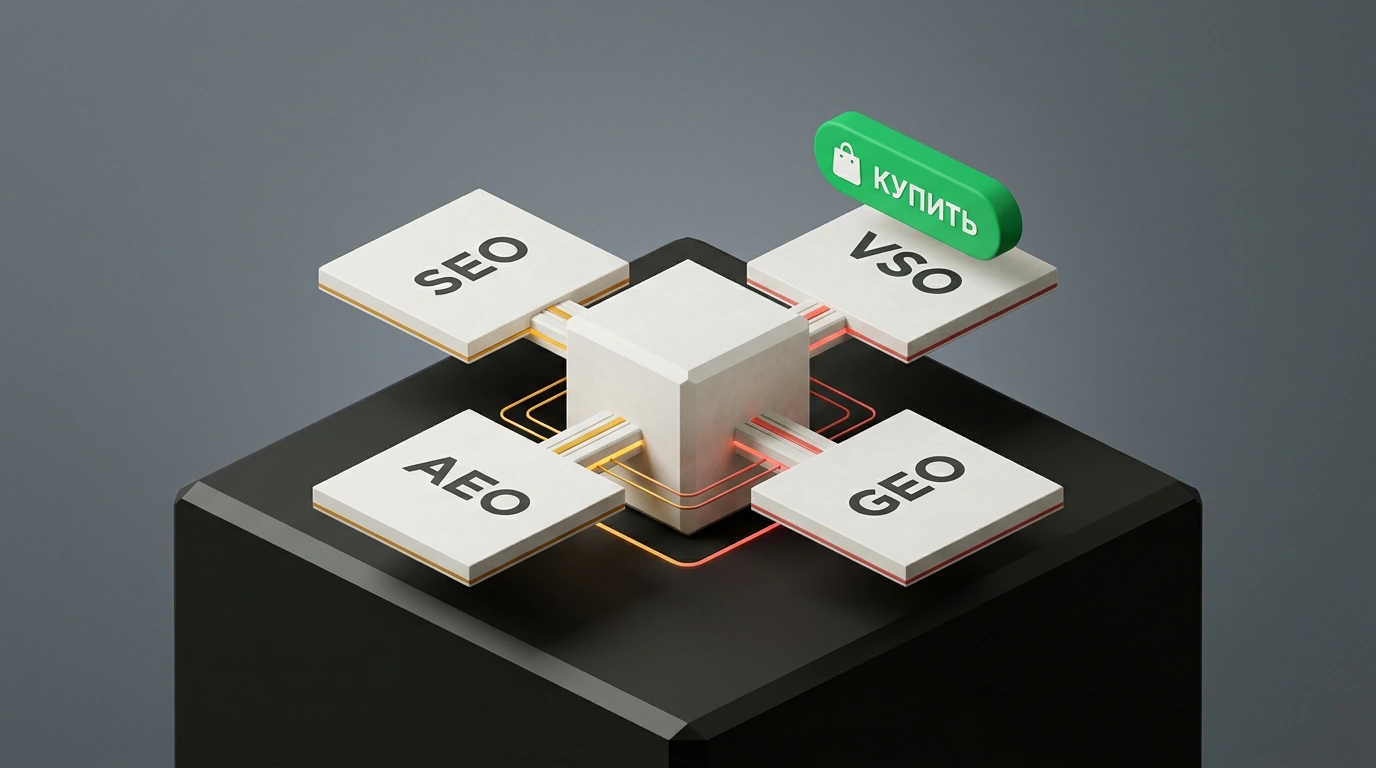
Yesterday, one word—SEO—was enough to win search traffic. Today, AEO, GEO, VSO, and agentic commerce fly at you from every angle. Your first instinct makes sense: time to hire four separate specialists and rebuild your site for every AI model.
In reality, that just burns budget. All these shiny acronyms rest on the exact same classic search foundation. Still, don't relax—the finish line really has moved. Buyers increasingly grab answers straight inside search results, and major platforms now embed checkout right inside AI chats so customers buy without ever opening your website. Let's separate real shifts from old basics in new wrapping.
SEO, AEO, GEO, and VSO: Four Labels on One Foundation
All four acronyms describe different spots where buyers meet your content. SEO (Search Engine Optimization) targets classic rankings in Google, Yandex, or Bing. AEO (Answer Engine Optimization) targets direct answer boxes: featured snippets, 'People Also Ask', and short AI summaries. GEO (Generative Engine Optimization) helps ChatGPT, Claude, Perplexity, and AI search overviews understand your material and cite your brand. VSO (Voice Search Optimization) tunes copy for voice queries on phones, smart speakers, and cars.
| Approach | Core Goal | Where Users See It | How to Measure Results |
|---|---|---|---|
| SEO | Rank pages in organic search | Classic Google, Yandex, Bing results | Impressions, clicks, rankings in Google Search Console |
| AEO | Deliver a direct answer | Featured snippets, question boxes, AI blurbs | Pages appearing in snippets and answer blocks |
| GEO | Enter AI synthesis | ChatGPT, Claude, Perplexity, AI Overviews & AI Mode | Regular checks of AI answers on target topics |
| VSO | Read aloud naturally | Smartphones, smart speakers, car assistants | Mobile speed, accurate map listings, question queries |
All four share one foundation: fast mobile loading, logical H1–H3 headings, verified facts, and clear answers to real buyer questions. Without that base, AI models and answer boxes won't see you at all—they pull from the exact same crawlable, well-indexed pages.
The differences sit in packaging. For AEO, put the question in a subheading and answer directly in the first two sentences before diving into details. Quick test: pull that paragraph out of the article—if it makes total sense on its own, it's snippet-ready.
For GEO, clarity and trust win. Language models get confused when your site uses one company name while directories list another. Spell out terms, cite primary sources for numbers, list experienced authors, show fresh update dates, and add Schema.org markup. Test your page with one question: can an AI summarize the main point accurately in two sentences? If not, write more directly.
For VSO, natural speech rules. People type 'best coffee shop near me', yet ask aloud: 'Which good coffee shop is open near me right now?' Short conversational answers to who, what, where, when, why, and how win here—alongside spotless local listings where your name, address, phone, and hours match across every map.
Ahrefs AI assistant interface for analyzing competitors and search data (Source: ahrefs.com)
In practice, five common mistakes wreck search growth: running four disconnected strategies instead of one process, stuffing pages with keywords for bots, publishing raw unverified AI drafts, expecting guaranteed AI citations, and ignoring page speed and freshness.
Attention Scarcity and Ahrefs' Bet on Autonomous Agents
While marketers debate acronyms, a far sharper shift hit distribution. Look at Product Hunt—the global showcase for new software. For years, 30,000–40,000 products launched annually, and between 2020 and 2023, 25% to 41% made the daily featured feed in front of millions.
In 2025, tools like Claude Code and Codex arrived, letting anyone build working software from text prompts. Launches nearly doubled. In 2026, Product Hunt is pacing toward ~228,000 products—over 5x higher than 2023—while the share getting featured crashed to 3.3%.
Building a product, website, or hundred articles just got cheap. Getting anyone to notice got brutally hard. That explains Sam Oh's move: after nearly 9 years, 290 videos, and 34 million views on AhrefsTV, he stepped back as host to lead marketing at Letaido, an autonomous AI agent platform built by the Ahrefs team.
Their bet rests on a split described by OpenAI co-founder Andrej Karpathy: roughly 75% of people globally have barely touched AI, about 20% use free ChatGPT as a slightly smarter search box, and only ~0.2% build real agent workflows compressing months of grunt work into one run. Early in the web era, companies built basic phone-number brochure sites too—until a few rebuilt how work actually got done.
Ahrefs is betting on three predictions:
- Marketers become system builders. Agents handle keyword research, page audits, drafts, and monitoring, leaving taste, audience insight, and priorities to humans.
- Demand for strong marketers will rise. When rivals clone your product in an evening, distribution becomes the true bottleneck.
- Teams with the best agent systems will win—even against rivals with massive budgets.
Letaido is already testing this in its 'Employee of the Month' project. They spun up an autonomous 'Head of Organic SEO' agent on a test site with access to Ahrefs, Google Search Console, Slack, and Hunter. The agent built the site, mapped content strategy, wrote articles, wired internal links, tracked rivals, updated pages from Search Console data, and even won backlinks via email outreach.
Shift from chatbots to autonomous AI marketing agents in the Letaido platform by Ahrefs (Source: letaido.com)
That agent runs autonomously for $20–25 a day in tokens, checking in with a human manager once a week for course corrections. The tech is still early, yet the unit economics of an automated workflow are already clear.
The 'Buy' Button Inside Chat: Shopify Opens the Door, Amazon Locks It
In e-commerce, AI moved past answers straight to the register. Agentic Commerce lets an AI assistant pick a product and complete payment inside the chat without visiting your store's website.
Google is rolling out in-chat checkout inside Google AI Mode and Gemini for eligible US Shopify stores. Meanwhile, Meta launched shopping assistant Muse with built-in Shopify checkout via Shop Pay. Legally, your store remains the Merchant of Record and keeps the revenue—yet Shopify enables this by default. Owners may not even realize their catalog is already selling inside someone else's chat.
The market split cleanly down the middle. Shopify, Google, and Meta opened catalogs to AI bots to grow GMV. Amazon did the exact opposite and blocked Meta Muse: sending the assistant to Amazon triggers a policy violation warning. The giant is protecting its ad business and direct customer relationship.
When shoppers buy without visiting your site, you lose three vital levers: upsell blocks ('add to your order'), email signup forms, and standard web analytics pixels that simply never see the sale.
On Shopify, go to Sales channels → Agentic, toggle off Allow Shopify to manage for me, select Google AI Mode and Gemini, and decide consciously whether to keep direct chat checkout on. If you keep it, sync your Google Merchant Center feed with your site (prices and return rules must match) and track AI-chat orders on the Agentic tab. Google is already opening early access for other store platforms too. Even in regions where direct chat checkout isn't live yet, clean product feeds and Schema.org markup already drive AI search visibility today.
How to Prep Your Site and Product Data for Both Searches at Once
Instead of splitting effort across traditional search, AI answers, and agentic storefronts, run your key pages and catalog through one unified checklist.
Unified Page and Catalog Check for Search and AI
- Gather real customer questions from search autocomplete, 'People Also Ask', support chats, and comments.
- Put the core question in a subheading and give a direct answer in the first 1–2 sentences.
- Read that answer aloud on its own: it must sound natural and make sense without the rest of the post.
- Add an FAQ block plus Schema.org markup for articles, products, prices, and reviews.
- Credit an author with real credentials, link primary data sources, and show a fresh update date.
- Standardize your name, address, phone, and hours across your site, maps, and directories.
- Verify mobile speed, clean indexing, and working links.
- For stores: sync prices, stock, and return terms across product feeds (Google Merchant Center and local feeds) and review AI sales channel settings.
From there, stick to steady monitoring: track rankings and clicks in Google Search Console, spot-check snippets and AI answers manually on core queries, and measure real visits, leads, and orders—tagging sales from AI chats separately.