While someone watches an ad spot, their brain stages a silent drama in seconds. Eyes snag on corner motion, attention drops at second four, and by the time your logo appears, they're staring elsewhere. Put that same person in a focus group, and they'll smile politely and call the ad 'nice and clear'.
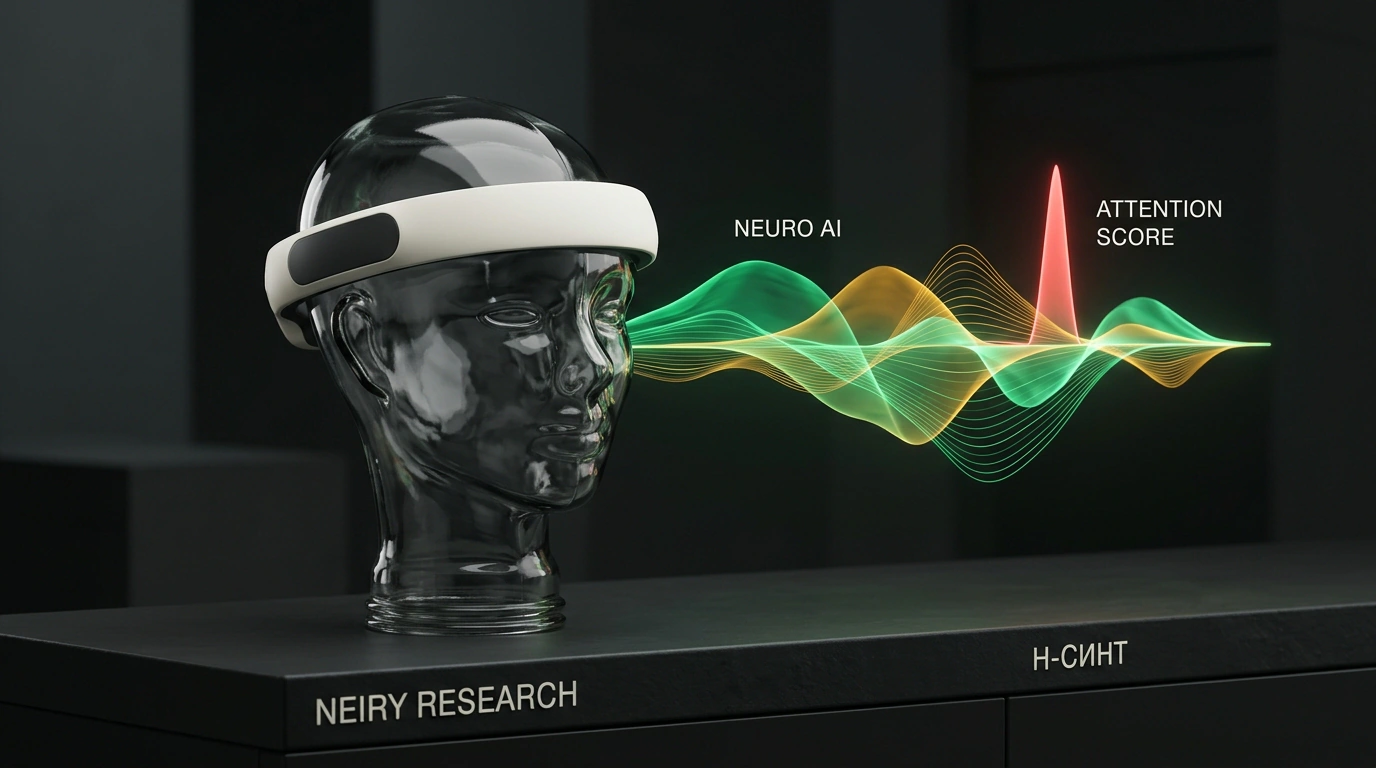
To capture honest reactions, marketers turn to neuromarketing—EEG headsets and eye-tracking cameras following pupil movement. It's accurate yet slow and pricey: recruiting target audiences, calibrating sensors, and decoding signals usually wait until a finished cut is ready. Neiry Research (part of the Neiry group) moved pre-testing online with an AI tool called 'N-Sint'.
Where the Data Came From and What the Model Scores
The algorithm wasn't trained from scratch. Neiry has built neuro-interfaces (EEG headbands and attention trackers) for over 10 years and holds a majority stake in neuromarketing firm Neurotrend. That built a library of brain-wave tests across 3,000+ ads of varied lengths measuring four signals: attention, interest, emotion, and memorability.
From that dataset, engineers and neurophysiologists built a synthetic respondent—a digital viewer model simulating how a chosen demographic reacts. One subtle detail: while trained on four neuro-metrics, reports score three—interest, attention, and emotional engagement.
Neiry Research reports a 0.77 correlation between predicted emotions and live human respondents as training continues, claiming 80%+ accuracy on attention spikes and gaze paths comparable to real eye-tracking. With no independent audits or public pricing at its late-November 2026 launch, treat those figures strictly as developer claims for now.
Testing a Video or Banner Before Buying Traffic
The workflow is simple. Pick your viewer demographics and upload a creative: a static image or any ad video up to 10 minutes—finished cuts, AI clips, or animatics (rough animated storyboards with audio tested before expensive shoots).
Visuals and audio are processed separately. The system parses speech, brand mentions, music, and sound traits, combining them into a predicted reaction. Output includes a heatmap over your video or banner plus a PDF report tracking emotional curves and key scenes—handy for comparing three rough edits without endless chat debates over where viewers tune out.
Where AI Magic Ends and Live Traffic Begins
Testing drafts against ten years of EEG data and fixing two frames before buying ads sounds dreamy. Reality is more grounded—and the creators say so themselves.
Neiry Research CEO Valeria Raevskaya notes directly that synthetic respondents don't replace full lab research for deep diagnostics; they help weed out weak drafts fast so you enter production with stronger concepts. COO Rustam Rzaev adds that no single gold standard exists for human perception—every method stays probabilistic.
There's a second limit too. Neural models track physiology—where eyes move and when emotions spike. High engagement alone doesn't guarantee clicks or sales: a spot can hold attention brilliantly and still bomb on CPA and ROAS due to a weak offer or broken landing page. 'N-Sint' saves money on storyboards and editing, yet your creative's real final exam stays an A/B test on live traffic.