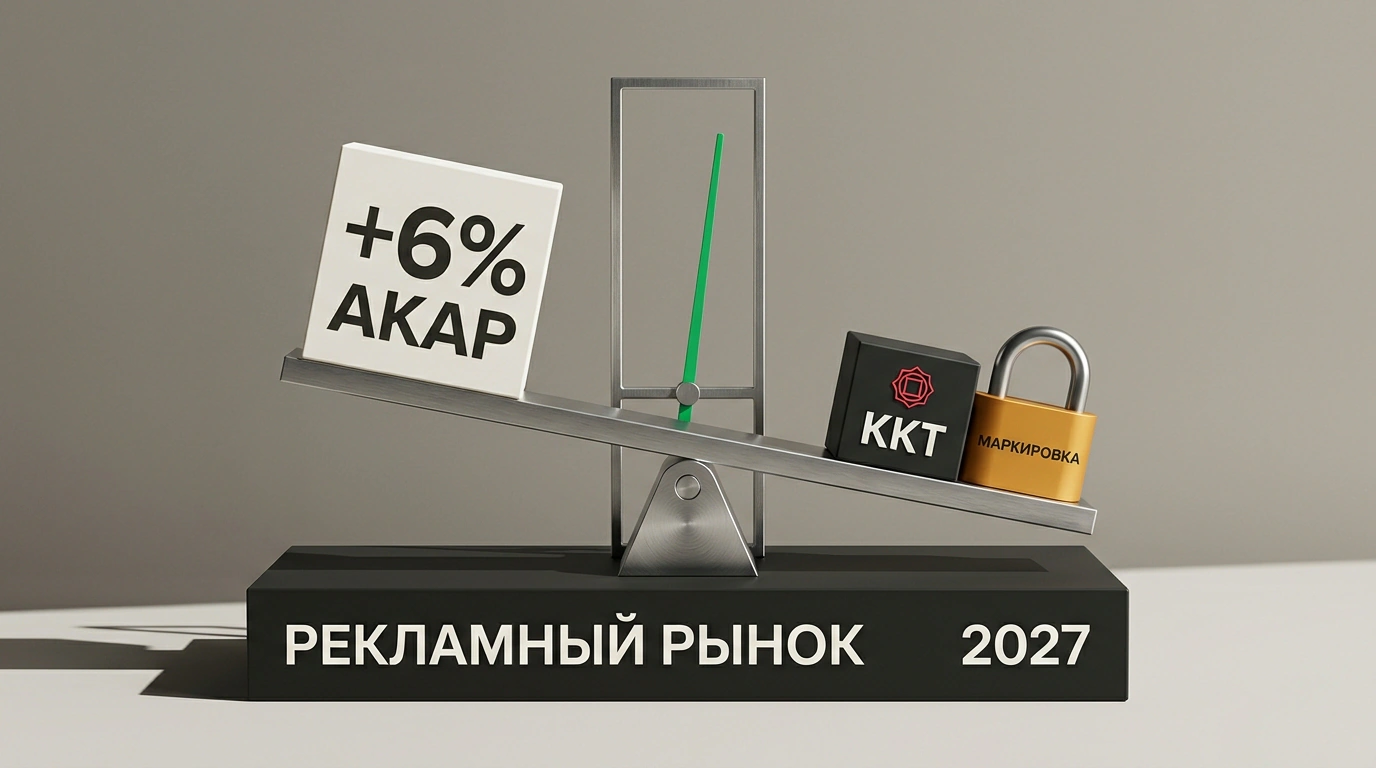
Planning next year's budget feels like a one-evening job: open last year's sheet, add inflation, hit send. In reality, plans are breaking before January. Ad growth is cooling, regulators are closing cash-register and cold-call loopholes, and big players are pulling media buying in-house. Here are four shifts rewriting marketing and online sales rules for 2027.
AKAR: Russian Ad Market Grew 6% in 9M 2026 to 720–725 Billion Rubles
The Association of Communication Agencies of Russia (AKAR) valued the January–September 2026 ad market at 720–725 billion rubles ex-VAT. After a sharp surge two years ago, growth cooled—which AKAR's expert council links to broader economic slowdown.
Russian Ad Market 9-Month YoY Growth Rates
The market no longer grows on inertia, and wide gaps hide behind that headline plus. Internet services led at 391.5–393.5B rubles (+9%). Out-of-home (OOH—billboards, screens, transit) also added 9% to 85–86B rubles (including 72.6–73.4B in classic outdoor). Video ads rose 3% to 213–215B. Legacy media shrank: audio slipped 4% to 16.9–17.1B (radio 16.3–16.5B), while publishers fell 5% to 15.4–15.6B (print down 14% to 2–2.1B, digital down 4% to 13.4–13.5B).
Outside Moscow, five measured regional segments shrank 3% to ~90B rubles. AKAR VP Sergey Veselov notes sharp divergence: online video and digital OOH (DOOH) grow while neighboring formats drop double digits. Money pools into digital and DOOH, making regional bidding mistakes hurt margins even harder.
Online Retail Cash-Register Registry: Site Blocking Starts June 1, 2027
If you take payments on your own website and keep putting off receipt compliance, time's up. The State Duma passed amendments to Bill No. 619-9 tightening control over KKT (online cash registers transmitting receipts to the tax service). Once signed, a strict calendar kicks in.
| Effective Date | Legal Change |
|---|---|
| February 1, 2027 | FTS launches online-retail KKT violator registry |
| March 1, 2027 | Mass-retail venue operators must verify tenant cash registers |
| June 1, 2027 | Violators banned from posting offers; own websites face blocking |
| By January 1, 2028 | Banks verify taxpayer IDs (INNs) of existing individuals (new ones from 2027) |
Firms and sole proprietors hit the FTS blacklist after three or more annual violations without a registered cash register—or errors across at least a fifth of registers (min three cases)—exiting only after 90 clean days. The scope is clear: site blocks hit own websites only, sparing sales via third-party marketplaces and classifieds.
Offline, venues leasing stalls to 10+ sellers across 3,000+ sq m must block tenants lacking KKT or listed in the registry. FTS will also flag shell-like accounts to the Central Bank, which shares high-risk lists with the Treasury, FTS, and Customs. Audit your cloud checkout now—losing your domain mid-season costs far more than fixing receipts.
FAS Rules Carrier Blocking of Unlabeled Calls Legal
Sales teams hoped Russia's Federal Antimonopoly Service (FAS) would strike down paid call labeling, yet that door slammed shut. Since September 1, 2025, companies must display their legal name or call category on recipients' screens. The National Financial Market Council (representing 90+ banks) asked FAS to probe VimpelCom, MegaFon, MTS, and T2 Mobile for threatening to block unlabeled calls. On November 10, 2026, FAS sided with carriers: the Telecom Law and government decrees let operators suspend non-compliant traffic.
Pricing and ROI tell an interesting story. Carriers initially asked 30 kopecks per call attempt before talks with banks pushed unlimited plans under 25 kopecks. Council head Andrey Emelin estimates banks face at least 3.5B rubles annually in new costs—passed along to clinics, service firms, and eventually consumer prices.
Yet labeling helps funnels too. Novofon data shows labeled calls get answered 80–85% of the time versus 40–50% for anonymous numbers. Seeing the company where they left a request stops buyers from rejecting calls as spam. Skimping on caller ID hurts twice: carriers legally cut your line, and you lose half your leads before 'hello'.
T-Bank Builds One In-House Media Buying Hub for T-Technologies Group
When markets slow and contacts get pricier, big brands pull ad buying under one roof. T-Bank created a unified media-buying and planning center covering all T-Technologies Group verticals. Media buying means bulk-purchasing TV, digital, outdoor, and special-project inventory at better rates. Inside Dmitry Paramonov's growth department, Ksenia Dyubanova became director while Veronika Markina leads media buying and special projects.
The hub unites media planning, inventory buying, campaign standards, and end-to-end analytics—focusing on direct publisher and agency deals for sharper pricing and custom formats. Every media plan ties to a business goal, linking spend directly to contact quality and payback.
Small businesses shouldn't copy that headcount—in-house buying desks only pay off at multi-million budgets across dozens of products. Yet the core rule scales down cleanly: when separate vendors run search, social, and seeding with no shared payback sheet, channels burn cash silently. Even one marketer can pull numbers into one summary and track blended customer acquisition cost.