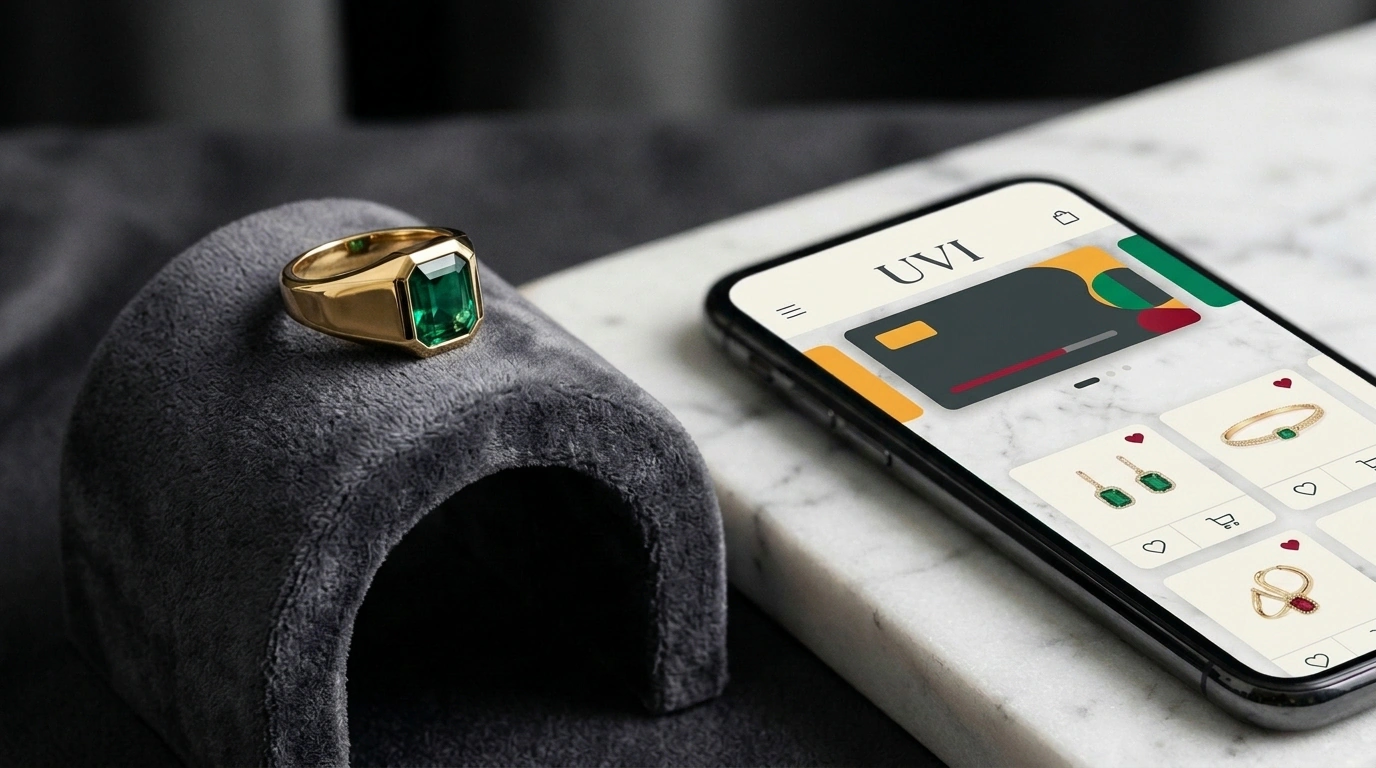
"First spark desire for the piece itself, then offer an extra reason to buy," says Veniamin Fomichev, Head of Digital at jewelry retailer UVI (Yuvelirochka). It sounds obvious—until you try selling a gold ring with natural gemstones using the exact playbook that sold grocery delivery yesterday.
People buy groceries every few days, so a first-order discount banner hits right away. With jewelry, that trick breaks immediately. Nobody buys earrings just because they are 15% off. Until a shopper falls in love with a specific piece, a discount flies right past. UVI's entire digital engine grew around that difference.
Why Yuvelirochka Became UVI and Kept the Old Name on TV
TV shopping channel Yuvelirochka launched in 2015 and built a loyal audience of women aged 55+. For many viewers, the 24/7 broadcast became daily leisure, mixing sales with educational segments on gemstones. Yet when the company went after online shoppers aged 35+, the old name held it back—too tightly tied to classic home-shopping TV.
That creates a classic fork: rebrand overnight and lose loyal viewers, or stay put and miss younger buyers. UVI split storefronts by channel. TV kept the familiar Yuvelirochka name, while online (uvi.ru, app, and ads) launched under the crisp UVI (UVI Jewellery) brand, adapted from an internal shorthand.
The 2025 rebrand went far beyond a logo. The team rebuilt the website and by year-end rolled out a full mobile app across App Store, Google Play, and RuStore, housing 16,000+ items and over 100 natural gemstone types with nationwide delivery and pickup.
UVI Jewellery online storefront and brand banner (Source: uvi.ru)
The setup runs on true omnichannel data: TV, web, app, retail stores, and call center share one customer database, serving two distinct buyer journeys inside one product:
| Journey Stage | TV Broadcast Viewer | Independent Online Shopper |
|---|---|---|
| Discovery | Watches the 24/7 host live, seeing sparkle and details | Arrives from search looking for a specific stone or item |
| Storefront | Shortest path to checkout without extra promos | Filters by metal, stone, size, collection, and comparisons |
| Order | Taps items in the live lot feed right under the video | Studies product pages and builds a cart independently |
The TV host handles product selection live, so viewers open the app ready to pay. Embedding the livestream inside the app with a real-time feed of current and recent lots underneath lets viewers spot, tap, and buy—while still letting search visitors wander into the broadcast.
The Mobile App as the Hub of a CRM Engine
Nobody buys fine jewelry every Friday, so cloning a website into an app makes no sense. UVI built its app as the center of CRM marketing—driving repeat purchases from existing customers.
Three functions meet in one place: checkout storefront, livestream screen, and ongoing touchpoints between rare orders. Through push notifications and in-app banners during active sessions, the brand stays top of mind without turning into spam.
Customer records flow in from the call center, retail, web, and app, feeding RFM segmentation (recency, frequency, monetary value) and behavioral triggers, plus win-back flows for lapsed buyers.
Context goes down to personal milestones—including a child's birthday for tailored gift offers. Order history guides which collections appear and whether a discount is even needed. Even abandoned-cart flows adapt depending on who left the cart and which piece sits inside.
In-app messages are easy to overdo: nobody wants a half-screen popup while inspecting a ring or checking out. The team tests formats and triggers constantly to stay helpful. Just as important, they test incrementality—whether a push actually drove net-new sales. When a test shows zero lift, they treat it as a clue to rethink the hypothesis.
Why Close-Ups Won in Creatives and How Channels Split Roles
Moving to UVI from Pyaterochka Delivery, Fomichev tried importing grocery retail's top hook: a first-order discount. In jewelry it flopped. Performance clicked only after flipping the sequence: show a desirable piece first, and use the discount strictly as a secondary nudge.
Every ad now carries one core argument matched to its segment. Gift shoppers see occasions and selection help; mineral fans see specific gemstones; style seekers see design. Landing pages continue that promise: tap a rare stone, land straight on that curated collection.
Natural gemstone jewelry collection on UVI's main storefront (Source: uvi.ru)
A video A/B test proved how fast mobile users decide. Comparing tight product close-ups from second one against moodier brand-image clips produced a massive CTR gap across nearly every channel:
Video Creative CTR in UVI's A/B Test
In a mobile feed, you have two seconds before a thumb swipes. If the product isn't unmistakable instantly, users don't click. Close-ups hook the eye immediately, while slow atmospheric intros never get a chance.
UVI also splits channel measurement by job:
- Performance: owns direct orders and new buyers, judged on CPO and CAC.
- Display & creators: warm up demand alongside performance, judged on CTR, post-click behavior, and post-view conversions.
- SEO: remains the online backbone, as most web revenue still comes from searches for specific stones and pieces.
- CTV (Smart TV): promotes the TV channel itself—clicks open the live broadcast rather than the website, so UVI tracks broadcast views and watch time against downstream sales.
Four Lessons for Any Low-Frequency E-Commerce Brand
UVI's playbook fits any emotional, infrequent category—fashion, gifts, home decor, or eyewear:
- You don't have to smash your legacy name during a rebrand—split storefronts by channel while upgrading digital for younger buyers.
- High-frequency retail tricks rarely transfer directly; lead with tight product visuals in second one, then close with value.
- Mobile apps pay off as personalized CRM hubs, not passive website clones.
- Never judge upper- and lower-funnel channels by last-click alone, and test CRM triggers regularly for real incremental sales.
Checklist Before Launching Mobile CRM and New Creatives
- Does the product separate a fast checkout path for hot buyers from a rich filterable catalog for browsers?
- Is the actual product unmistakable in the first two seconds of video ads rather than hidden until the end logo?
- Does clicking an ad land directly on the exact collection or item promised in the copy?
- Do abandoned-cart flows adapt to customer history and cart contents?
- Do you measure incremental sales lift from push and in-app messages to cut noisy alerts with zero impact?