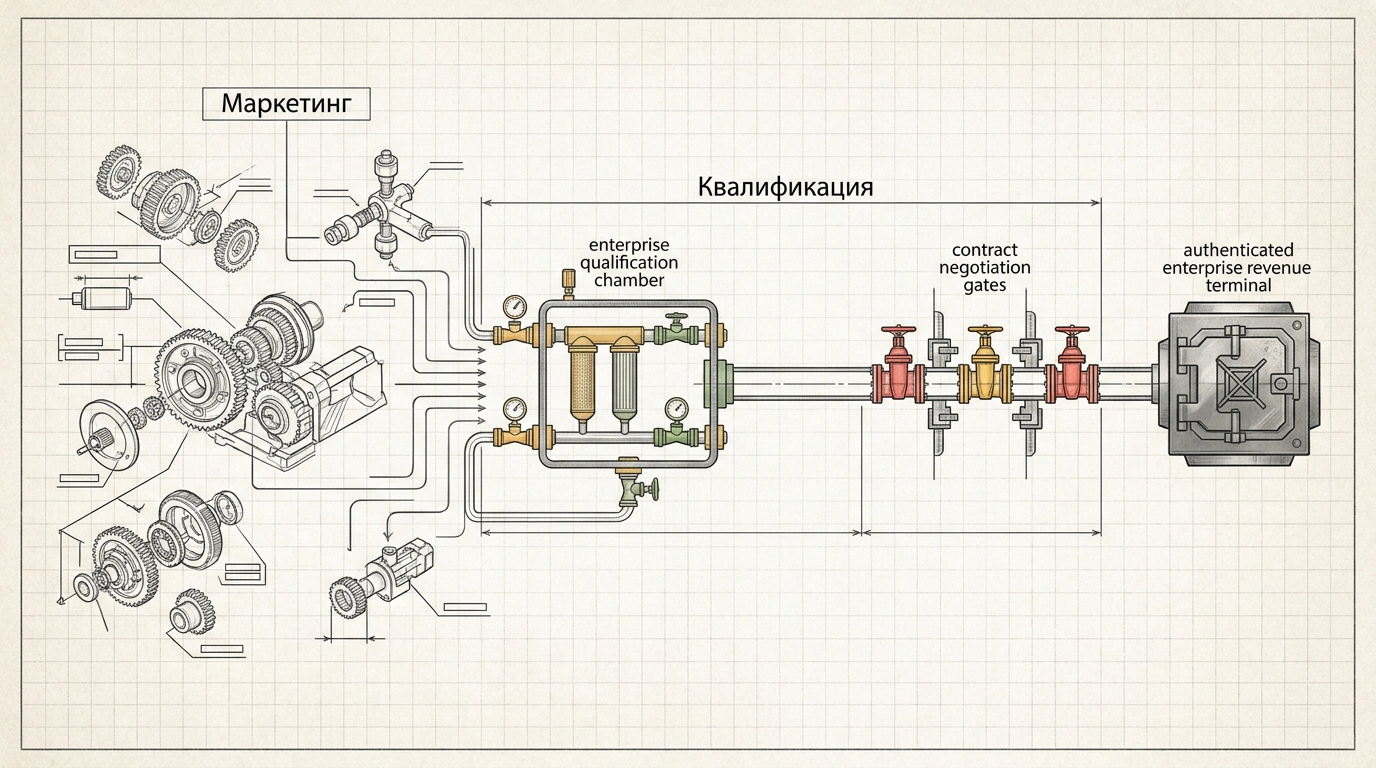
Behind the scenes of complex B2B, the same play repeats endlessly. The owner funds ads "for leads," marketing brings a shiny click report, and sales reps call contacts only to hear "just browsing" or "we'll think about it." Meanwhile, inside the buyer's company, a completely different game is playing out: 5 to 16 people across four or five departments debate the deal—and by the time your rep reaches the director, a favorite is almost certainly chosen.
Why Chasing 'Leads' Burns Budgets in Complex B2B
In consumer retail, you pour money into traffic and build a line. In complex B2B, often only a few hundred companies nationwide can afford your contract. Mass lead-gen ads carpet-bomb the market: collecting curious browsers and tiny firms while missing real decision-makers.
According to 6sense research, roughly 82% of B2B buyers sign with a vendor who was already their favorite before first sales contact. Over 90% of buying groups build their shortlist ahead of time and keep sales reps at arm's length for ~60% of the buying cycle. When RFP emails go out, the winner is usually already picked.
A second brake sits inside the buyer's building. A May 2025 Gartner survey found unhealthy internal conflict inside 74% of B2B buying teams. Commercial wants speed, finance wants lower spend, and legal and security see risk in every new vendor.
How B2B Buying Cycle Time Splits (Gartner, 2025)
Buyers spend 83% of their cycle debating internally, leaving a sliver of meeting time split across every competing vendor. Effective B2B marketing therefore runs as an engineering system that makes big deals predictable and takes selling off the founder's personal shoulders.
Engineering-Grade B2B Marketing: Six Rules for Narrow Markets
Instead of mass traffic, complex B2B runs on ABM (Account-Based Marketing): targeting a curated list of companies and warming executives inside them, paired with strict lead qualification at the door (active pain, budget, access to decision-makers) across six rules:
- Audit cash before spending: dissect your 5 best wins and 5 losses before buying ads—what triggered the buy, who opened the door, and where deals died. Scale only what already paid.
- Target active buying triggers: a wishlist of the top 50 corporations looks impressive, not actionable. Prioritize accounts with an urgent problem you have a strong case study for and a realistic path in.
- Enter the buyer's head six months pre-RFP: key executives must know and trust you before an urgent tender hits. Measure success by how many target accounts know you and invite you to the table—not clicks.
- Help your champion sell internally: deals die at "we'll think about it" when your contact can't defend your proposal to finance, legal, and security. Arm them with ROI calculators, proof, and risk answers. Gartner notes buying groups reaching consensus are 2.5x more likely to close a high-quality deal.
- Harvest existing clients first: winning a new enterprise logo takes six months and carries high error costs; expanding an existing happy client is faster and higher-margin.
- Never hire a sales team before documenting how you sell: hiring five reps expecting them to match the founder burns cash. Break down why buyers trust the founder personally—keep founder time for high-stakes expertise while handing prep, warm-up, and routine steps to a system.
Two Halves of Sales Technology: Algorithm and Knowledge
Even a warm executive walks away if sales reps improvise. Sales technology—a repeatable system turning prospects into paid invoices—always needs two halves: a sales business process (algorithm) and the knowledge to execute each step.
The process defines what to do and in what order: an "action -> intermediate output" chain where each step triggers the next—like using an office water cooler (walk up, grab cup, fill water, drink). Remove the cup, and the chain breaks: by the weakest-link rule, a system performs only as well as its weakest step. Run out of water, and the rep walks to a corner store—same result in 20 minutes instead of 1, at higher cost.
Knowledge defines how and why to execute each step: product mastery, UVP, objection handling, CRM hygiene, and sales techniques (discovery questions, pitching, closing).
| Component | Question Answered | Where It Lives | What Breaks Without It |
|---|---|---|---|
| Business process (algorithm) | What to do and in what order | Sales funnels, CRM stages, checklists | Training fades; deals stall at random steps |
| Knowledge | How to execute each step and why | Product book, UVP, sales playbook, scripts | Every rep wings it; quota depends on 'stars' |
Neither half works alone. Process without knowledge is an empty checklist; knowledge without process is a one-day workshop whose objection-handling script fails if the funnel never creates the conversation where it belongs. Knowledge differences explain why two reps following the same funnel produce wildly different revenue.
The spine is a three-part revenue funnel: acquisition (lead arrives), first sale (first payment), and repeat sales (recurring revenue). Hang three knowledge assets on it: product book, UVP, and sales playbook with CRM rules. At each stage, execution lives in standards: checklists set step order, while scripts and guides supply knowledge. In Igor Maltsev's methodology (claiming 819 built systems across 12 countries since 2010), roughly half of the 37 core tools are operating standards.
Connecting Marketing and Sales Into One Revenue Loop
To turn binders into bank deposits, Maltsev's framework applies the PAR law: Point of view -> Action -> Result. Point of view is everything written down (numeric targets, processes, knowledge—what isn't written doesn't exist). Action is team and manager execution strictly by the book. Result is revenue and margin. That draws a sharp line: technology is the documentation, while a sales system is technology plus real daily compliance.
If a company makes 10 million RUB/month and wants 15 million RUB, shouting "try harder" won't work. Growing 1.5x requires different actions—which starts with updating what's written down.
Here both loops lock together: repeat-sales funnels mine current accounts; warming executives six months early feeds acquisition; ROI sheets and risk answers for finance/legal sit in the proposal-defense standard; and documenting the founder's personal sales process prepares five new hires to replicate it.
Implementation builds new habits in five steps: spot the weakest link, redesign that stage's process, write the standard (checklists + scripts), train the team, and audit metrics until the habit sticks. In one B2B case rebuilding the post-proposal follow-up stage through initial staff pushback:
Share of Proposals Reaching Issued Invoice Over 2 Months
In two months from the exact same proposal volume, the company nearly doubled issued invoices with zero extra ad spend—shifting leadership from mood-based management to process control.
Quick Pre-Scaling and Hiring Check
- 5 won and 5 lost deals audited: you know who opened doors and where talks stalled.
- Accounts selected for active buying triggers, with ROI math and risk answers ready for buying committees.
- Three funnels (acquisition, first sale, repeat sales) and the founder's selling playbook are written down.
- Bottleneck stages have two-part standards: step checklists plus knowledge/argument guides.
Resist the final temptation: skipping documentation to plug in CRM automations or AI agents right away. One law rules: "Automate chaos, and you get automated chaos." Software and AI act like a gas pedal—on a crooked process, they only drive you off course faster. Keep the sequence strict: process first, knowledge second, and executor third—whether human rep or AI agent.