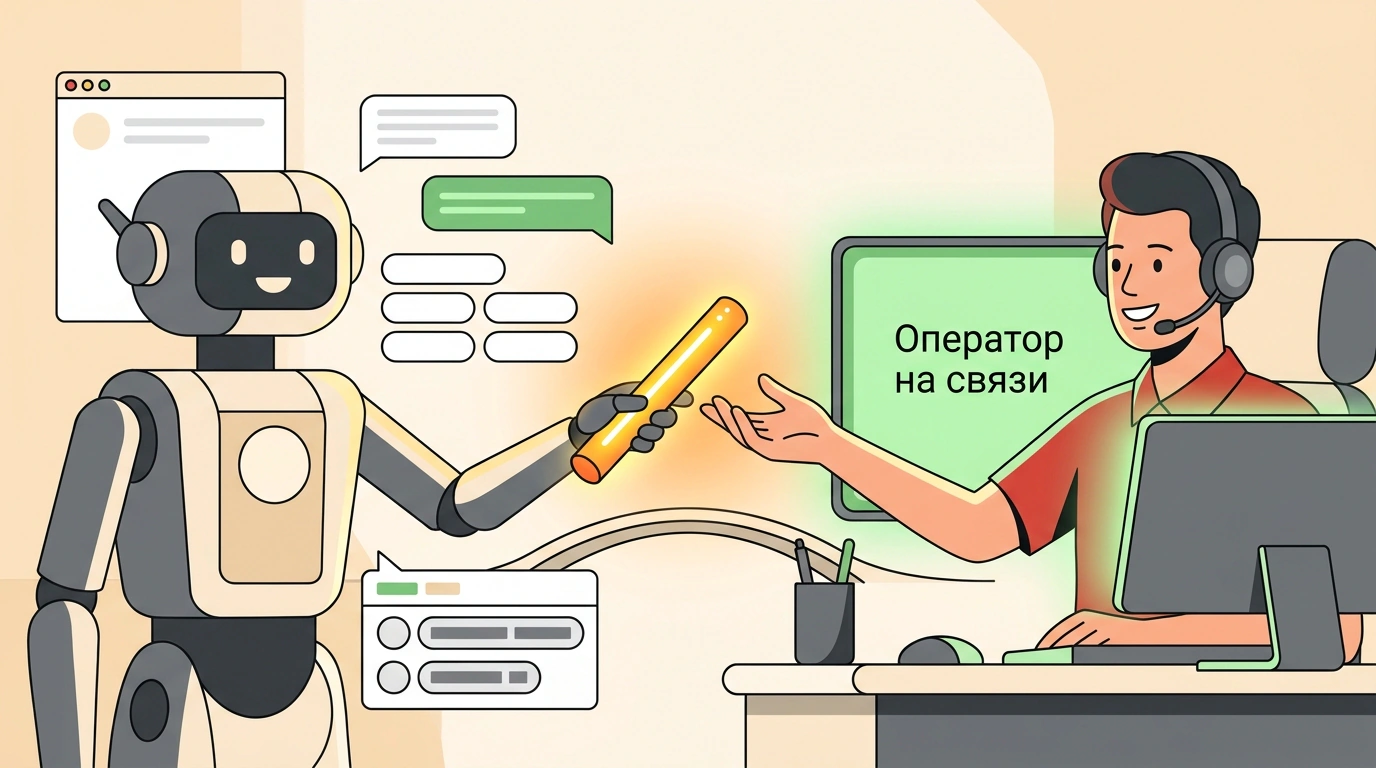
Look at both sides of a support chat. A shopper writes to your store bot: order 4172, move delivery from Thursday to Friday, same address. The bot replies it's calling a specialist. In the customer's window, only the agent's name changes—the chat thread stays right there, so the buyer assumes the agent read it.
What does the agent see? A queue alert tagged "Delivery." The order number scrolled off-screen behind ten bot prompts, the customer card is blank, and two other chats are flashing. The agent fires off a macro: "Hello! Could you share your order number?" The buyer scrolls up, sees 4172, and starts simmering.
What Actually Happens on the Agent's Screen
Transferring a chat from bot to human is called a handoff (moving complex issues up a tier is escalation). Repeat questions happen for two very different reasons.
First, the customer held back details from the bot. In 2026 (Discourse & Communication), Gabriella Martijn and colleagues analyzed 132 bot-to-human transfers at Dutch financial and transit organizations. At the bank, a user typed just two words about a payment request to the bot—saving the full story (sending a request to a friend, friend paid, money missing) for the live human. Linguists call this recipient design: users toss keywords to bots and save real explanations for people.
Second—and far more infuriating—the customer did give the order number and request, yet gets asked again because data failed to pass between systems or the agent is overloaded. At Norway's labor agency NAV with bot Frida (where agents juggled three chats at once), an auto-message politely asked for "a minute to read" while the agent scrolled through a long bot log—prompting staff themselves to ask for auto-summaries. Skipping that pause and asking "start from the beginning" dumps the summary job onto the customer.
Three Context Leaks Between Bot, Chat, and CRM
Repeat questions rarely stem from lazy agents. Context drops at three technical seams:
- Chat transferred, fields left empty: routing and context transfer are separate settings. Zendesk tags route tickets without surfacing order fields on screen; Just AI's
switchcommand transfers chats while history injection requires separate setup; Jivo internal-comment summaries require toggling on. Omnichannel widgets auto-fill phone and email into sidebars—order numbers must populate fields the exact same way. - Friday in chat, Thursday in CRM: a crisp two-line internal summary ("Order 4172. Customer asks to move delivery to Friday, same address. Bot escalated.") shows intent, not CRM truth. One sloppy word ("rescheduled" vs. "asked to reschedule") creates false certainty—and agents must save the new date back into CRM so the next shift doesn't see Thursday.
- Summary goes stale in the queue: while waiting for a free agent, the shopper adds, "Friday after 6 PM only." Without an update button (like Usedesk provides) or new-message flags, summary, chat tail, and CRM disagree.
AI agent and omnichannel support chat interface in Jivo (Source: jivo.ru)
| Where Context Breaks | What the Agent Sees | What the Customer Feels |
|---|---|---|
| Handoff without fields | Blank card & long bot transcript | 'I typed the number a minute ago—do you read?' |
| CRM out of sync | Summary says Friday, order says Thursday | 'You promised Friday—why is the courier coming tomorrow?' |
| Queue follow-up missed | Stale summary missing 'after 6 PM' | 'Why did I even specify a time window?' |
What Broken Handoffs Cost—and Why Bot Dashboards Lie
Think a few repeat questions don't matter while CSAT looks fine? Check handle time first. In an MTS pilot passing short bot summaries to agents, average handle time (AHT) dropped by 11 seconds per chat—saving hours of paid labor daily across thousands of tickets.
Now check churn. Zendesk CX Trends shows over half of consumers (60%+ in several cuts) will switch after one bad support interaction, and 73% leave after multiple poor experiences. You pay to acquire warm buyers, then lose repeat orders at the bot-to-human seam.
Worse, bot dashboards hide the bleed. Intercom Fin separates Confirmed Resolution (user thanked or rated positively) from Assumed Resolution (user simply left without asking for a human or rating down)—yet both count toward Resolution Rate and billing. An annoyed shopper closing the tab and buying from a rival gets logged as a "resolved chat." Measuring response time only for users who waited out the queue creates the same survivorship bias.
AI agent workflow with data connector and customer verification in Intercom Fin (Source: fin.ai)
Fixing the Handoff and Auditing Your Chat in Two Hours
You don't need to rebuild support from scratch—hand your chat/CRM team four requirements:
Requirements for Bot, Chat, and CRM Integration
- Push structured fields (order number, contacts, queue tag) into the agent's sidebar on every escalation.
- Enable a 2–3 line internal summary clearly separating what the user asked vs. what the bot already did.
- Trigger summary refreshes or highlights if the customer adds details while waiting in the queue.
- Enforce write-back so final agent decisions update the CRM order record.
Pair tech fixes with one opening-line habit: the agent states what they already see and asks only what is missing—"I see order 4172 and your request to move delivery. Let me check Friday slots." (If security verification is mandatory, confirm the order is on screen first and explain why verification is needed.)
In Martijn's transit case, a passenger asked when a Flex pass activates; the bot misheard "subscription" and offered to pause it. The live agent asked one targeted question ("Do you already have Flex?"), learned it started tomorrow, and solved it instantly. One sharp question moves forward; blind repetition resets to zero.
Audit your own chat in two hours: export a few dozen sequential tickets from one category (like delivery reschedules) and compare three things—what the user told the bot, what appeared on the agent's screen, and what the agent asked next. Track two honest metrics: repeat-question rate (non-security transfers asking for already-provided info) and time to first useful action (including chats abandoned before reaching it).
For order 4172, you may still need to ask what time Friday works—that info is genuinely needed. The order number already did its job.