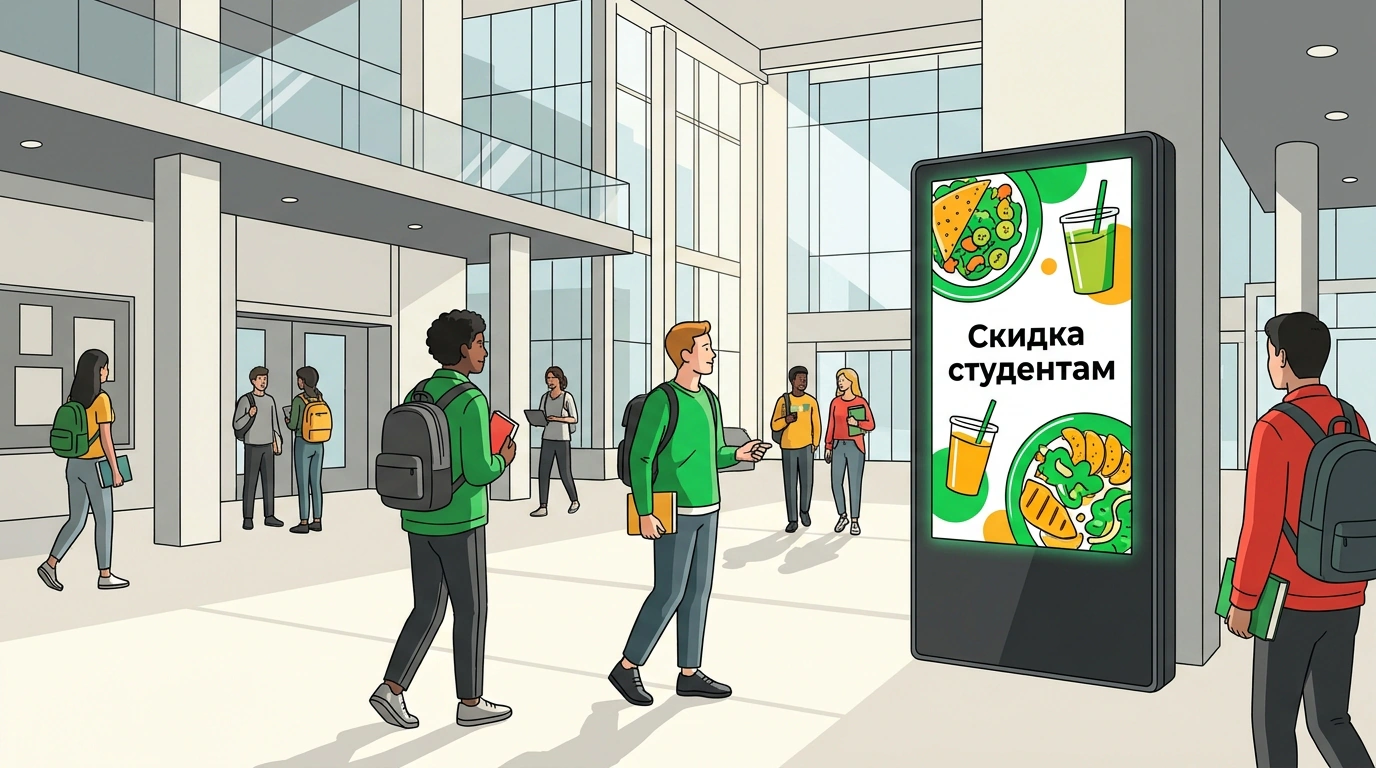
Over nine months of campus advertising across 51 cities, Pyaterochka lifted regular student shoppers from 67% to 78% (+11 percentage points, or pp)—and store consideration by the same 11 pp. The catch? It took nearly a full year. Three months in, the campaign looked invisible: students noticed the ads, yet didn't shop there more often. This case captures the biggest shift in out-of-home (OOH) media, where budgets are fleeing static billboards for digital screens and indoor placements.
Why Digital Screens Grow 20% While Static Billboards Lose a Quarter of Revenue
OOH covers all ads outside home and office: street billboards, digital screens, transit, and indoor venues. According to ESPAR-Geo for 9M 2026, Russian OOH grew 10.8% YoY (accelerating to +11.1%, or 32B RUB, in Q3)—holding #1 growth among Russian media.
Inside the total sits a sharp split. DOOH (Digital Out-of-Home) grew 20.2% over nine months, capturing 83% of outdoor spend across 93 monitored cities, while static billboards dropped 24.6% (stabilizing at 4.5B RUB flat YoY in Q3).
Russia Out-of-Home Ad Market Breakdown (9M 2026)
ESPAR-Geo CEO Andrey Berezkin links growth to static-to-digital upgrades and an influx of Wildberries sellers—marketplace merchants don't want month-long vinyl prints; they need screens updated in an hour for flash sales.
How Pyaterochka Entered 336 Universities—and Paused for Summer
Street screens catch commuters rushing past; campus indoor hits daily routine. With operator MaxMedia, Pyaterochka entered 51 cities from Astrakhan to Vladivostok across 336 universities (nearly half of Russia's campuses), reaching 2M+ students and 345M+ contacts (170+ per student).
Students walk the exact same hall-schedule-cafeteria loop 5–6 days a week. MaxMedia places INFOboard stands right beside class schedules—impossible not to read—plus A1/A0 lightboxes, DigitalBox screens, and floor stands.
Pyaterochka chose an always-on strategy instead of two-week bursts: launching in January, pausing two summer months when halls sat empty, and returning in autumn while rotating product messages (per strategic marketing director Andrey Egorov) to broaden brand perception. CNN International Commercial and MTM note 65% of brands run continuous comms, while Google research shows brand sales lift often surfaces five months in or later.
The Q1 Trap, Contact Cost, and When Indoor Pays Off
Insight Expert ran two brand-lift waves (400 students aged 17–25 per wave: 200 test, 200 control—essential when baseline awareness tops 80% to isolate campus impact from TV).
Q1 set a classic trap. Ad recall jumped right away (59% vs. 46% control), yet consideration barely moved (65% vs. 62%—noise on 200 people) and assortment image stayed flat. Stopping in March would have labeled the campaign a flop.
By Q3, compounding kicked in: Pyaterochka awareness hit 92% (+8 pp vs. control), consideration and regular shopping both jumped +11 pp, and wide-assortment association climbed from 40% to 47%.
Keep trade-offs clear: 19% of test students recalled campus ads versus 46% for Smart TV and 45% for online/outdoor, yet indoor cost far less per ruble and delivered high frequency. Since budget, CPM, and loyalty-card receipts weren't disclosed, lift rests on surveys. Campus indoor pays off for high-frequency B2C (retail, delivery, telecom) able to fund 6–9 months with seasonal pauses and fresh creatives—not if you need B2B software leads by Friday.