In November 2026, OpenAI shared numbers that made SEO specialists around the world blink: ChatGPT processes roughly a fifth of Google's search volume and sees 1.2 billion weekly users. At first glance, you might think classic search is done and it's time to move your entire budget into AI optimization.
Then you open real referral data and get a cold shower. According to an October study by Marie Haynes (12 months of Google Analytics 4 data across 100 sites and over 145 million visits), direct referrals from ChatGPT make up just 0.62% of Google's organic traffic. Add all AI assistants together (ChatGPT, Claude, Gemini, and Perplexity), and you get 0.73%. Less than one percent.
But here is where it gets interesting. Across 55 sites in that sample with proper lead tracking, visitors from ChatGPT buy or leave contact details 13.8% of the time. Standard Google organic traffic converts at 3.02%. That is more than a four-and-a-half-fold gap. By the time someone clicks through from an AI chat, they have already compared options and arrived with their wallet ready.
That tension defines marketing heading into 2027. Some claim SEO is dead, while others dismiss AI as a toy with less than one percent market share. Both camps are leaving money on the table. Below, we examine four recent benchmarks (145 million sessions, 35,000 answers from seven AI models, a strict Moscow map-listing test, and a live earring shopping test in St. Petersburg) to see how AI actually chooses businesses and where companies are losing high-intent buyers.
The Death of SEO Myth: Why Clicks Are Dropping, Yet Search Still Pays
Let's start with lead volume to calm the panic. Even with a 13.8% conversion rate, AI assistants still lose to classic search on sheer volume. In the same Marie Haynes dataset, Google organic search generated roughly 27 times more completed deals and leads than all chatbots combined.
Share of Total Conversions: Google Organic vs. All AI Assistants
GA4 does have a blind spot that is easy to miss. Analytics only tracks direct clicks on links inside a chat. If a buyer asks ChatGPT for advice, remembers your company name, opens a new tab, and types your brand into Google or Yandex, the report logs that lead as branded organic search. Haynes also found that direct ChatGPT referral growth plateaued back in August 2025. Part of AI's influence now flows into hidden branded searches, yet classic search still drives the bulk of sales.
Even so, you can't relax in traditional SEO because the rules have already shifted. Ahrefs compared desktop click-through rates in Google Search Console across 300,000 queries (half showing AI Overviews above results, half informational queries without them) between December 2023 and December 2025. When an AI summary sits at the top, the number-one organic result loses 58% of its clicks. In April 2025, that drop was 34.5%; by year-end, it deepened to nearly three-fifths. On live sites, top-spot CTR falls from 3.7% to around 1.5%.
The entire top five took a hit: position two lost 50.8% of clicks, position three dropped 46.4%, position four fell 38.8%, and position five lost 32.6%. Users read the short summary at the top and close the tab without scrolling.
There is a second blow to old SEO habits. In summer 2025, Ahrefs found that three-quarters of links inside Google AI Overviews pointed to pages in the classic top 10. By March 2026, that share cut in half to 38%. Another 31% of links came from pages two through ten, and the remaining 31% came from outside the top 100 altogether: industry rankings, reviews, and forums. Ranking in the top 10 no longer guarantees a spot in an AI answer.
Does that mean investing in your website is pointless? Not at all. Take the EDUGUSAROV blog, which grew from 197 to 504 weekly Google clicks in a single month (mid-October to mid-November 2026)—a 2.6x jump—through steady SEO work. Even after filtering out bot-spike days, the weekly curve climbed steadily: roughly 200, then 411, 491, 429, and 640 clicks. Ironically, the top-performing new post covered Google's AI Mode and drew nearly 9,000 weekly impressions from scratch. People still use traditional search to ask about AI. In Belarus, October StatCounter data shows Google at 58% market share, Yandex near 39%, and Bing plus others around 3%. Both major search engines now pin AI answers above organic links, yet websites remain essential.
Where Seven AI Models Actually Pull Business Answers
Suppose your site is cleanly indexed and ranks at the top. Does that ensure AI will recommend you? To test this with hard numbers instead of guesses, the GUSAROV agency ran a large-scale study across 890 Belarusian companies from July 21 to November 24, 2026. They excluded SEO agencies so their own checks wouldn't skew the data.
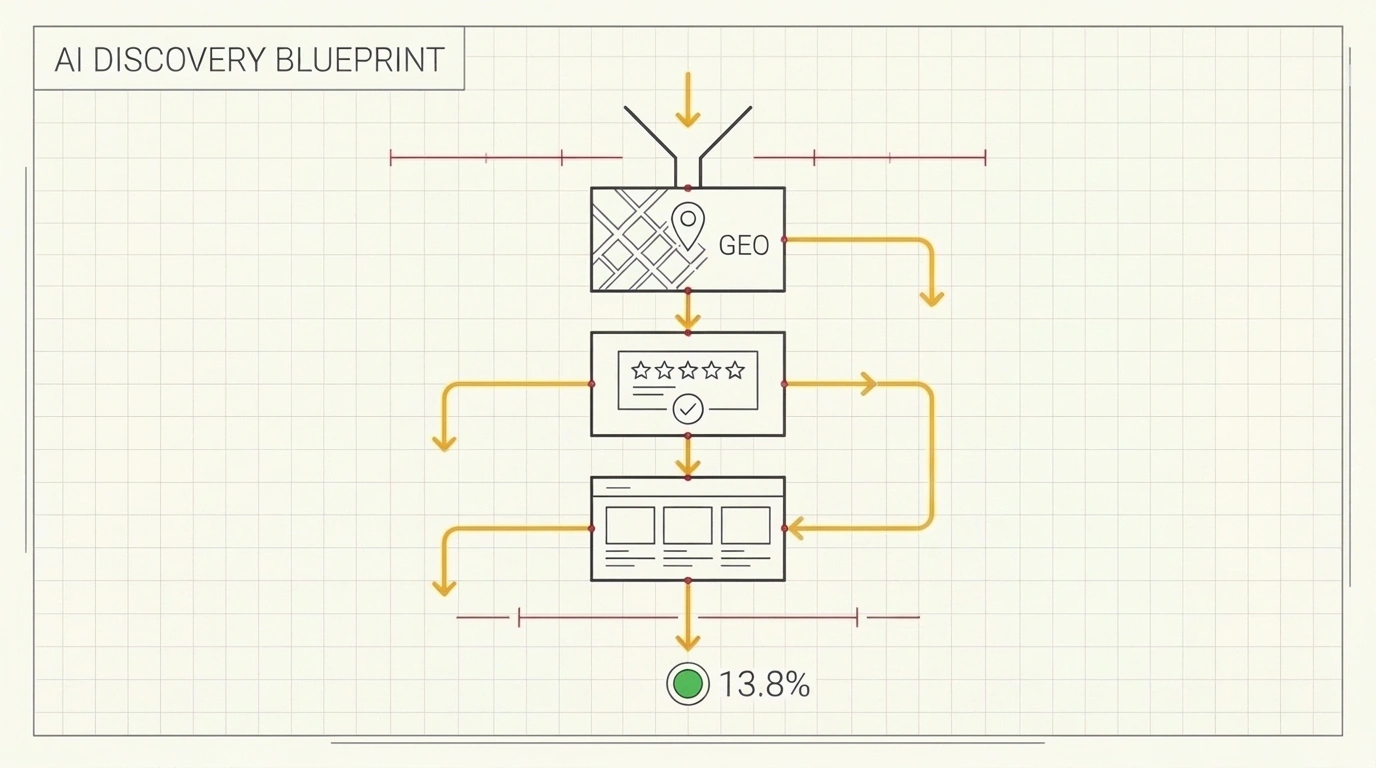
Multi-layer conceptual diagram of source selection by seven AI models: knowledge bases, geo-maps, and independent reviews driving a 13.8% conversion rate.
They asked real buyer questions: "where to buy," "who do you recommend," and "how much does it cost." Seven systems were tested: Perplexity, Google AI Overviews, Alice in Yandex Search, ChatGPT with search, Claude with search, Gemini, and DeepSeek. Out of 63,816 total answers, 35,456 included source links, which formed the basis for the breakdown. If a site appeared three times in one answer, it was counted once.
Three limitations apply to this dataset. First, the sample isn't random across the whole market; it reflects companies that signed up to track their visibility. Second, for ChatGPT and Claude with search, the parser only counted clickable links inside the answer text, which sets a lower bound. Third, the parser excluded Yandex's own services from Alice's sources, meaning maps play an even bigger role for Alice in reality.
Here is the number that surprises owners of polished corporate sites: a company's own website appears as a source in only 29.5% of answers. Seven times out of ten, AI tells buyers about your market and your business using third-party platforms. You can spend months perfecting your homepage design, yet AI decides whether to send you buyers based on external sites.
Let's see which third-party platforms capture the lion's share of citations in commercial answers.
Which Third-Party Platforms Appear in 7 AI Models' Sources
This breakdown shatters two common myths. First, flooding dedicated review sites won't buy you AI visibility; they sit at the very bottom of the list. Media and content portals hold a solid second place, while maps and directories lead by a factor of two: Zoon, 2GIS, Yandex Maps, Relax, and Blizko.
Looking at specific domains (excluding company websites), the top five in the study were directory zoon.by (6.0% of all answers with links), followed closely by 2gis.by (5.9%) and Yandex Maps (5.4%). Business media outlet myfin.by took fourth (4.83%), and Instagram rounded out the top five (4.4%).
The myfin.by case is a textbook lesson in content marketing. That single outlet appeared in answers for 265 different companies—twice as often as the massive portal onliner.by (around 2%) and five times more than any other Belarusian media site. The secret is simple: it hosts structured catalogs for courses and logistics and regularly publishes "how much does it cost" breakdowns.
Across the 129 media outlets in the sample, the top ten captured 44% of all links. AI models are picky about formats. Standard founder interviews about "mission and values" or PR fluff rarely make the cut. Three specific genres win citations:
- roundups and rankings with "top," "rating," or "best" in the URL, accounting for 11.4% of all media links (for example,
infotrans.by's top-250 freight forwarders list was cited 49 times, andbelretail.by's best online stores roundup appeared 46 times); - pricing breakdowns and "how much does it cost" guides, taking another 5.3%;
- industry directories and catalog sections inside media sites.
There is also an odd "evergreen old list" effect. Nearly half of all media links with a year in the URL pointed to articles from 2024 or earlier. A 2020 roundup of ten digital marketing schools in Minsk on aif.by appeared in AI answers 99 times over four months in 2026. Six years later, half the programs and prices have changed, yet AI still recommends them. Newcomers left out of those old lists can barely break in using their own website alone.
Why Every AI Model Sees a Different Market
When marketers discuss GEO (Generative Engine Optimization—optimizing company and product facts for AI-generated answers), the talk often turns into a hunt for one magic button. The GUSAROV data proves no single button exists: each model pulls from a completely different ecosystem of sources.
Look at how widely media citations vary across the seven AI systems.
How Often Different AI Models Cite Media in Commercial Answers
The gap is more than tenfold. Perplexity acts like a thorough analyst: in three out of four answers (75%) it opens maps and directories, in nearly one in three (31.1%) it checks rankings and aggregators, and it actively pulls marketplaces (25.3%) and social/forums (21%). Claude with search favors press and marketplaces (27.5%), checks directories less often (29.5%), and mostly ignores social networks (9.6%) and rankings (5.3%).
Alice in Yandex Search leans heavily on maps and directories (57.6%, even before counting Yandex's own services), pulls social networks and forums (29.2%), and uses marketplaces less (16.3%). Google AI Overviews favors directories (36.2%) and social media (20.5%), rarely citing press. Gemini is stingy with external links in commercial queries overall (14.2% directories, 6.3% marketplaces, 3.2% social).
ChatGPT with search stands apart. In visible answer text, it cites media, maps (18.6%), marketplaces (7.6%), and social networks (2.8%) least often. It relies primarily on company websites—provided they have clean service landing pages with city, pricing, and clear facts. On the EDUGUSAROV case in October, that created a sharp split: ChatGPT named the company in 65% of answers, while Claude named it in only 15%.
A second trap is regional spillover. If a local market lacks fresh reviews and directories, AI readily pulls platforms from neighboring countries. Even after excluding Yandex services, 2GIS, and local .ru directories in the Belarusian test, Russian sites like mirstat.ru, vc.ru, tripadvisor.ru, klerk.ru, ratingruneta.ru, rbc.ru, and sostav.ru appeared in an average of 31.8% of all answers.
Alice showed this most strongly: 71.2% of its answers about Belarusian businesses linked to Russian domains. Perplexity hit 61%, Claude reached 35.2%, Google AI Overviews hit 28.7%, and only ChatGPT stayed low at 9.6%. For local businesses, that means lost revenue: a user asks about a service in their city, and AI serves federal competitors and prices from another country.
Finally, platform weight shifts dramatically by industry. Buying PR articles across the board is a fast way to burn cash.
| Industry | Answers Citing Media | Answers Citing Maps & Directories |
|---|---|---|
| Logistics | 29.8% | 57.9% |
| IT | 29.6% | 40.5% |
| Online Stores | 24.3% | 35.3% |
| Education | 22.5% | 40.7% |
| Healthcare (indicative, n=334) | 10.8% | 69.2% |
| Auto Repair | 3.5% | 46.5% |
| Construction | 2.2% | 23.6% |
The takeaway is practical. If you sell logistics, IT development, courses, or e-commerce, skipping industry rankings and press roundups hands traffic to competitors. If you run a dental clinic, auto shop, or renovation crew, business media PR brings pennies; your battle happens on 2GIS, Yandex Maps, and niche directories.
The Local Services Filter: 4 Companies Out of 2,703 and a 17-Subscriber Article
Thousands of answers give you the macro view. What happens inside an AI model when an ordinary business owner in Moscow opens Yandex Search and asks for a contractor? On November 27, 2026, this scenario was tested live across eight local service niches.
Algorithmic filtering funnel for local businesses: narrowing 2,703 companies down to 4 finalists with authentic reviews.
The test began with the query "recommend an office moving company in Moscow." Open 2GIS for that topic and you see 2,703 businesses. At the very top sits a federal mover with an "Ad" badge and a wall of 1,390 reviews. By old local marketing logic, that company gets the call.
Yet Yandex's AI returned a shortlist of just four companies across three consecutive runs. Picture that filter: out of 2,703 options, only one in 675 makes the cut. Even stranger was who took first place. In all three runs, the leader was a small firm with only 62 map reviews (a 4.8 rating and two branches). The second company also held steady in all three runs.
Where was the federal giant with 1,390 reviews and paid map ads? It didn't appear at all in the first run, and peaked at third place in the next two. A 22x review lead and ad budget failed.
The clue sat right under the first line of the AI answer. The model wasn't counting 2GIS stars or copying paid map placements. It relied on third-party review articles about office movers. In one of those articles, that small firm with 62 reviews ranked first (and the fourth company in the AI answer ranked eleventh in the same article).
To rule out a fluke, seven more Moscow service niches were tested the same day. The results revealed two more uncomfortable truths about AI search.
| Service Niche (Moscow) | Companies on Maps | Companies in AI Answer | What the Test Showed |
|---|---|---|---|
| Office Moving | 2,703 | 4 | Firm with 62 reviews ranked #1 in 3 of 3 runs; ad-backed leader with 1,390 reviews missed run #1 |
| Windows | 1,313 | 5 | Top two firms matched an article by an author with 17 subscribers (1,167 views) |
| Turnkey Apartment Renovation | 2,531 | 4 (repeat: 2) | List shrank by half on a repeat query |
| Personal Bankruptcy Lawyers | 1,573 | 4 | List reshuffled in 8 minutes; #1 spot went to a lawyer absent from run #1 |
| LLC Accounting | — | 4 | #1 spot went to an audit firm operating since 1995 |
| Auto Repair, Detailing, Driving Schools | — | 0 (no AI block) | No AI answer shown; user saw standard search results |
Look at the windows row. Over 1,300 companies compete fiercely there, and Yandex Direct ad clicks are expensive. Yet the top two firms in the AI's second run matched the exact order of an article by an author with just 17 subscribers and slightly over 1,100 views. AI doesn't care about influencer fame. If a piece is well-structured, answers a real buyer question, and sits on an indexed platform, it can beat million-ruble ad budgets.
The second takeaway is extreme volatility. In bankruptcy law, the list reshuffled in eight minutes, putting a previously unmentioned lawyer at #1. In apartment renovation, the list shrank from four names to two. Measuring your AI visibility with a single phone query is pointless. As Peec AI's tracking methodology emphasizes (measuring brands across four metrics: visibility, share of voice, sentiment, and average position), answers are probabilistic, so you must test in batches.
This also clarifies how maps and articles work together. Paid #1 map placements don't carry into AI answers. Strong ratings and hundreds of reviews matter at step two, when a buyer hears your name from AI and checks your address and stars. What gets you into that 2-to-5-name shortlist is third-party reviews and roundups with concrete numbers and buyer language.
From Mention to Click: A Live ChatGPT Test on Earrings in St. Petersburg
Suppose your business does the homework: lands in roundups, cleans up map listings, and gets named by AI. Victory? Not quite. Between a brand mention and a sale sits another hurdle: where the link lands and what the buyer sees there.
On November 26, 2026, a practical, high-intent shopping prompt was entered into standard ChatGPT web chat with search enabled:
"I want to buy earrings from Russian brands in St. Petersburg so I can see them in person at a store or showroom. My style: calm minimalism, warm gold or gold plating, small geometric shapes, for everyday office wear. Budget up to 15,000 ₽. Suggest specific places and brands in St. Petersburg with links to browse."
In 27 seconds, the model built a five-part shopping plan: named five Russian brands (Avgvst, Despina Jewelry with a note on DAFNA, 47 Store and Poison Drop, URA Jewelry, Dazzle Mood, and Caviar Jewellery), plotted a St. Petersburg map with six locations, addresses, and hours, displayed four product cards with photos under "Specific earrings worth trying on," suggested shapes (10–15 mm mini-hoops, 5–8 mm studs, gold-plated 925 silver ovals), and even mapped a walking route starting at SENO space on Gorokhovaya 49 and ending at DAFNA on Petrogradskaya.
The answer contained 17 links across eight websites and one Telegram channel. Here is a technical detail highlighted by Peec AI researchers: AI search uses two distinct sets of pages—Sources (all URLs the search module opened and read in the background) and Citations (the clickable links the model chose to display in the answer). Since autumn, ChatGPT increasingly embeds clickable links directly into paragraphs, and they often differ from the bottom source list.
All eight websites from the answer were opened manually that same day to check landing pages. The gap was huge.
Only one store out of eight, DAFNA (Kronverkskaya 12; 11:00–21:00), got deep links straight to specific product cards instead of a homepage. Two of its three featured pairs hit the mark: the "Konfetki" hoops page clearly stated the name, "gold-plated silver" material, 6,000 ₽ price, 3 cm length, and "in stock" status at the St. Petersburg showroom. The same held for the "Raznostoronnyaya lichnost" model. Only the third pair (with an amber circle at 10,850 ₽) linked to the homepage.
One step down sat Caviar Jewellery (Pionerskaya 1; 11:00–20:00). It was the only brand to get a link straight to its earrings catalog section, listing 59 models with names and prices alongside the address and hours. It made both the map and the try-on quartet, though it missed out on single-item deep links.
The other six brands lost the shopper on the first click, despite making the AI answer. Flagship Avgvst at Rubinshteina 16 ranked first on the brand list, yet received only homepage links featuring the slogan "Jewelry for people who don't wear jewelry" and a contacts page. Zero specific pairs, plus a note in the chat warning "many pairs cost over 15,000 ₽." ChatGPT placed Dazzle Mood (SENO, Gorokhovaya 49) first on the walking route because its homepage listed its address, hours, and materials (silver, titanium, surgical steel, gold-plated alloy) in plain text. Still, the link opened a homepage dominated by a giant Black Friday banner instead of minimalist office earrings.
47 Store (Bolshoy Prospekt P.S. 47 and Gorokhovaya 49) and Poison Drop (Moyka Embankment 73, Au Pont Rouge) made the map thanks to clear addresses and hours, but their links led to general storefronts and location lists. Despina Jewelry, with vague homepage copy about "ideas of beauty," and URA Jewelry, labeled as a Moscow brand, also got only homepage links.
The mechanics are crystal clear. External reviews and roundups decide whether AI remembers your name. Link depth—whether a buyer lands on a product card with a "Buy" button or hits a sale banner on your homepage—depends on how clean and factual your own website is. Poetic brand slogans without prices, materials, and city-specific stock get skipped by AI.
Hidden Sabotage Inside Your Catalog: Three Errors That Ruin Store Visits
Think a direct product-page click guarantees a sale? Checking the four pairs ChatGPT placed in its "worth trying on" block exposed a worse issue. Out of four recommended items, three had factual errors—and in two cases, the culprit wasn't "AI hallucination," but messy data inside the stores' own product cards.
Structured product snippet data showing price, availability, and rating in Google Search Central documentation (Source: developers.google.com)
The screenshot above shows how search and AI systems expect product data: one unambiguous name, current price, clear stock status, and rating. When fields on a page contradict each other, AI grabs the first value it sees and confidently sells the buyer a fiction. The St. Petersburg test uncovered three classic sabotage patterns.
Error one: the title promises one thing, specs say another. In chat, the model described one pair as "gold-plated silver" and attributed it to the store's own brand. Open the product page: the browser tab (<title>) indeed says "gold-plated silver." Scroll down to the specs block, and it lists 3,900 ₽, material "costume alloy," pearl insert, and a completely different manufacturer brand. ChatGPT's search module grabbed the <title> tag and missed the contradiction. A shopper who specifically asked for silver or gold would only discover the costume alloy in-store.
Error two: old price and zero stock. For a second pair, ChatGPT quoted 13,700 ₽ and suggested visiting the showroom to try them on. On the site, the catalog showed two prices, while the product card crossed out 13,700 ₽, showed a discount price of 8,220 ₽, and displayed "in stock: 0 pcs." The AI read the old price and missed that the item was physically out of stock. Picture someone spending an hour in traffic to try on earrings that aren't there. They won't blame OpenAI; they will blame the store.
Error three: someone else's photo due to a similar name. Inside the chat card sat chunky rings with colorful stones and an English caption from a foreign brand with a similar name. On the St. Petersburg store's site, that same product name belonged to thin, smooth open hoops with no stones at all. When a model lacks clean native photos clearly tied to your product name and brand, semantic matching easily pulls a competitor's image from the web.
The most telling moment came at the end of the answer. Below the entire selection, ChatGPT added a cautious disclaimer that showroom stock and prices for two models couldn't be confirmed—even where the page showed rubles and an "in stock" note for the St. Petersburg address. When a site doesn't serve price and stock cleanly without contradictions, the model voices doubts out loud and cools off the buyer before they even click.
A Practical 2027 Action Plan: Splitting Your Budget Without Wasting Cash
Put all four benchmarks together, and panic over the "new era of search" turns into a clear action plan. You don't need to burn down your old website. You need to fix three connected layers.
Before splitting your 2027 budget, run your business through three quick diagnostic questions:
- Are people searching for your product or service in classic search right now? Check Google Search Console, Yandex Webmaster, and Wordstat. If commercial demand is active, classic SEO remains your main lead engine—remember that 27x conversion volume edge.
- Does AI name you? Take 10–20 real questions customers ask your sales reps and run them in incognito mode across ChatGPT, Alice, Google, and Perplexity 2–3 times each. Write down who gets named and in what order. Most importantly, open the links under the #1 result. That gives you the exact list of platforms feeding AI in your niche.
- Where does real revenue come from today? Look beyond analytics clicks to closed deals in your CRM, and add a simple "How did you hear about us?" question to intake forms or sales scripts to catch hidden AI-to-branded-search traffic.
From there, divide the work into three clear tracks without inflating headcount or chasing buzzwords.
Track one: update classic SEO. Technical site health, load speed, clean indexing, and dedicated service landing pages with city, prices, and facts still matter—that is what ChatGPT checks before giving a deep link. Restructure your copy: put a direct, honest answer to the buyer's question in the first paragraph, add a clean FAQ block below with real questions, and track impressions alongside clicks, since many users now remember your brand directly from AI answers.
Track two: build an "AI media plan" and sync your maps. Start with the basics: align your profiles across 2GIS, Yandex Maps, Zoon, industry directories, and review sites. If addresses, hours, or service lists conflict, no PR article will save trust. Next, list the 5–15 specific domains that surfaced under AI answers in your test. Check those "evergreen" 2-to-6-year-old rankings; often it is cheaper and faster to contact the editors and update an existing list than to publish ten new posts into the void. When publishing new external pieces, skip pompous founder-mission interviews and create practical "how much does it cost," "how to choose," and "best in the city" guides with numbers and buyer phrasing. In regional niches, local reviews also stop Alice or Perplexity from recommending Moscow competitors instead of you.
Track three: clean up product and service cards for direct deep links. Use this short checklist so AI sends buyers straight to the right item with accurate facts.
Product and Service Card Audit for AI Deep Links
- Product name, material, or service scope is written in plain text and matches across the
<title>tag, page body, and specs block. - Only one current price is shown without lingering old prices; out-of-stock items (
0 pcs.) are removed from try-on showcases or clearly marked unavailable. - Stock availability is tied to a specific store, showroom, or office address rather than a vague "in stock."
- Original photos of the exact model are uploaded with clear captions so algorithms don't swap in a similar-sounding competitor's image.
- City, exact address, and current hours appear prominently as text, not embedded inside images.
- In multi-brand catalogs, each item clearly states its manufacturer brand so AI doesn't confuse it with the store name.
If your catalog has dozens or hundreds of items, offload the first pass to an AI assistant using this prompt, adapted for retail or services.
"Audit the your category, e.g., earrings product cards on my site. Find where the material or key spec in the title conflicts with the description, where an old crossed-out price remains, where showroom-specific stock is missing, and where original model photos are absent. Show me the list of discrepancies, and change nothing until I say 'yes.'"
Running that audit alongside test queries in four AI models every couple of months costs far less than wondering why your map ad spend keeps rising while ready-to-buy customers walk into a neighboring showroom with 62 reviews and clean product cards.