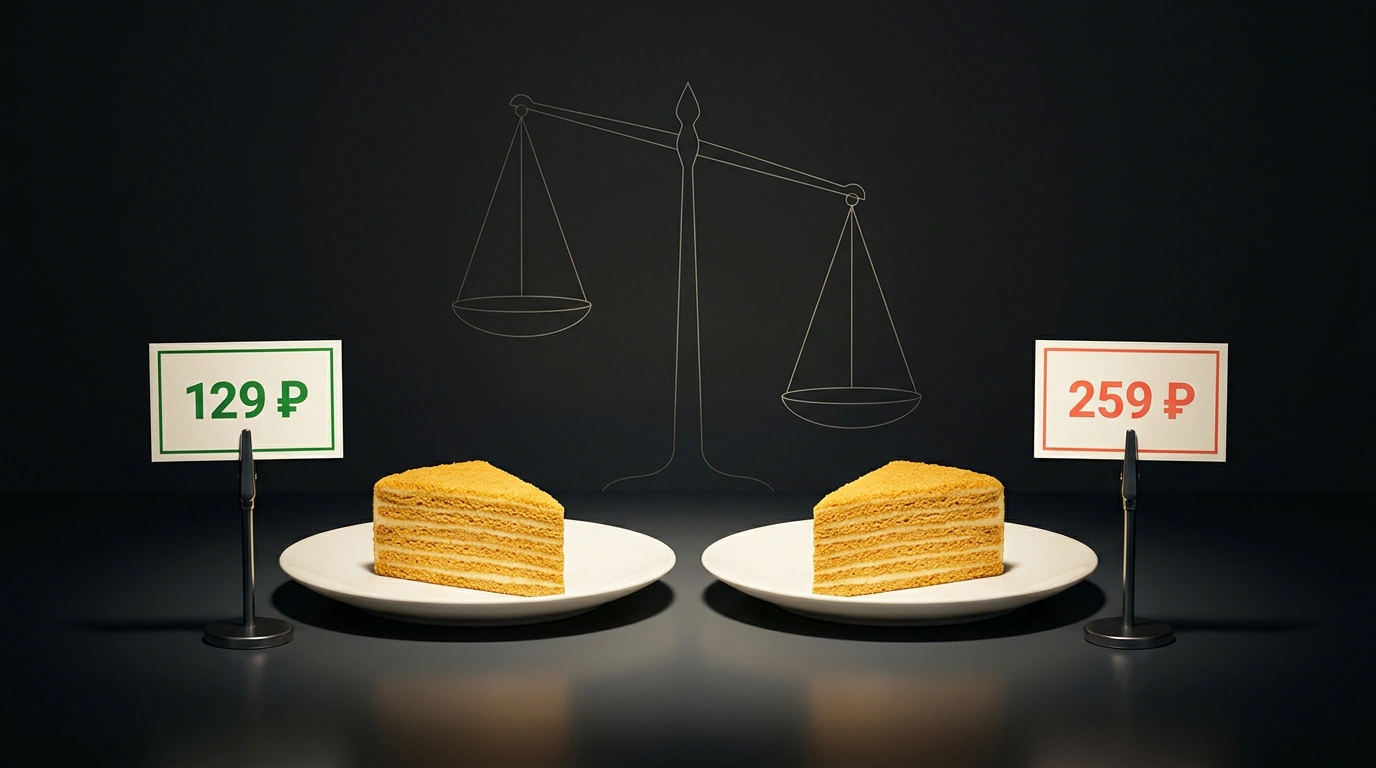
In November 2026, two people in the same apartment opened Yandex Lavka and added identical "Medovichki" honey cakes to their carts. Same delivery address down to the apartment number, same order time. Yet the prices on their screens differed by half: 129 ₽ on one phone, 259 ₽ on the other. Screenshots went viral fast, earning the story the nickname "Medovichok-gate."
If you work in marketing or sales, that scene probably made you squint. Behind a funny story about pastry sits one of e-commerce's sharpest dilemmas: where does smart personalization end, and where does penalizing loyal customers begin?
'Medovichok-Gate': Why the Personal Discount Explanation Failed
At first, it looked like a classic internet rumor about an app glitch. On November 15, 2026, Fontanka journalists ran their own test and confirmed different accounts genuinely see different prices for identical items. A T-J investigation documented that exact 129 to 259 ₽ spread on Medovichki delivered to one address—and found similar swings on other staples, including red caviar.
Yandex Lavka responded calmly and carefully. The company stated that base item prices inside any single darkstore (a neighborhood fulfillment warehouse) are identical for everyone. Final totals vary due to personalized promos, first-order discounts, and Yandex Pay card perks. Across different districts, differences reflect rent, logistics, and local operating costs.
Logical, right? To be fair, two screenshots with different prices don't by themselves prove an algorithm is calculating each shopper's wallet ceiling in real time. Without reading internal pricing code, no outsider can confirm or deny that. One screen may simply have triggered an ecosystem card discount, a win-back promo, or a routine A/B test.
Yet for brand reputation, that caveat changes almost nothing. Shoppers don't read footnotes about darkstore rent. When a loyal customer sees their partner at the same kitchen table buy the exact same honey cake for half price, the brain reads it instantly: "They rewarded my neighbor and punished me for buying here regularly." No polite PR statement erases that feeling of unfairness.
Willingness to Pay Math: Making 50% More Revenue Without a New Product
To understand why retailers take such reputational risks, look at basic economics. Marketers track Willingness to Pay (WTP)—the highest price a specific person will pay before walking away to a competitor.
Stepped Willingness to Pay chart illustrating price differentiation for the same product across three buyer segments.
Picture a coffee shop near a subway station with three potential guests. Guest one thinks paying over 150 ₽ for a cappuccino is silly and walks past if it costs more. Guest two happily pays 250 ₽. Guest three can't function without morning coffee and will pay 350 ₽.
Put one fixed menu on the wall, and you face a classic squeeze. Price low, and all three buy—meaning you hand a free discount to people willing to pay more. Price high, and only the caffeine fan stays. A middle price compromises, yet still loses buyers. Now imagine the barista knows each person's ceiling in advance and charges each their personal maximum.
Coffee Shop Revenue Under Flat vs. Individual Cappuccino Pricing
Compare the best flat price (500 ₽) against individual pricing (750 ₽): revenue jumps by half. The shop didn't upgrade beans, buy a new espresso machine, expand the menu, or acquire a fourth customer. Same three guests, same three cups—50% more cash in the register.
Economics calls this price discrimination—charging different people different prices for the same item when costs don't justify the gap. It comes in three degrees:
- Third-degree: segmenting by visible groups—student, senior, regional, or new-customer discounts. Everyone accepts this.
- Second-degree: volume or tier discounts—wholesale rates, cheaper annual plans, "3-for-2" bundles.
- First-degree (perfect): an individual price tailored to each buyer's exact WTP.
In brick-and-mortar supermarkets, first-degree pricing stayed a textbook theory for decades. How could a clerk guess at what butter price you'd walk across the street? Nobody wears their WTP on their forehead.
Apps solved that problem. Every time you order groceries online, you leave months of behavioral data behind. Stores no longer guess—they feed your history to an algorithm.
Inside Surveillance Pricing: What the FTC Found Across Six Industry Giants
For years, personalized pricing sounded like an urban legend: everyone suspected it, few had proof. That changed when the US Federal Trade Commission (FTC) stepped in. In July 2024, the agency issued compulsory orders to major tech intermediaries and consultancies, publishing preliminary surveillance pricing findings in January 2025—defining it as algorithmic pricing driven by personal consumer dossiers.
The FTC examined six major B2B firms selling pricing and personalization software to global retailers: Mastercard, Accenture, PROS, Bloomreach, Revionics, and McKinsey & Co.
The most striking finding was the depth of data these tools ingest. They moved far beyond age, gender, or ZIP code long ago. Technically, platforms can incorporate real-time screen micro-signals: mouse cursor trajectories, hover duration on product cards, precise geolocation, browsing history, and device specs.
Abandoned carts are another goldmine. Items you added, considered, and dropped before paying carry huge signal value. If a shopper adds expensive cheese three times and deletes it at checkout each time, the system gets a clean reading: high interest, but price crossed a psychological threshold.
Five Signals Apps Use to Score Your Price Sensitivity
People often assume apps try to guess their salary. In reality, businesses barely care what you earn; they care how you part with money. Five everyday signal groups let an algorithm estimate your price sensitivity:
Five digital sensors scoring customer price sensitivity: cart history, order timing, and phone battery level.
- Order history. The app sees which brands you pick, your usual price tier, average basket size, and how often premium items appear. Consistently buying artisanal bread and farm cottage cheese puts you in the "quality and habit over savings" bucket.
- Promo responsiveness. It tracks how often you enter promo codes, what share of orders you pay at full sticker price, and how deep a discount it takes to make you check out. Ten percent off hooks one shopper; another waits for a third off.
- In-app behavior. How many seconds do you spend picking an item? Do you compare three pasta brands by price per kilo, or toss your usual pack straight in? Do you revisit saved items after price drops? Every tap scores how meticulous you are.
- Purchase frequency. Algorithms distinguish someone ordering every other day on autopilot from a rare guest checking in once a month. Recency is a major e-commerce trigger: the longer you stay away, the more nervous the system gets and the richer the offers become.
- Geolocation and demographics. Delivery neighborhood, usual drop-off pins, and basic account traits offer a rough baseline on their own—yet paired with the four signals above, they predict both purchasing power and urgency. A late-Friday snack order in a business district sends a very different signal from a calm weekly grocery run in a residential suburb.
The Loyalty Paradox: Why Regulars Pay for Everyone Else
Combine those signals and compare two real shoppers on the same delivery app.
Shopper one is a COO's dream. They order groceries almost daily, stick to favorite brands, rarely scrutinize prices, almost never hunt for promo codes, and never abandon a cart because milk rose 15 ₽. Speed and predictability are all they want.
Shopper two is the opposite. They open the "Deals" tab first, check two rival apps side by side, keep a bookmark folder of promo codes, and close the app guilt-free if the total feels high.
Here is the twist: shopper two might earn several times more than shopper one. High income doesn't automatically make someone price-blind—plenty of wealthy buyers love chasing bargains. Algorithms don't care about bank balances; they care about price elasticity.
Put yourself in a marketer's shoes with a margin target. Without a real discount, shopper two walks away—so you serve them a personalized coupon. Why offer that same discount to shopper one when they are nearly 100% likely to buy at full price? On an Excel sheet, discounting a loyal buyer looks like pure margin loss.
That creates the loyalty trap: your easiest, most reliable, highest-value customer systematically gets the worst prices precisely because they behave well. Yet that math carries a hidden risk—reputational churn. The moment loyal buyers compare screens, a chunk feels betrayed and leaves. Adjust the sliders below to see when chasing personalized revenue stops paying off.
Personalized Pricing Calculator: Revenue vs. Churn
The simulation exposes the fragility of secret discounts across 1,000 buyers. While quiet, extra revenue from deal hunters lifts the top line nicely. Yet if just a quarter of insulted regulars walk away, every cent of gain vanishes and total revenue drops below simple flat pricing.
What the Law Says and How Companies Bypass Bans via Discounts
Naturally, people ask: is selling the same item to different people at different prices even legal? In Russia, there is no explicit ban on dynamic or personalized pricing, yet businesses bump into three general rules.
Article 426 of the Russian Civil Code on public contracts requires identical prices for consumers within the same category. Charging groups differently is allowed if criteria are objective, legal, and publicly disclosed—covering senior, student, newcomer, and loyalty-tier discounts. Article 10 of the Competition Protection Law bars dominant companies from setting unjustified price differences for identical goods. As Pravo.ru's review of FAS practice shows, the antitrust regulator closely watches marketplace algorithm transparency while still allowing loyalty programs. Finally, Article 16 of the Personal Data Law (152-FZ) restricts decisions made solely via automated processing if they affect a person's rights.
How do platforms thread this needle? Simple: they never touch the base price. The shelf price inside a darkstore stays identical for everyone to satisfy public-contract rules. All variation shifts into discounts: personal coupons, first-order promos, platform subsidies, and bank-card perks. Two buyers still pay different totals, yet legally it isn't "two prices"—it is "one base price minus an individual bonus."
Globally, regulators are closing that gray area with mandatory transparency. Compare how three jurisdictions handle it.
| Jurisdiction | Law & Effective Date | Core Business Requirement | Penalties & Limits |
|---|---|---|---|
| Russia | Civil Code Art. 426, FZ-135 Art. 10, FZ-152 Art. 16 (active general rules) | Identical base price per category; discount transparency and limits on purely automated decisions | No explicit ban; FAS warnings and cases target dominant players first |
| European Union | Omnibus Directive (EU) 2019/2161, since May 28, 2022 | Must inform buyers when a price is personalized by an automated algorithm, plus 30-day prior-price rule for discounts | Cross-border fines up to 4% of annual turnover |
| New York State (USA) | Algorithmic Pricing Disclosure Act (N.Y. Gen. Bus. Law § 349-a), since Nov 10, 2025 | Must display a verbatim notice beside any price set by an algorithm using personal data | State Attorney General enforcement; civil penalties up to $1,000 per violation |
New York's law delivered the sharpest blow to silent personalization. Companies must print verbatim right next to the price: "THIS PRICE WAS SET BY AN ALGORITHM USING YOUR PERSONAL DATA."
Imagine opening your Friday grocery app, tossing milk, apples, and honey cake into your cart, and seeing that label under your total. Perception shifts in a split second. Getting a birthday gift or loyalty cashback feels fair; seeing your dinner marked up because an app studied your habits feels invasive.
Risk Boundaries for Businesses and Five Price Checks for Buyers
If you run marketing or unit economics in e-commerce, nobody expects you to abandon personalized offers—the financial upside is too high and the tools are standard. Trouble hits when personalization turns opaque and targets everyday staples.
A brand's safe zone relies on clear rules: buyers should know why a price is what it is. Public loyalty tiers, transparent payment-method perks, clear new-user promos, and birthday gifts rarely spark outrage even when neighbors pay differently. The toxic zone begins when "win-back" promos or silent tests turn identical-address staples into a lottery. Brand trust takes years and millions in ad spend to build, yet burns down in one evening over two screenshots in a neighborhood group chat.
What if you are on the shopper's side of the screen? Honestly, there is no magic button to trick a closed pricing algorithm. We can't see model weights or know which factor fired today. Still, you can check price fairness and avoid overpaying.
First, before a big order, compare prices on the exact same items in a family member's account. Pair with someone whose habits differ from yours—say, you order every two days while your partner last opened the app six months ago. Keep the test clean: same time, same delivery address, same payment method, and comparable promos.
Second, don't stick to one mobile app. Before paying, check the same store in a logged-out incognito browser so the storefront has minimal history on you (though totals may recalculate after login). Also check sibling storefronts in the same ecosystem: identical items sometimes differ noticeably between the Yandex Lavka app, its web version, and Yandex Market without switching accounts.
Third, pause before hitting "Pay" on non-urgent orders. Paying instantly at full price every time trains algorithms to tag you as price-insensitive. Waiting a few hours lets you compare rivals and test the classic abandoned-cart trick—services genuinely trigger win-back promos for unfinished carts, though don't expect them automatically every time.
Fourth, occasionally "cheat" on your favorite app with competitors. Marketers use win-back mechanics to re-engage lapsed buyers. They already paid to acquire you, and you know the app, so tempting you back with a promo costs less than buying a new ad click. Taking a two-week break often triggers push-notification discounts regulars haven't seen in months.
When switching apps for a flashy discount on one item, always compare the final basket total including delivery fees, service charges, and order minimums. Otherwise you save 100 ₽ on cake while quietly overpaying 500 ₽ on milk, produce, and courier fees.
Fifth, practice basic digital hygiene. Check phone permissions granted to delivery apps and marketplaces. Does a grocery app need background geolocation? Should you allow ad tracking and third-party cookies? Turning those off won't guarantee instant discounts, yet it cuts off extra behavioral data a grocery courier doesn't need.
Quick Price Check Before a Large Order
- Compare key basket items against a relative's account at the same address and time.
- Check prices in an incognito browser and on sibling storefronts in the same ecosystem.
- Leave non-urgent carts sitting for a few hours and check totals at one or two rivals.
- Compare the final checkout total including delivery, service fees, and minimum-order thresholds.
- Revoke background location access and unnecessary ad-tracking permissions.
That check takes three minutes and clears the air fast: either you confirm the price is fair, or you spot where an app tried to charge extra margin for your loyalty.