A corporate evening in central Moscow. Guests settle into a spacious, column-free hall. Even lighting hangs seven meters overhead, motion graphics flash on cue behind the host, and catering rolls out snacks right on break. From the floor, everything looks effortless—as if local crews from two blocks away built it. Backstage, half the production crew just flew 2,000 kilometers from Omsk and Tyumen, other teammates are dialed in remotely, and a coordinator in black whispers into a headset telling the host to stretch for thirty seconds because a speaker is still in the lobby.
From the outside, event marketing looks like pretty slides and stage charisma. In reality, a major forum, client awards show, or corporate party rests on two unglamorous pillars: how you assemble crews and gear in another city, and how your team hears each other on show day. If either pillar wobbles, budget burns on flights and rework while the room sits in awkward silence.
How a Team from Omsk and Tyumen Runs a Moscow Hall
A clear real-world example is Aventura agency's corporate event at Soluxe Hotel Moscow (inside the Park Huaming Chinese Business Center at 16 Wilhelm Pieck Street). They booked the main Beijing Hall. Production ran through a crew where half flew in from Omsk and Tyumen while others worked remotely from other cities.
Beijing Hall is serious real estate where logistics mistakes hit budgets fast. Occupying an isolated third floor separate from hotel guest rooms, it spans 890 square meters in a column-free trapezoid with seven-meter ceilings. A soundproof partition splits it into Beijing 1 and Beijing 2 (~445 sq. m each), backed by a 1,500 sq. m foyer.
Beijing Hall at Soluxe Hotel Moscow: 890 sq. m column-free space with 7-meter ceilings where a team from Omsk and Tyumen produced a capital event (Source: Soluxe Hotel Moscow)
For a producer, room specs set the technical scale right away. Zero columns give clean sightlines, yet seven-meter ceilings and deep room geometry demand powerful audio, exact rigging math, and smart seating layouts. Seating format shifts guest density sharply—changing screen widths and door-coordinator headcounts.
Beijing Hall Capacity at Soluxe Hotel Moscow by Seating Format
The chart shows how crowd density swings between a desked conference and an open reception or theater setup. More bodies in the room mean longer walks from foyer to stage and higher stakes for any bottleneck at check-in.
Soluxe Hotel Moscow also brought cultural specifics. A Chinese-operated hotel with its own sign-off rules, access windows, and staff workflows feels like "abroad inside Moscow." Showing up on load-in morning thinking "we'll wing it" guarantees delays. Aventura mapped every truck route and load-in window before signing the contract, so crews walked onto the floor and started rigging immediately.
After sixteen years (founded in 2010, running 100+ events annually from 30-guest dinners to 10,000-person city festivals), geography no longer dictates quality. Guests in downtown Moscow have no idea where the producer lives. They only judge what happens in the room.
Four Offices, Hubs, and the 'Three Piles' Logistics Rule
Some agencies open regional "branches" just for a slide deck line: two desks, a fancy address, and zero in-house technicians. In live events, that facade collapses on the first urgent job. A real distributed model runs four full offices—Moscow, St. Petersburg, Tyumen, and Omsk—each staffed with producers, managers, tech leads, and its own core gear warehouse.
Distributed production logistics diagram showing four equipment hubs and sorting gear by the three-piles rule.
Why keep live teams in four cities? Local street knowledge. A local office knows a city like a 20-year cab driver: which venue actually has clean acoustics, when traffic chokes truck docks, and which lighting tech never ghosts on Saturday night. When an event lands in a hub city, nobody flies out for scouting, burns a day traveling, or spends three days orienting. Scouting wraps in two hours.
What if a client books a city with no office? Hub-model regional production kicks in. The nearest anchor office takes the wheel with familiar roads and local pricing:
- Tyumen covers Yekaterinburg—just a four-hour drive, so the producer walks the venue in person instead of squinting at ceilings on a video call from Moscow;
- St. Petersburg covers Kazan;
- Moscow handles long-haul destinations and complex travel hubs.
Next comes freight math. Veteran organizers start logistics with a packing list, not a truck order. Before booking anything, they sort every item into three buckets—the three piles rule.
| Logistics Bucket | What Goes Here | Why Split This Way | Hidden Trap |
|---|---|---|---|
| Ship with you | Custom props unavailable locally and pre-built complex structures | Saves on-site build hours and locks quality standards | Must weigh freight rates against on-site labor hours |
| Rent locally | Heavy trusses, standard furniture (counters, stools), basic lighting and PA | Hauling standard stands across half the country wastes cash | Local rental gear must be vetted ahead or arrives battered |
| Buy locally & discard | Badges, stationery, fasteners, simple decor, consumables | Cheaper and faster to source locally than haul in luggage | Leave time buffer so nobody hunts badge lanyards at midnight |
Sometimes the math surprises people. Building a stage set locally looks cheaper on paper. Yet if assembly takes two days, needs tight supervision, and burns two extra days of venue rent, shipping a pre-built set from your own warehouse and installing it in three hours wins.
Another non-negotiable line in any regional budget is critical-gear redundancy. Projectors don't take weekends off, and airlines lose bags. Anything that would halt the show if it failed either travels in duplicate or has a confirmed local partner backup waiting on standby. "A lamp blew and we have no spare" is engineered out before takeoff.
In-House Core vs. Local Crew, and Vetting Venues Before Signing
The most common budget pushback from clients is predictable: "Why pay flights for your staff when local crews exist?"—or the flip side: "Why hire a local sound engineer instead of flying in your Moscow pro?"
The answer is pure pragmatism: every ruble of travel must buy quality. If Omsk has a proven sound engineer in your vetted roster, flying someone from Moscow with airfare, per diems, and hotels inflates the bill without improving room audio. Lighting, base PA, staging, catering, and floor staff belong in local hands—strictly from your vetted list or verified live.
Your in-house core travels wherever complex direction and unified standards matter: show director, technical director, and lead managers. They hold the full script, cue sheet, and cross-team handoffs in their heads. No local hire can replace them; a local vendor owns one slice, while only the core sees the whole picture.
Fake savings backfire brutally here. A slick website and confident phone pitch prove nothing. Skip vetting to hire a cheap vendor "from internet recommendations," and load-in stalls at midnight before show day. Suddenly you are buying last-minute plane tickets for your whole team, turning fake savings into double costs.
Vetting an unfamiliar venue follows the same discipline. Never pick from page one of search results. Ask local partners for a shortlist of 3–5 halls matching your brief and budget—they already know which roofs leak and where security is difficult. Next, do a live walk-through or raw phone video tour. Hotel promo photos use wide-angle lenses that hide columns, low beams, and narrow freight elevators; an unedited phone walk from loading dock to stage tells the truth.
Then bring in the technical production team led by your tech director to verify lighting, sound, screens, rigging, and the venue's tech rider (its official technical spec sheet). Before signing, check ceiling height, load-in path, truck parking, green rooms, and three-phase power capacity. If the hall lacks power for your rig, setup fails before day one.
Finally, test venue management itself: how fast they reply, whether they send the tech rider promptly, and what load-in curfews they enforce. A hall can boast great hardware, yet if the venue manager takes three days to approve one cable run, the project suffocates.
That exact filter paid off at Soluxe Hotel Moscow: mapping load-in routes and access windows upfront meant crews skipped hallway arguments with management. An extra prep day always costs less than an opening-night surprise.
Abroad, the playbook barely changes. A producer runs the job from home base while local crews execute under the same checklists and sign-offs. Only wrappers change: language, currency, customs, and local safety permits. Management stays identical.
One Contract vs. Five Vendors: How Clients Should Judge Production
Now view this from the buyer's chair—a CMO or founder handed the task: "Put 400 people in a room in Kazan in six weeks."
It is tempting to skip agency fees and hire vendors directly: book the hall, hire AV, book catering, hire an emcee and decorators. In Excel on day one, it looks neat. Then reality hits.
Five vendors mean five contracts, five deposits, five invoice schedules, and five calendars. When decorators run two hours late on stage build, lighting techs miss rigging windows, sound checks slip, and asking "who's at fault?" gets five shrugs: "We arrived on time; that's not our scope." Hunting for someone to blame an hour before doors open is miserable.
A single-window model removes that headache. One contract, one budget, unified paperwork, and one person answering the phone—your project manager. You never explain why lights aren't hung; cross-team handoffs are their job.
Spot a real producer versus a middleman in one minute. Weak managers act like secretaries—forwarding client emails down a vendor chain and creating broken telephone. Strong producers live in real operations. They know Omsk riggers enter the hall at 6 a.m. while Tyumen's warehouse opens at 9 a.m.—and solve that three-hour gap on the schedule weeks before crews sit idle on flight cases.
When hiring an event partner for an out-of-town forum or client summit, check three things: do they have vetted local vendors in that region, who from their core team flies on-site personally, and will they clear the venue tech rider before you pay a deposit? Five minutes of answers separate a real system from a pretty deck.
'Men in Black' and Why Messaging Apps Fail on Show Day
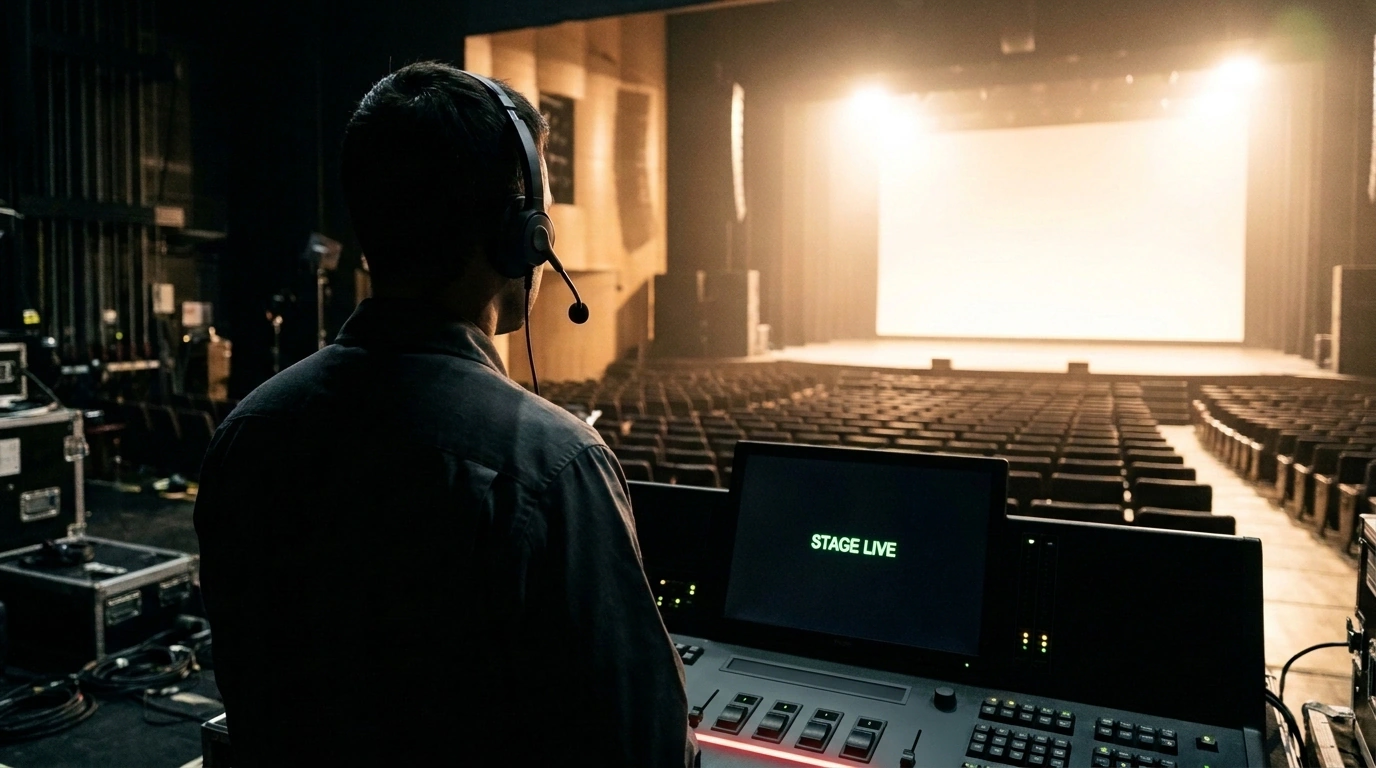
Now the venue is cleared, gear arrived on time, the stage shines, and guests enter the foyer. Enter the "men in black"—coordinators, show director, and floor managers with discreet earpieces. To guests, they look like serious staff pacing the walls. In reality, inside those headsets every few minutes, they decide whether the program flows smoothly or falls apart on stage.
Comparison of live-show communication channels: 5–10 second messaging delays vs. instant technical-crew intercom.
At a 30-person dinner, you can catch someone's eye across the room or wave at the DJ. Once headcount passes 300 guests, line-of-sight dies. At Aventura, headset comms become mandatory at that mark, with a minimum controllable loop of 3–4 connected staff.
Why not just text a Telegram group chat or call a cell phone? Check the clock. Calling requires pulling out your phone, unlocking it, finding the contact, dialing, and waiting for rings—which nobody hears beside PA speakers anyway. Typing in a chat burns 30 to 60 seconds. On stage, a fatal dead-air pause lasts 2 to 10 seconds. While you type "guest isn't here yet, stall," the emcee already read their name into the mic and awkward silence fills the room.
Phones also steal visual focus. Looking down at a screen pulls you out of the room for five seconds. Headsets let you speak and listen while keeping eyes locked on the stage, doors, and seating plan.
Even among headsets, tools differ sharply. Teams often confuse professional intercoms with basic walkie-talkies, yet on site they serve different roles.
A full-duplex wireless intercom (typically DECT 1.9 GHz) works like an always-on conference call. The channel stays open continuously: key crew hear each other simultaneously and talk without pressing buttons. Director calls "hold," tech lead confirms, emcee adapts—all within one second. Mics pick up whispers cleanly, and both hands stay free to hold a tablet script, adjust a chair, or wave a volunteer toward a speaker. Trade-offs: ~300–400 meter line-of-sight range, signal drop through thick concrete walls, and typical limits of 5–8 users per base group.
A half-duplex walkie-talkie (UHF/VHF with Push-to-Talk / PTT) works one speaker at a time: hold the button to talk. Under stress, staff accidentally "step on" each other—someone leans on their mic key and blocks an urgent director cue. On the upside, radios cost less, scale across dozens of staff, and punch through concrete basements and outdoor perimeters.
| Feature | Full-Duplex Intercom (DECT 1.9 GHz) | Walkie-Talkie (UHF/VHF, Half-Duplex PTT) | Phone & Messaging Apps |
|---|---|---|---|
| Comms mode | Everyone hears simultaneously; open channel | One at a time while holding PTT button | 1-on-1 call or text chat |
| Reaction speed | Instant (~1 sec) | Fast, but risks channel lockouts | Slow (30–60 sec; missed rings) |
| Hands & focus | Both hands free; eyes stay on room | One hand on button; static/noise | Hands and eyes stuck on screen |
| Range & walls | 300–400 m line-of-sight; blocked by concrete | Punches through floors and wide yards | Depends on cell towers & congestion |
| Best fit | Director, tech lead, FOH console, stage, emcee | Security, parking, catering, outdoor crew | Pre-event prep and non-urgent notes |
Large forums and complex venues run a hybrid setup: director and technical core sit on clean DECT intercoms, while perimeter teams (parking, security, catering, dock) carry radios. Both networks bridge at the central coordination desk so every team gets the right tool.
Channel Discipline and Four Steps to Set Up Live Coordination
Headsets alone don't create order. Hand earpieces to eight people without rules, and five minutes later chatter gets so noisy the show director rips off their headset.
Live control runs on a rundown—a minute-by-minute (and on tight awards shows, second-by-second) master cue sheet synchronizing all teams: when the speaker's car arrives, which line dims house lights, when screens switch to title cards, and the exact second servers bring hot courses.
To keep the rundown intact live, comms converge into one ear. Six independent tracks run at once: parking, floor, stage, screens, talent, and catering. Every update flows to one person—the show director. Hence the iron rule: every change goes to the director's ear first, and only moves after their cue.
A classic mistake at corporate events and forums is letting the emcee scan the room for the next speaker or award winner. The second the host drops eye contact with the crowd to hunt rows, energy drops. Live pacing is merciless: two seconds of dead air and guests start whispering and checking phones. Winning attention back takes ten times the effort of keeping it.
Give the emcee one job only: hold the room. Let the floor coordinator handle everything else via earpiece. Rehearse that partnership before guests arrive so the host trusts the voice in their ear instead of glancing toward doors.
If you are running your own forum, conference, or client day, build basic live coordination in four steps.
Four-Step Coordination Checklist for Your Event
- Appoint one "picture holder"—a director or lead coordinator with final say on any call. When a vendor says the stage is ready while tech says lights aren't hung, one person decides in a second without a doorway huddle.
- Assign strict zones: who owns VIP guests, stage, vendors, and timing, so an audio glitch doesn't pull everyone to the console while check-in backs up.
- Agree on a shared command vocabulary upfront ('guest in room,' 'roll bumper,' 'five-minute hold') so 'five minutes' means the exact same thing to host and floor crew.
- Run a full comms check 30 minutes before doors: test every channel, volume level, and battery charge for 10 minutes before guests enter.
That battery check feels minor until a stage coordinator's pack dies mid-ceremony. Ten minutes before doors open prevents the most avoidable failure of the night.
What Actually Plays in the Earpiece—and Where Systems Break
Listen to a well-run show channel, and you won't hear movie-style screaming. Real show cues are short, calm, and exact:
- "Speaker's car pulled up—meet at service entrance." Parking alerts the desk; a coordinator heads downstairs. The speaker never wanders hotel hallways or misses their slot.
- "Guest isn't seated yet; still in foyer." Floor staff spots an empty seat on the chart, alerts the director, and the host smoothly holds the intro while the guest is escorted in.
- "Cue bumper, host wraps in 30 seconds." Director catches the closing line and warns video control early. Stage and screens transition cleanly with zero black frames.
- "Guest stepped out—skip to next block, we're fetching them." Did an award winner hit the buffet right before their cue? The host learns early, swaps segments seamlessly, and keeps momentum intact.
Systems almost always break at one spot: when tracks act independently around the director. Parking calls the speaker directly, a floor manager sprints across the room waving at the host, and video fires a slide on a hunch. The headset goes eerily quiet while chaos cascades across the venue: the host reads a name, nobody walks up, ten seconds of silence hang in the air, and clumsy improvisation derails the segment.
Scripts look flawless on paper, yet live venues shift every five minutes. Someone steps out for a call, check-in backs up, catering runs late. Without someone hearing a slip twenty seconds early, dispatching a coordinator, and calmly rerouting the host by ear, even the priciest hall and cleanest lighting feel chaotic.