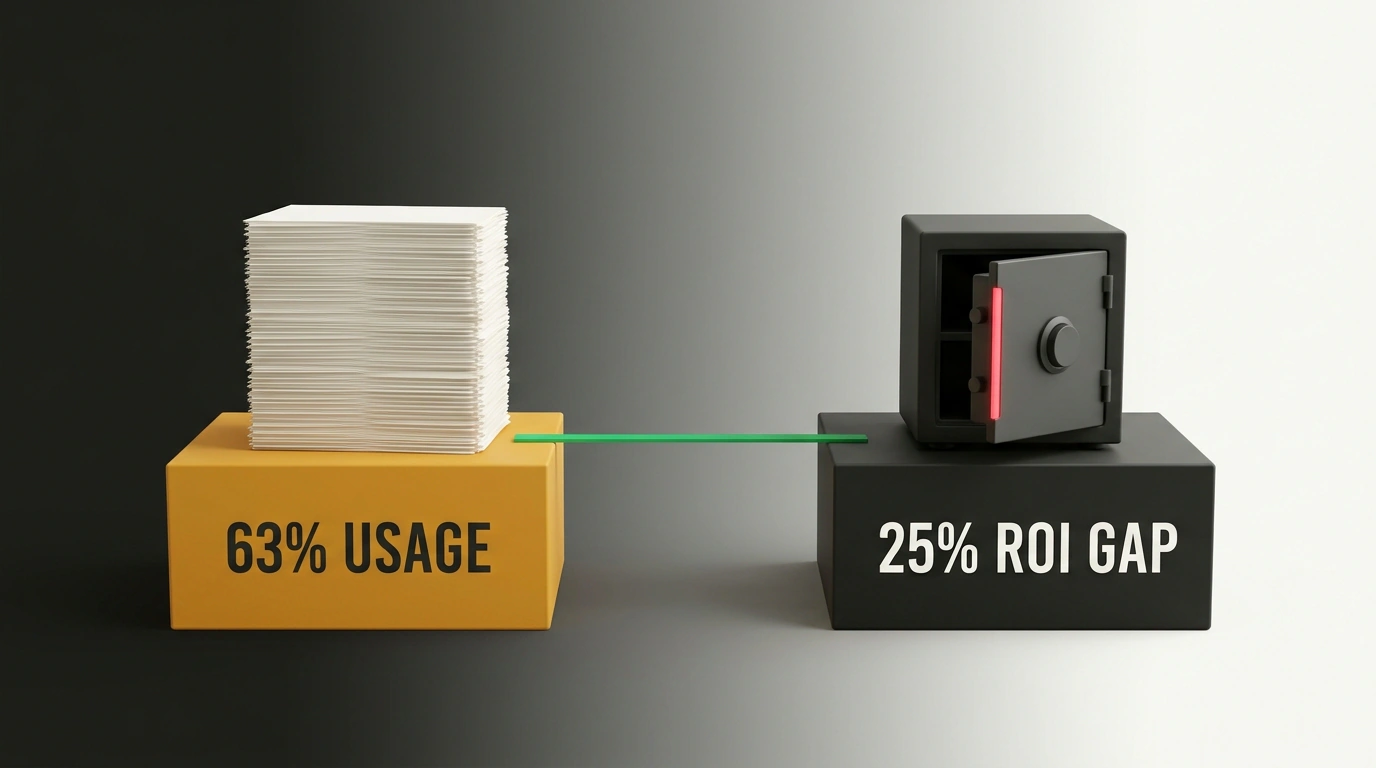
Walk into almost any marketing or sales team today, and AI looks unstoppable. According to a November VCIOM survey, 63% of working Russians used AI over the past year, and 36% apply it directly to work tasks. Inside active teams, employees draft memos faster and clear routine busywork quicker.
Then the owner opens the P&L statement—and sees silence. Hard cost savings and new revenue show up at a minority of firms, and in a global IBM Institute for Business Value study, just one in four AI initiatives met CEOs' financial expectations.
It creates a strange split: staff move faster and monthly AI subscriptions auto-renew on the corporate card, yet the bottom line barely budges. Looking at numbers from Sber, VCIOM, and IBM, let's see where AI value leaks out—and how to test any tool for real cash payback in 30 days.
Staff Use AI Daily, While the Cash Register Stays Quiet
The first gap shows up before money even enters the room: who is actually pressing the buttons? Two-thirds of VCIOM respondents support AI in their profession, and 41% are ready to hand routine work to algorithms: gathering data, drafting docs, writing code, processing leads, answering client emails, and making content.
Inside companies, adoption varies sharply by role and age. In administration, analytics, and management, 58% use AI at work. That drops to 39% in retail and services, 35% in healthcare, education, and social work, and 17% in manual and industrial jobs. Age splits similarly: 50% of workers under 35 use AI on the job, 37% aged 35–49, and 20% over 50.
Fear fades fast after first contact. Only a quarter of working Russians worry about delegating tasks to AI. Among people who have tried AI themselves, 77% back adoption versus 40% among non-users. So why is workplace use still 1.5x lower than personal use? Corporate walls: missing infrastructure, security bans, and AI tools completely disconnected from CRM and daily document workflows.
At the business level, the gap sharpens. Per November research by Sber2B Analytics and Sber2B AI, 23% of Russian firms use AI regularly and 26.1% run pilots. Time savings look real: 47% save 10–24% of work time, 23.7% cut task time by 25–49%, and 14.2% cut it by half or more.
Yet when asked about concrete business outcomes from regular AI use, operational speed and actual money part ways.
Reported Effects of Regular AI Use in Russian Companies (Sber2B)
That chart is sobering. Nearly half of companies feel decisions happen faster, and over a third see smoother service, less manual labor, and fewer mistakes. Yet the moment you ask about money—cost cuts or revenue gains—positive answers drop nearly in half. Saved minutes evaporate into the workday: a rep writes emails faster, yet closes zero extra deals while payroll stays unchanged.
How Much Companies Save—and Where Profit Vanishes
To see the ruble scale, examine Sber2B's financial slice. One fair caveat: data on savings, added revenue, budgets, and math came from 87 respondents, and payback timelines from 48—reflecting firms already advanced enough to count money, not every small business nationwide.
Annual Savings and Added Revenue from AI at Russian Firms (Sber2B, n=87)
At first glance, it looks brisk: one in four sampled businesses saved 1–5 million rubles a year, and some reached tens of millions. Now put the other side on the scale: implementation spend. In the same Sber2B data, 24.1% spent 500,000 to 1 million ₽ annually developing and launching AI, and another 24.1% spent 1 to 5 million ₽.
Put those two facts side by side. The most common implementation bill sits squarely on top of the most common annual savings bracket. Save two million rubles on busywork while paying two million to vendors, licenses, and integration, and net profit equals zero.
Reliable returns show up away from the hype: document workflows (45.9%), IT development (43.4%), analytics and forecasting (42.1%), and customer support (39.7%). Even in marketing and sales, real money lives at the intersection of analytics, rapid lead routing, and standard ticket replies—not mass-producing generic blog posts.
Measuring ROI stays primitive too: 44.8% simply compare expenses before and after launch. Sber First Deputy Chairman Alexander Vedyakhin points to Total Cost of Ownership (TCO)—folding development, integration, security, staff training, and maintenance into payback math instead of staring at a base SaaS fee. Skip TCO, and breaking even looks like a victory.
400 Articles, Chatbot Kevin, and the Global ROI Ceiling
Russia's gap between speed and cash isn't local. In IBM Institute for Business Value's global survey of 2,000 CEOs, just 25% of AI projects delivered expected ROI—net payback where verified savings or new revenue beat total launch costs. Only 16% scaled AI company-wide. Paradoxically, CEOs aren't pulling back: they plan to more than double AI investment growth rates.
IBM analysts traced why projects stall, and the culprit is rarely "dumb AI." Initiatives bog down in organizational mess: fragmented IT stacks, siloed databases, unchanged workflows, and unclear governance. Teams bolt a smart model onto the side of a broken assembly line.
In marketing, that becomes a weekly huddle cliché. Leadership asks how AI is going. The team beams: "Using it everywhere! Generated 400 blog articles, 90 ad creatives, and launched a cute chatbot named Kevin." The owner asks one question: "How many customers did Kevin bring in?" Silence fills the room, followed by: "Well, it feels like we're working more efficiently."
Marketers call that vanity output—activity for a pretty slide. Four hundred posts and ninety creatives look busy, yet mean nothing alone. More content does not automatically generate more leads. If generated volume can't tie back to revenue, qualified leads, or freed staff hours, you are paying for a noise machine.
The 30-Day Rule: Testing Any AI Tool for Real Money
Pulling marketing and support out of "feels faster" mode takes strict measurement discipline: zero verified numbers, zero renewal next month. Instead of trying to AI-enable the whole company at once, pick one concrete workflow and run a 30-day test.
First, lock a baseline—the hard numerical state before AI touches it. Say your team spends 20 hours weekly answering customer emails. For marketing and support, three hard metrics work: staff hours saved, qualified leads generated, or tickets resolved. Never accept "feels easier" or "3x more posts published."
After 30 days, measure the exact same number. If customer replies still eat 20 hours a week or lead conversion hasn't budged, the call is binary: cancel the subscription and stop funding a toy out of pocket. If hours genuinely dropped or leads rose, the tool earned expansion—bring the numbers, and "Kevin" gets promoted.
One final check before scaling spend: run TCO math. Convert saved hours or extra leads into rubles, then subtract tool fees, integration costs, custom tweaks, and the human editor hours spent proofreading and fixing AI mistakes.
30-Day AI Tool Payback Test Checklist
- Pick one measurable task (inbox triage, support replies, lead qualification) instead of 'deploying everywhere.'
- Record a hard pre-launch baseline: weekly hours, qualified leads, or closed tickets.
- Run a 30-day pilot without swapping the goal for generated text or image volume.
- Compare day-30 numbers against baseline and cancel immediately if the metric didn't move.
- Weigh verified ruble gains against full TCO: integration, maintenance, and human review time.
If the tool still finishes in the black after that check, you hold a real business asset worth rolling out to neighboring workflows.