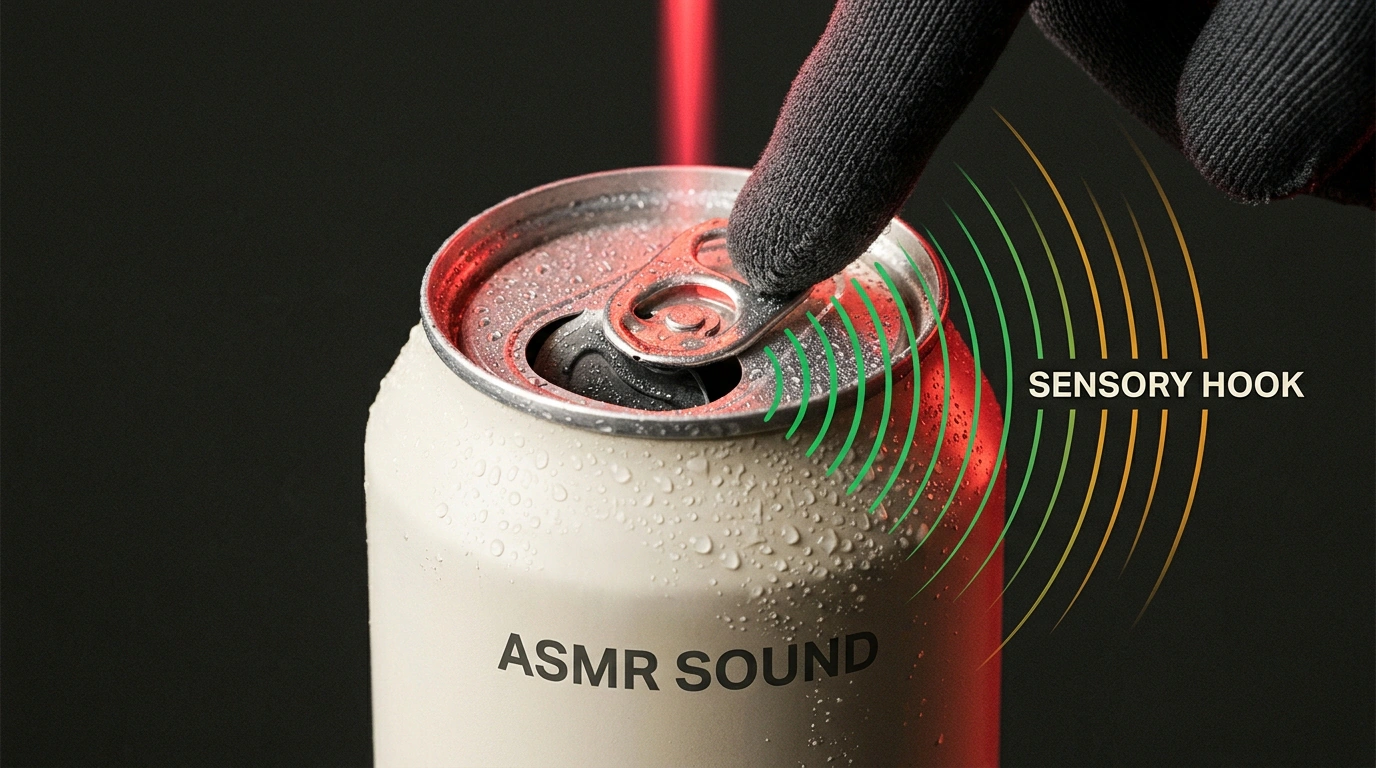
Picture fingers resting on the aluminum tab of an ice-cold soda can. Zero voiceover, yet your brain already hears the sharp snap and fizzing foam. In that split second, sensory anticipation fires—your body reacts as if the can sits on your desk. When the pssh hits, the ad stops being a flat video and feels physical.
Social feeds are packed with loud banners and rapid cuts, training eyes to swipe past visual noise on autopilot. A crisp, clean sound still breaks through that filter like a sudden pattern interrupt.
First, separate two concepts. ASMR (Autonomous Sensory Meridian Response) is a physical tingling and relaxation response triggered by quiet, crisp sounds like whispers or tapping—experienced by roughly 20–35% of people. Sonic marketing and audio branding reach wider: using a product's signature sound as a commercial trigger. Chocolate snapping cleanly or a lid popping works on everyone, tingles or not, letting buyers experience the product before purchasing.
How Ears Trick the Tongue: Sensory Marketing Mechanics
A standard food ad photo looks like a bakery display behind thick glass—you see color and glaze without knowing if the crust is fresh. Sound removes the glass and puts the item in your hand. That is sensory marketing: engaging hearing and touch through a screen.
Inside a spot, the mechanic works in three steps. First, sound proves texture: photos can't convey chocolate thickness or apple juiciness, whereas a sharp crunch signals freshness instantly. Second, it proves your core benefit without a narrator—thick coating, lively fizz, or crispy crust beats any slogan. Third, a hand poised over a chocolate bar builds tension, and the clean snap delivers release that sparks craving.
Lab science backs this up. In 2004, Massimiliano Zampini and Charles Spence gave participants identical potato chips from the same bag while boosting crunch volume and high frequencies (2–20 kHz) through headphones. Subjects rated the exact same chips noticeably fresher and crisper. Flavor and texture are built across two channels at once: tongue and ears. Video-ad studies confirm ASMR cues deepen immersion, boost recall, and lift purchase intent.
There is a production secret behind it. Real cookies or chocolate snapping into a standard mic often sound dull and dry. Shoots bring in foley artists—studio sound specialists who record snaps separately and boost key frequencies so a phone speaker makes glaze feel thick and drinks feel ice-cold.
From Crunch to Cash: Brand Cases and Making a Sound Your Own
One pretty crunch in a single ad gets forgotten fast. To drive sales, build sound into a system. One signature gesture—a snap, can pop, or pour—links an entire campaign until viewers recognize your brand with their eyes closed. Even better, if fans can recreate the sound on a phone at home, they fuel free UGC.
The viral Dubai chocolate boom proved this organically: millions bought bars just to hold them near a phone mic and record the pistachio filling crunching on break. The sound itself became viral currency without paid creator fees.
Major FMCG brands run this playbook systematically. Magnat ice cream built its positioning around signature crunch: its Double Salted Caramel spot focused on thick chocolate cracking inside the pint, while stick-bar ads highlight dense coating on the first bite.
Coca-Cola has leaned on its classic trio—can pop, fizz, and ice clink—for years. In April 2024 with AKQA (WPP Open X), it launched Coke SoundZ, using AI and neuroscience to turn Coca-Cola Zero Sugar sounds into a musical instrument across a mixing app and physical DJ bottle.
Frozen-food brand Delimex (Kraft Heinz) engineered sound straight into its recipe. For Crispy Quesadillas, food scientists tweaked batter, frying thickness, and 360CRISP™ microwave tech specifically for maximum crunch. In October 2024, GUT Miami launched an ironic "anti-ASMR" campaign, CAUTION: LOUD, showing quiet office coworkers snapping as someone crunches a quesadilla—backed by TikTok and Snapchat audio filters.
Beauty, home goods, and fast-food brands—including Dove, KFC, IKEA, and Apple—use whispers, box taps, and texture cues similarly. One rule holds everywhere: the sound must match a real product trait, or buyers feel cheated on first bite.
Proving Sound Paid Back Production
Studio foley costs money, so judging results by "everyone in the office loved it" fails. Measure sonic campaigns across four levels:
| Evaluation Tier | Core Metrics | What It Actually Measures |
|---|---|---|
| Ad engagement | VTR (view-through rate), watch depth, CPCV | Whether sound hooks viewers early and lowers completed-view cost |
| Brand perception | Brand Lift & Product Lift | Gains in brand recall and target traits (freshness, richness, quality) |
| Viral tail | UGC clip count and organic reach | Whether viewers recreate the sound cue on their own phones |
| Sales impact | Conversion & revenue A/B test | Real purchase lift from the foley cut vs. a standard audio cut |
That bottom row settles everything. Higher watch rates can come from slick editing; only a direct A/B split between studio foley and standard audio proves sound design paid back.
Where ASMR Breaks Campaigns: Misophonia, TV, and Muted Feeds
Sonic marketing carries three hard constraints that wreck careless budgets.
Mine one is misophonia—intense irritation triggered by specific mouth sounds like chewing, slurping, or "wet" whispers. In 2018, researchers Janik McErlean and Banissy found a paradox: people who experience ASMR are statistically more likely to report heightened misophonia due to shared sensory sensitivity. One careless mouth noise flips a viewer from relaxed to furious in a second.
Mine two is platform context. A 2023 University of Florida study found ASMR ads work best in pull media like YouTube and social apps where users control audio. On broadcast TV, sudden whispers or loud chewing grate on unprepared viewers. Stick to object sounds—crunch, fizz, packaging rustle—and skip extreme chewing close-ups.
Mine three is muted playback. On TikTok, 88% of users call sound essential, and most watch Instagram Reels with audio on. Standard mobile feeds flip that: on Facebook, up to 85% of views happen muted.
How Viewers Watch Video in Standard Mobile Feeds
If an ad in a muted feed relies purely on an audio hook, most viewers hear nothing and scroll past in three seconds. In sound-off feeds, pair audio with unmistakable visual action—tight snap close-ups, hand motion, texture—plus on-screen text.
Quick Pre-Launch Check for ASMR Ad Creatives
- Sound highlights a real physical product trait rather than chasing a random trend.
- Uses object triggers (crunch, fizz, snap) instead of risky chewing or wet whispers.
- First three seconds read clearly muted via tight close-ups and captions.
- Scheduled an A/B test against a standard-audio cut to verify conversion lift.
Before booking expensive studio foley, shoot two prototypes on a decent shotgun mic and test them lightly in sound-on feeds—one week tells you if the cue hooks your buyers.