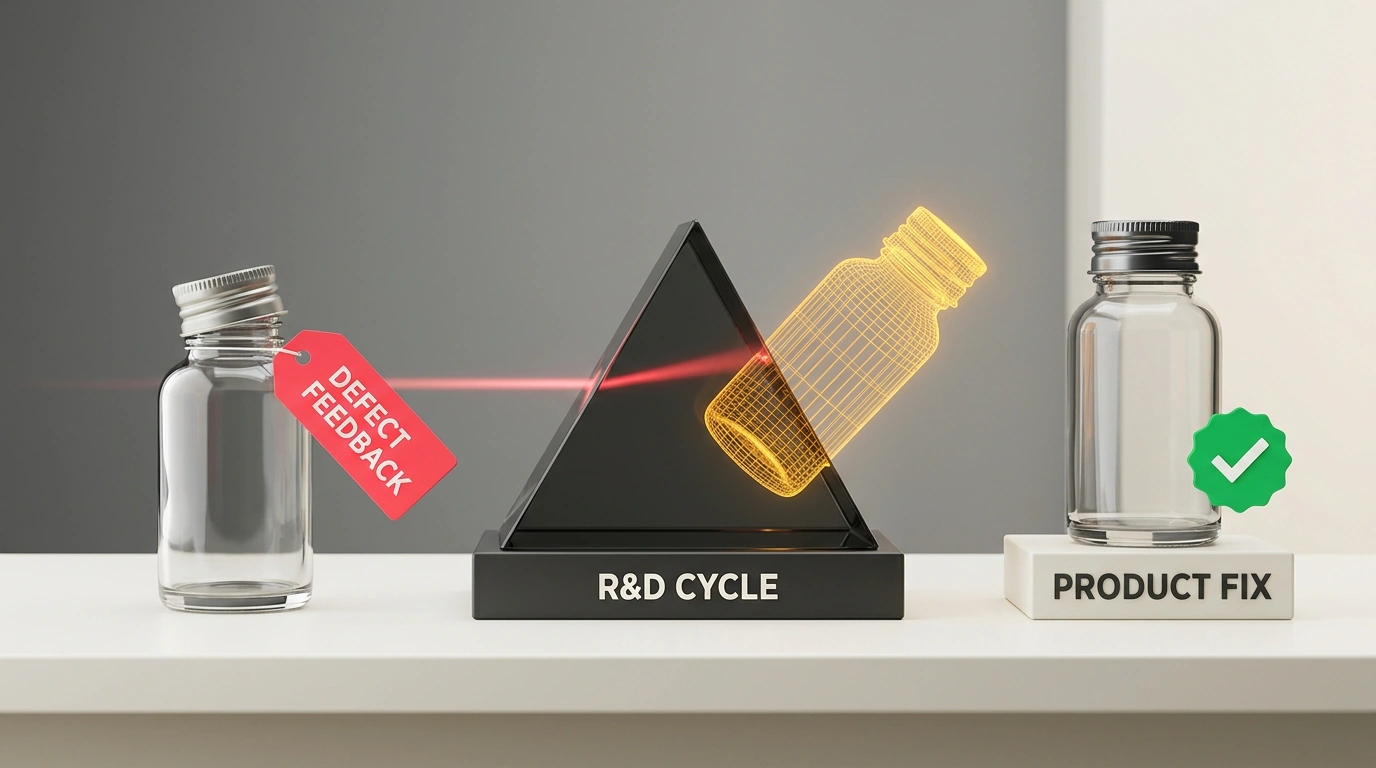
A shopper opens a marketplace product page and writes a detailed review: the lid leaked, the label peeled off, half the jar spilled out. Two hours later, a polite reply lands: "Thank you for your feedback, we'll pass this along to our team." Ticket closed, support KPI green. Meanwhile, that exact same week, the next hundred buyers receive the exact same leaking jar.
In retail and e-commerce, reviews are too often treated as rating cosmetics—put out the comment fire and move on. The problem is that a boilerplate reply fixes the chat thread while the underlying flaw in your product or logistics keeps bleeding revenue.
Why Polite Boilerplate Hides Product Leaks
Every review does two jobs. Job one is conversational: someone spent time describing their experience and expects a human reply, not a bot script. Job two is operational. Comments expose what internal dashboards miss—where items break in transit, which flavor annoys buyers, and where checkout or service stalls.
Stopping at apologies costs businesses twice. In a 2025 PwC survey, 52% of consumers stopped buying from a brand after a bad experience. That covered overall customer experience rather than comments alone, yet a single complaint often signals a buyer already half out the door.
The second hit hurts more because it stays invisible. A 2026 Qualtrics XM Institute study (20,000+ people across 14 countries) found only 29% of unhappy customers report issues directly to the company, while 30% say nothing to anyone and silently defect to a rival. That is silent churn.
Zero complaints does not mean high quality. Only the loudest top slice writes to support or marketplaces; everyone else votes with their wallet quietly. And the harder shoppers check ratings before buying, the costlier every unfixed product flaw becomes.
How Russian Shoppers Research Products Online (VCIOM & E-Commerce Union, Jan 2026)
The chart makes one thing clear: in buying mode, shoppers turn into skeptical detectives. They cross-check marketplaces, read ratings, and scan real experiences. When a repeating complaint sits in your reviews beneath a dry "noted," your paid ad traffic crashes into that wall week after week.
Gathering Signals Without Drowning in Noise
A fair question follows: "Okay, we stopped sending boilerplate. How do we tell a real product defect apart from one person having a bad morning on the subway?"
Use a Voice of Customer (VoC) loop—a steady pipeline where reviews don't stop at moderators, but flow from every channel, get sorted by root cause, and land with whoever owns product, logistics, or retail stores.
Rule one of VoC: never trust raw complaint counts. Ten angry reviews a month mean nothing across 100,000 orders and spell disaster across 50 orders. Tag every complaint by root cause (formula, packaging, transit damage, shelf display, service), then track complaint rate per comparable order volume.
Next, cross-check against hard operational data: returns, sales velocity, repeat purchases, mystery shops, and lab checks. When the same complaint spikes in reviews, pushes up return rates, and shows up in store checks, you have a systemic issue—not random venting.
Leading chains don't wait passively either. Dodo Pizza invites selected app raters to complete detailed mystery-shopper audits scoring taste, dining-room cleanliness, and staff service. At Arnest UniRus (major Russian FMCG maker, formerly Unilever Russia), an internal employee channel lets any staffer spotting a dented box or messy shelf snap and flag it straight to operations.
Two easy-to-miss habits matter too. First, read positive reviews where buyers explain why they love an item—so you don't accidentally break winning traits during updates. Second, launching an easy feedback channel almost always spikes complaint counts initially. That isn't falling quality; you are finally seeing part of your silent churn.
From Complaint to Task: Routing Fixes and Proving Impact
Once signals are cleaned of noise, route cleanly: local glitches go to the store or warehouse; systemic flaws go to product.
According to a May 2026 ROMIR study, 46% of shoppers judge external appearance when picking products. A batch can leave the factory spotless and get crushed during shipping, storage, or shelving. Arnest UniRus splits those two paths: local store issues go to merchandisers who fix storage and displays, while R&D investigates systemic drops tied to sales and rival benchmarks to adjust formulas or packaging. Per its non-financial report, this helped cut negative reviews by 10% in 2025.
Buyers rarely hand you engineering specs—they simply point out where expectation missed reality. At VkusVill, shoppers complained about hard seeds inside a sea-buckthorn dessert filling. Food technologists reviewed the feedback stream and switched from whole berries to smooth purée—making the soufflé softer and eliminating seeds.
Sometimes feedback tells you to step backward. Dodo Pizza updated the sauce recipe on its meat pizza, and guests disliked it. Rather than stubbornly defending the "new standard," the chain rolled back the original sauce. Reverting a bad update beats losing regulars.
Hardest of all is verifying whether a fix worked. Raw complaint numbers swing with seasonality, order volume, assortment shifts, and platform quirks. Pick metrics tied to the specific defect and, where possible, pilot fixes on one batch or store group against a control group.
| Issue Type | Owner Team | Key Check Metric | How to Verify Without Illusions |
|---|---|---|---|
| Packaging or shelf display | Logistics, warehouse, merchandising | Damage complaints per 1,000 orders | Mystery purchases and comparison against untouched stores |
| Taste or formula | Product, technologists, R&D | Taste ratings and repeat purchase rate | Pilot batch/segment vs. control group |
| Post-update backlash | Product and operations | Rating recovery and repeat orders | Before/after check across equal sales volume |
| Spike on a new channel | Analytics and support | Cause share per order volume; returns | Cross-check sales and returns to confirm real defect |
Watch repeat purchases closely. If complaints drop yet customers still don't reorder, your fix missed the mark or solved only half the problem.
The 'We Heard You' Effect: Closing the Loop Without Empty Slogans
Fixing the product internally is three-quarters of the job. A buyer burned by a leaky lid or hard seeds won't magically know you fixed it. The final step is closing the loop: telling buyers publicly or directly what changed.
Empty lines like "we listen to our customers" tune out instantly. Stick to three concrete beats: what buyers spotted, what you checked, and what is different now—just like VkusVill's "We Got Better" updates explaining fixes like that sea-buckthorn soufflé.
Keep balance, though. If audits, returns, and sales show no systemic flaw, don't redesign a product around one loud comment. Calmly explain your findings and constraints rather than letting random negativity dictate your lineup.
Four-Step Customer Feedback Loop
- Gather signals across every channel: marketplaces, support, in-app ratings, mystery shoppers, and staff notes.
- Tag complaints by root cause normalized by order volume, while logging product strengths from positive reviews.
- Route systemic issues to owners (store/logistics or product/R&D), pilot fixes, and track repeat-purchase lift.
- Close the loop publicly via 'what you noticed -> what we checked -> what changed,' or explain clearly why nothing changed.
When support logs experience, analytics spots patterns, owners fix root causes, and marketing shares the result, reviews stop gathering dust in monthly decks—and keep your brand promise honest.