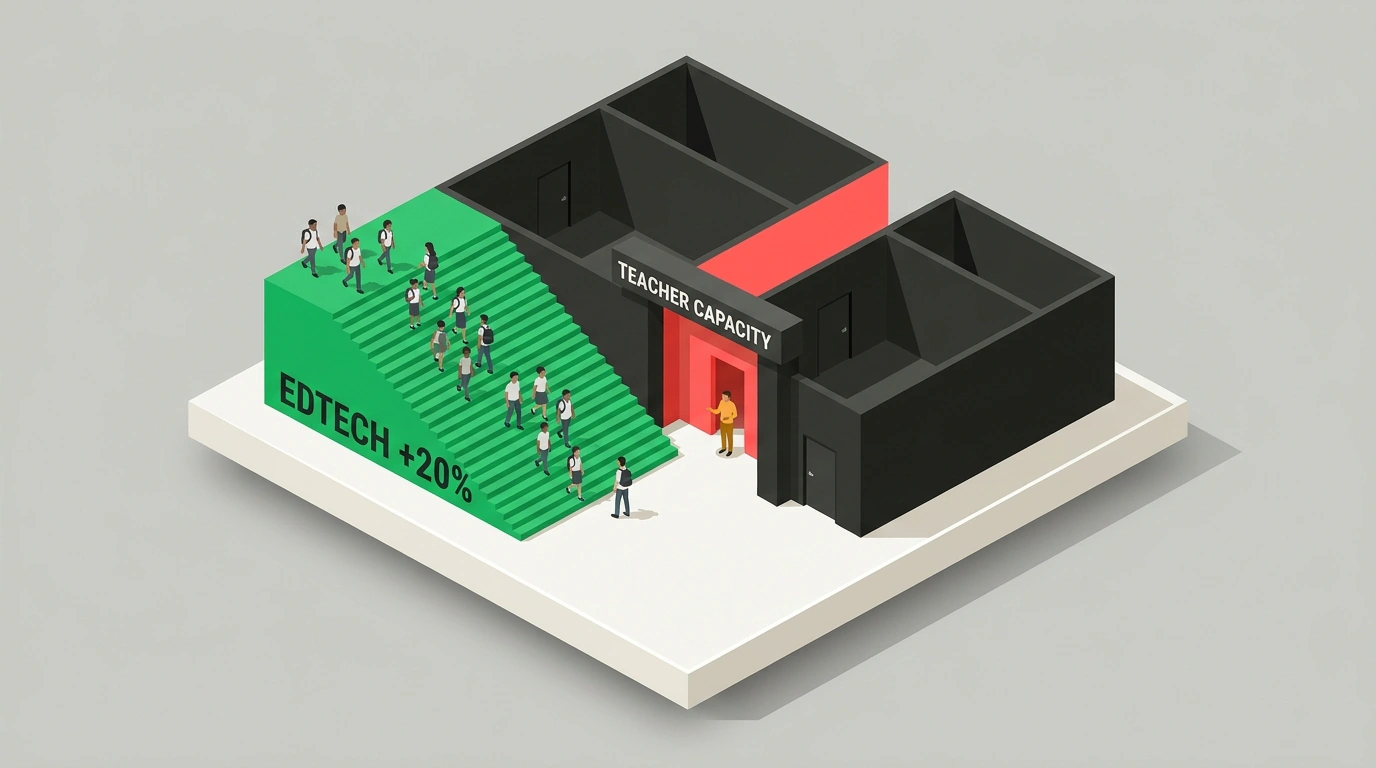
Two facts sit side by side and barely fit the same slide. Russia's kids' EdTech market (online schools and digital learning platforms for school-age kids) is surging: in Q2 2026 it jumped 22% YoY to 14.1 billion ₽, capturing 39% of top-100 industry revenue. Meanwhile, adult continuing education (DPO) next door flatlined at +0.2%.
Looks like a gold rush: crank up ad spend and harvest leads. In reality, the opposite happens. The moment a kids' online school doubles ad budgets, it frequently hits a cash crunch instead of double profit. Dashboard revenue climbs while the bank account runs dry.
Where 20%+ Growth Comes From—and Why It Lulls Founders
Zoom out to Russian EdTech as a whole, and euphoria cools fast. Per Smart Ranking, overall top-100 growth slowed to 11–12% YoY in 2026: 73.6–73.8 billion ₽ in H1 and ~119 billion ₽ over nine months. Adult courses sagged on cooling demand and tighter corporate training budgets, leaving the kids' segment to pull the entire sector.
Two engines drive it. In Q3 2026, homeschooling (systematic online replacement for brick-and-mortar school) jumped 37.3% to 3 billion ₽, while exam prep grew 35.2%. Demand is grounded: stricter 10th-grade selection, shifting college/university admission rules, and teens flocking to coding, AI, and content-creation courses.
Q3 2026 Russian EdTech market results showing revenue of top companies, growth rates, and segment shares (Source: Smart Ranking / edtechs.ru)
Major players like Foxford, Uchi.ru Group, Algorithmics, Online School #1, and 100ballny Tutor adapted early—shifting away from aggressive traffic buying toward base retention, group cohorts, career guidance, and multi-year tracks from elementary school through final exams.
Small and mid-sized founders, however, get lulled by brisk early category numbers. First sales come easy, creating an illusion that demand will carry any ad budget. Yet the market matured and stopped rewarding raw lead volume: signing your first students and building a repeatable profitable model are two very different jobs.
The Dual-Customer Trap and Blurry Buyer Profiles
Mistake one happens at positioning. There is no single "kids' EdTech" market. Under one roof sit OGE/EGE exam prep, homeschooling, languages, coding, preschool, clubs, tutoring, and school software. Each has its own sales cycle, ticket, renewal rhythm, and churn triggers.
Write "parents of kids aged 7–17" on a creative brief, and you burn cash on click one. That buyer doesn't exist. Look how differently families buy inside one segment:
| Buying Situation | Decision-Maker | What the Family Actually Buys | Where Generic Offers Break |
|---|---|---|---|
| Elementary school | 2nd-grader's mom | Safe environment, routine, consistency | Dry exam-focused pitch |
| Homeschooling | Family replacing traditional school | Structure, guidance, accountability | Pitching 'access to video library' |
| OGE/EGE exam prep | 9th/11th-grader and parents | Target exam scores and clear study plan | Vague 'we'll boost grades' |
| After-school club | Parent with free evening slot | Kid engagement and useful hobby | Heavy school-like workload |
Start from the buying situation, not age brackets. "Parents of 7–17-year-olds" says nothing. "Parent of an 8–11-year-old frustrated with school support, ready to pay 8,000–15,000 ₽/month for structured lessons with feedback" gives you a real target—making your offer, traffic channel, and price ceiling obvious.
Second is the dual-customer effect. Parents pay; kids attend class. Engagement depends on the child, yet an adult pulls out the card each month. And parents aren't buying "lessons" or "platform logins." They buy a clear change: child confidence, visible subject progress, less parental anxiety, and a predictable roadmap.
Fail to prove that progress, and you re-sell your school from scratch every month—triggering churn, constant discounts, ad addiction, and low LTV. Even in booming homeschooling, opening a portal isn't enough; families need mentoring and oversight. Bake measurable progress into the product before buying ads: after 12 lessons the student solves target problems, every two weeks parents get a progress report, and before exams students take mock tests with a clear prep plan.
Four Bottlenecks That Break Schools When Budgets Double
Say you narrowed your segment and sharpened the offer. Why do unit economics still crack when you double ad spend? Projects hit four systemic walls.
Wall one: broken student economics. Revenue climbs while profit melts because CAC (full cost to acquire a paying student across ads and sales reps) outruns LTV (total revenue a student brings before leaving). The classic money-losing loop is familiar: ads bring a lead, a rep closes month one with a heavy discount, teacher pay and support eat margin, the family skips month two—and the school sprints back to buy more ads. Growth outside, hand-to-mouth inside.
Seasonality hits cash harder. Summer study activity drops, burning ad dollars during worst-case conversion and renewal months. Uchi.ru explicitly flags Q3 as low season, making nine-month views far more honest. Track full cohort unit economics: CAC, paid conversion, average ticket, lifespan, cohort retention (share of a cohort still paying in months 2, 3, and beyond), renewal cost, refunds, and net margin after teacher, content, and support costs. If LTV doesn't beat CAC with room to spare, doubling ad spend doubles losses.
Wall two: content stopped being a moat. Two years ago, crisp workbooks and studio videos beat rivals. Today that is table stakes: industry digest estimates suggest 85% to 93% of online schools already use AI to speed up lesson, quiz, and feedback creation. A "unique curriculum" impresses nobody alone. Revenue and retention follow the full student journey: diagnostics, personalized plan, live/structured classes, feedback, progress tracking, parent check-ins, and measurable outcomes.
Wall three: scaling marketing instead of the model. If product quality, onboarding, and retention buckle under load, extra ad spend just exposes cracks faster. Sales resting on founder charisma, one star rep, or one lucky month make a solid boutique business—not a scalable machine.
Wall four: headcount outruns systems. Education easily falls into "manual growth": the founder closes tough deals, curriculum leads patch lessons on the fly, teachers carry struggling kids heroically, and managers put out chat fires by hand. At 10 students, heroism works. At 100, the system chokes before the ad budget runs out—because you lack hiring playbooks, sales scripts, onboarding rules, lesson QA, complaint handling, and financial reporting.
What to Fix Before Doubling Your Traffic Budget
Scaling starts with repeatability, not topping up ad accounts. Run your school through six questions before raising spend:
Repeatability Test: Six Questions Before Scaling Spend
- Where exactly do qualified leads that actually convert to payment come from?
- Which specific offer converts steadily without one-off discounts?
- Who closes sales, and using what repeatable script?
- How fast does a student hit their first visible win?
- What specifically keeps families paying in months two and three?
- Which metrics must move for a new product line or channel to pay back?
If answers wobble or depend on one person, hold off on new cities, ages, or subjects. Lock one segment, one offer, and one channel into steady profit first, then replicate.
Skip heavy bureaucracy—you don't need manuals for every click. Nail four core workflows: acquisition & sales, student onboarding, lesson quality control, and parent communication. One litmus test: if you can't hand those four areas to a new hire in two to four weeks without quality dropping, you aren't ready to scale traffic.
All prep fits into a clean 90-day plan. First, narrow to one buying situation, one age bracket, one pain, and one measurable outcome. Second, build honest cohort economics (CAC, conversion, ticket, retention, LTV, margin). Third, wire visible progress so parents see movement in the first 2–4 weeks. Fourth, treat renewal as a product feature rather than a sales-team chore. Fifth, map the student journey from inquiry to renewal with clear owners at every step. Only at step six—once the core engine prints reliable profit—open a new channel, city, or course line.