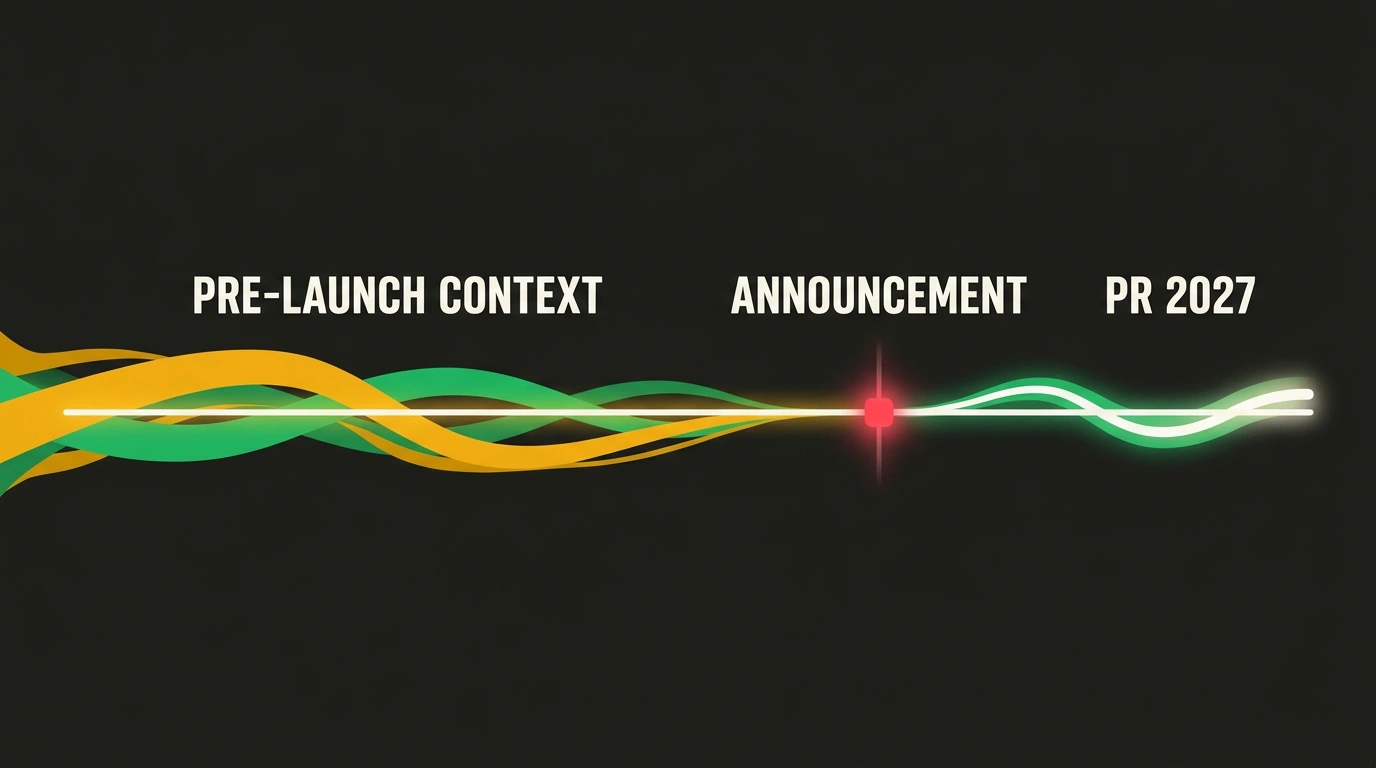
Late 2026 brought 2027 forecasts from Worldcom, PR Daily, and 5WPR, fresh data from Edelman Trust Barometer and Reuters Institute, and the updated AMEC 4.0 standard. Put those eight PR trends together, and one shift jumps out: PR is moving from the finish line straight to the starting blocks.
Historically, teams called PR once a product was built and ready for a press release. Now the toughest PR questions land before any announcement: how will people react, and what will AI assistants say about the brand?
Audit Decisions First, Announce Second
Worldcom predicts preventive PR will become standard in 2027—bringing comms teams into pricing updates or reorganizations before launch. Teams run a reputational audit: stress-testing the plan through the eyes of customers, staff, and partners. That catches phrasing that sparks anger, promises operations can't keep, and details worth clarifying upfront.
Fixing clumsy terms on paper costs far less than putting out comment-section fires later.
Internal comms is shifting too. Per Gallup data on AI adoption, managers must be the first to explain clearly what changes in staff roles and which questions remain open. Meanwhile, PR Daily sees crisis plans evolving into joint live drills for executives, PR, and frontline teams. Rehearsals quickly expose who can fact-check fast, who holds authority to speak for the business, and where approvals stall.
Trusted Channels and Monitoring AI Answers
As ad claims lose punch, trusted media channels—places where unpaid customers, employees, and peer communities talk—take center stage. In Edelman Trust Barometer 2026 (~18,000 respondents across 15 countries), unpaid third-party voices shaped trust more than brand statements—driving demand for practical client case studies showing problem, change, and proof.
One real customer story travels faster than any glossy press release.
For the same reason, T-Business observes more hands-on builders—the engineers and specialists making the product—speaking in press and on stage. Audiences want real kitchen details: mistakes made, fixes shipped, and why a choice worked. A 2026 Reuters Institute survey across nine countries explains why human voices beat generated copy.
Reader Comfort with Different News Authorship (Reuters Institute, 2026)
Readers accept AI as a helper, yet reject fully generated copy—and even "human oversight" barely rescues AI-written text. Offline shows the same hunger for real contact: in a 2025 Harris Poll for the Freeman Trust Report, 95% of US professionals trusted a brand more after in-person networking events. Since Edelman, Reuters, and Freeman surveyed international samples, treat those figures as directional shifts rather than local benchmarks.
Meanwhile, 5WPR warns that AI assistant monitoring is now core PR work. An EBU and BBC study (News Integrity in AI Assistants, 22 outlets, 18 countries, 14 languages) found serious flaws in 45% of AI answers and defects of some kind in 81%—most often broken links (31%) and factual or outdated-data errors (20%), ranging from 30–37% critical failures in ChatGPT, Copilot, and Perplexity up to 76% in Google Gemini.
An AI assistant will happily quote your old pricing to a buyer without blinking.
PR teams now need to audit three or four major assistants regularly and scrub outdated source pages.
Pilot Collabs and Vanity-Free KPIs
T-Business notes that brand collaborations are moving away from raw reach. Before launching, partners check audience overlap, real buyer value, and shared goals, locking team contributions and success metrics upfront—starting with a tight pilot to test response and teamwork instead of giant rollouts.
In executive reporting, clip counts no longer cut it. Updated in June 2025, the AMEC Barcelona Principles 4.0 tie outputs (publications) to outcomes (audience behavior shifts) and business impact. They explicitly reject AVE (Advertising Value Equivalency—converting articles into ad-rate dollars), require pairing numbers with qualitative context, include AI platforms, and demand transparent data and evaluation methods.
A slide saying "we landed in twenty outlets" no longer defends your budget.
When planning 2027 PR, work backward: decide which relationships matter most right now and what blocks them, then split budget across press, case studies, pilots, and live events.