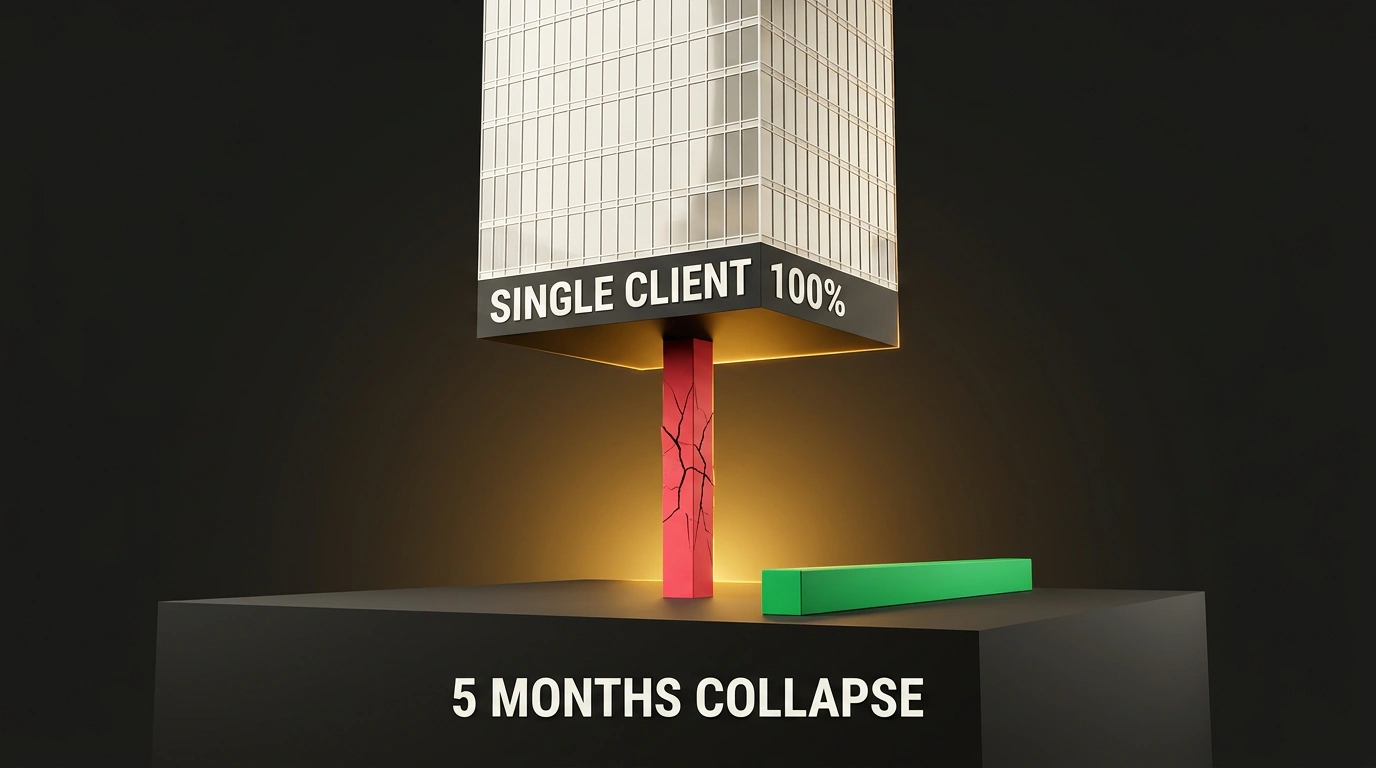
It is an ordinary, brutal story. Strong engineering team, fresh funding round in the bank, roadmap stretching toward an IPO. At the first marketing kickoff, someone asks a simple question: where does revenue come from right now? Answer: one major client covers current revenue, while investor cash funds growth.
Five months later, the round ran dry. That exact month, the anchor client changed executives and paused the contract. Yesterday's IPO hopeful dropped into survival mode in two weeks—zero cash cushion, zero backup sales channels.
How an Anchor Client Puts Sales to Sleep
Early on, one steady buyer is normal. That anchor client keeps the team busy and pays bills while the product matures. Danger begins when your whole strategy rests on one contract with no backup runway.
Teams fall into two traps. In trap one, funded founders vanish into endless "packaging": polishing the website, redrawing decks, hiring PR agencies, and tweaking positioning. Everything looks impressive outside while net-new deals stay at zero.
In trap two, founder beliefs block action. In a similar IT case, shareholders insisted the market was "locked up" and big enterprises only bought through personal connections—so testing demand or outreach was pointless. The company had zero sales function: nobody knocked on doors. Founders saw the single-client risk yet coasted while checks kept clearing.
Dependency carries a side effect too. Once a client realizes they drive most of your revenue, negotiating power collapses: they push custom features onto your roadmap, demand discounts, and stretch payment terms to 90 days—squeezing margins and leaving even less time to hunt alternatives.
Why Five Months Isn't Enough to Restart from Zero
From outside, it sounds simple: lose a client, hire reps, run ads, plug the hole. In enterprise B2B, that math fails.
Overall SaaS sales cycles average ~84 days, pulled down by cheap self-serve SMB card subscriptions. Mid-market deals take 3 to 6 months; large enterprise B2B runs 6 to 12 months from first call to cash in the bank.
No executive order speeds that up. Enterprise buying runs through 6-to-10-person committees—business sponsor, IT, security, legal, and finance. Benchmarks show the final stretch alone (negotiations, redlines, compliance) eats 35–40% of total cycle time. Starting to build a pipeline the day your anchor client pauses guarantees a cash crunch before your next deal closes.
Concentration Thresholds and Storm Insurance
Investors and acquirers ruthlessly discount revenue concentration—one customer's share of total revenue. Reporting rules IFRS 8 and US GAAP ASC 280 force public and IPO-bound firms to disclose any customer crossing the bottom threshold below. Subsidiaries under one holding company count as one client—splitting invoices across three sister entities won't hide it.
| Single Client's Revenue Share | How Investors & Buyers Score It |
|---|---|
| Under 10% | Low risk, healthy baseline |
| 10–20% | Deep audit of contract & renewal history |
| 20–30% | High risk: 15–35% valuation discount or deferred payout |
| Over 30% | Deal-breaker for many funds and acquirers |
In high-risk deals, buyers protect themselves with earnouts—holding back part of the purchase price unless the anchor client renews. Mature B2B firms also watch a second guardrail: your top five clients combined shouldn't exceed half of total revenue.
Check your company's exposure against four warning signs:
Four Red Flags of Single-Client Dependency
- One customer generates the bulk of your revenue.
- Your company lacks a real staged pipeline of upcoming deals.
- Budget and energy go into packaging (site, decks, PR) with zero sales growth.
- Nobody on the team owns active outbound sales and demand testing.
If two or more match, rebuild your revenue engine now. Launch second sales channels and hypothesis tests during calm months while funding or anchor checks flow—and weave your core contract across multiple client departments and multi-year terms so one executive change doesn't sink your business in a week.