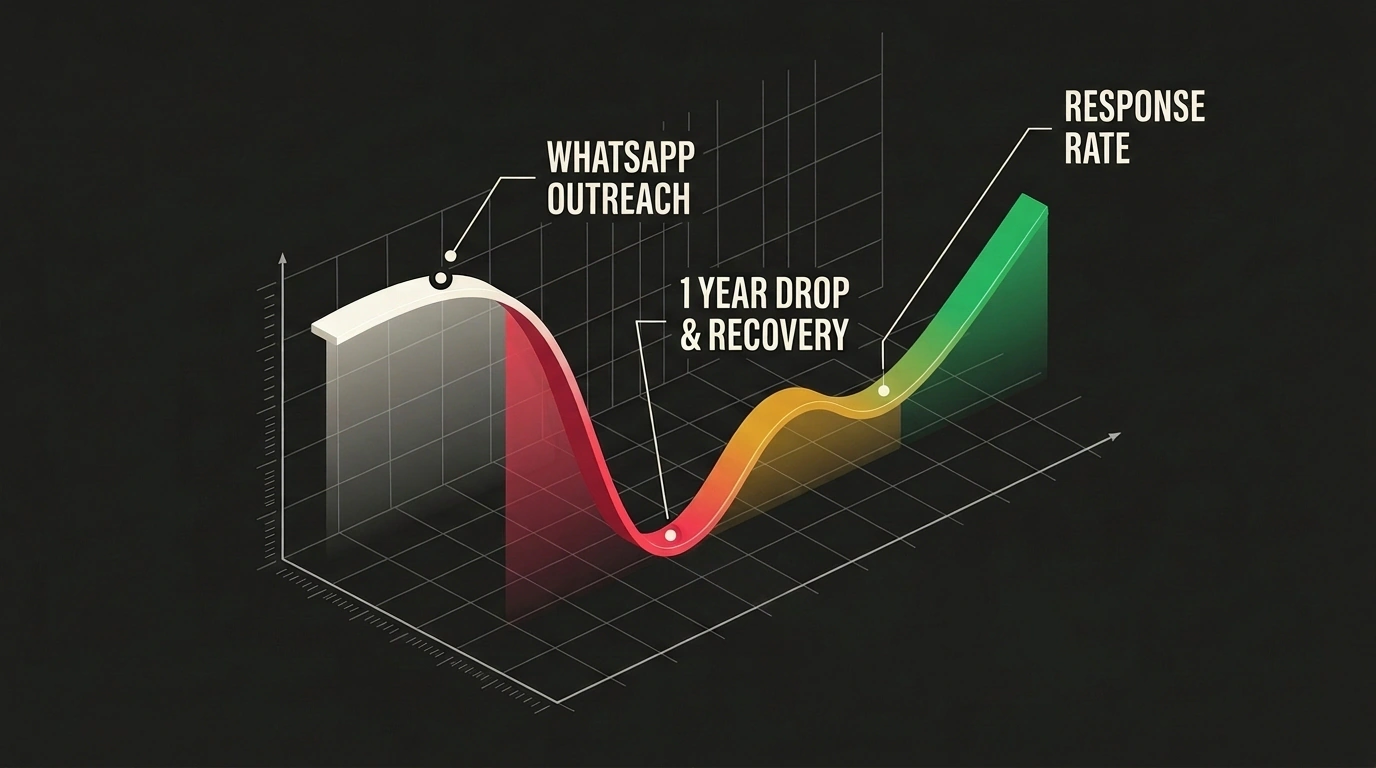
When Roskomnadzor announced phased restrictions on WhatsApp in late November 2025 (owned by Meta, designated an extremist organization and banned in Russia), sales teams saw an obvious call: archive WhatsApp and move every outreach list to Telegram. Winter delivery glitches deepened, and spring numbers seemed to prove them right—reply rates collapsed nearly threefold.
Over a full year, things flipped. WaLead, which runs monthly outbound messaging via live human operators (short scripted chats rather than bots), tracked tens of thousands of contacts across WhatsApp, Telegram, and Max. By November 2026, WhatsApp reply rates recovered and outperformed Telegram on identical contact lists.
How Replies Sank and Rebounded Over 12 Months
To keep stats honest, reply rate measured responses to message two—the one carrying the actual offer. Replies to message one weren't counted, since the opener was always a brief non-promotional greeting.
Reply Rate to Offer Message #2 in WhatsApp
After peaking in December, the channel plunged to an April floor: monthly volume shrank to 4,200 contacts as replies fell nearly 3x. Digital Budget Android data mirrored that drop—from September 2025 to September 2026, Russian monthly WhatsApp users fell 30% from 82 million to ~57.9 million.
By summer, the slide stopped. Digital Budget logged Android user gains of +1.7% in July and +4.4% in August. WaLead's chats bounced right on cue, scaling back up to nearly 80,000 monthly contacts by November. Two shifts drove it: users set up VPNs and returned, while operators stopped blasting dead numbers and filtered lists by last-seen online activity.
Why WhatsApp Draws More Replies Than Telegram
On paper, Telegram looks easier: no workarounds, massive reach. In practice, recipient fatigue decides. Across 19 campaigns running identical lists on both messengers, WhatsApp beat Telegram on reply rate in 12 projects—nearly doubling it in three. November 2026 averages hit 26.0% on WhatsApp versus 22.3% on Telegram.
The cause is technical. Spinning up mass bot blasts on Telegram is cheap and easy, flooding personal DMs with cookie-cutter pitches until users archive strangers reflexively. WhatsApp polices devices and accounts harder, keeping SIM-farm spam bursts smaller. Less inbox noise means real human messages get answered.
Four Details Behind a Working Script
Close inspection shows why some teams print leads while others waste lists. First, number-checking: in November 2026, checkers found WhatsApp accounts for 78% of lists, yet many sat dead since winter. Messaging purely on "account exists" shoots into thin air—filter by recent online activity.
Second, never put a link in message one. When an unknown number sends a URL upfront on WhatsApp, the app often strips clickability into plain text—looking broken and spammy.
Run a two-step dialogue instead: send a short, personalized question first with zero pitch. If silent after 5–6 hours, send a gentle follow-up rephrasing the question. Only after they reply does the operator share the offer ending in a closed question. Long cold pitches fail flat.
Most importantly, assuming "all our clients live on WhatsApp" is expensive. Even with WhatsApp carrying the biggest share, relying on one app is fragile. Build an omnichannel fallback: check contacts across WhatsApp, Telegram, and Max, and message people where they are actually active.