Online sellers used to face a simple fork: chase ready traffic on marketplaces and eat commissions, or build an independent site and pay for every click. By late 2026, major players are breaking that binary—launching direct storefronts atop marketplaces, merging pickup points with grocery chains, tying retail to banks, and testing stair-climbing robots.
Russian E-Commerce Hits 10.85 Trillion ₽ in 9M 2026 (+16.6%)
Over the first nine months of 2026, Russian online retail climbed 16.6% YoY (+1.54 trillion ₽) to 10.85 trillion ₽, per AKIT—capturing 21.6% of all retail. Domestic platforms hold 96.6% (10.48 trillion ₽) against 3.4% cross-border (374.3 billion ₽), with 70%+ of purchases flowing through digital platforms used monthly by ~80% of Russians.
Leading Russian E-Commerce Categories in 9M 2026 (AKIT)
Everyday categories—home, food, and clothing—now outpace electronics, while digital goods grew fastest (+38.6% YoY).
Yandex Factory Launches Tuvio, Pragma, Commo, and Muted D2C Stores
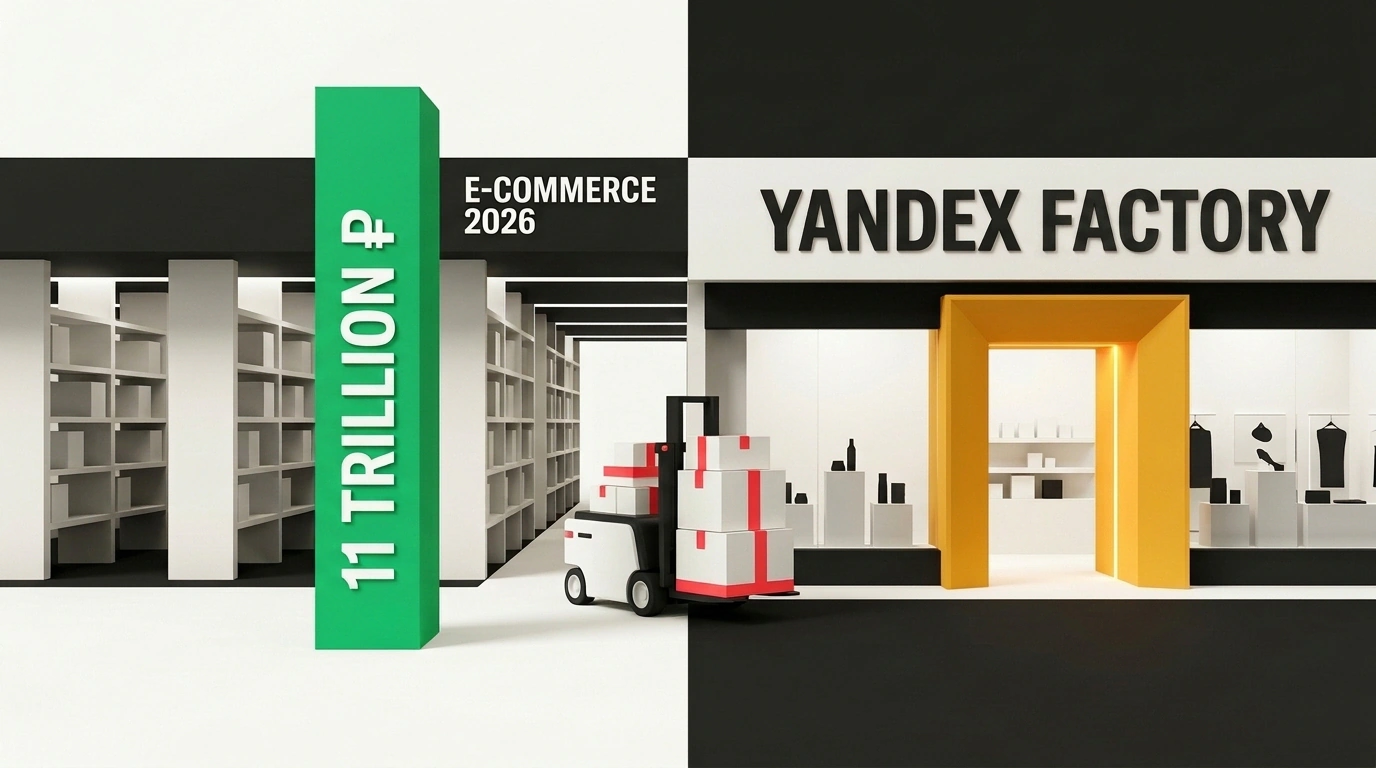
Yandex Factory (Yandex's 11-brand private-label unit) opened direct D2C sites for Tuvio appliances, Pragma home goods, Commo accessories, Muted apparel, and a unified 11-brand store—powered by Yandex KIT handling catalog, checkout, payments, and delivery. On marketplaces, brands fight rivals on price; on owned sites, Muted curates full outfits and the multi-brand shop cross-sells (cables with chargers, Pragma cookware with Tuvio tech) while staying listed on Yandex Market, Ozon, Wildberries, Lamoda, and offline. Unified loyalty perks and sites for Junion, Nocord, Lunnen, Raskat, and Cubits come next.
Economy Ministry Proposes Merging Marketplace Pickup Points and Offline Retail
Under a draft National Digital Platform Strategy through 2036 submitted to the government, Russia's Economy Ministry proposed turning pickup points (PVZ) into multi-brand mini-hubs serving multiple marketplaces, chains, and sellers (even subletting spare space to cafés), while allowing supermarkets to store, pack, and hand out online orders.
With half of PVZ owners seeing agent fees drop, shared capacity helps preserve margins and reach small towns—mirroring market moves where Wildberries opens partner counters inside stores, banks, and gas stations and over a third of X5 supermarkets fulfill online orders. Businesses want participation strictly voluntary, with unified quality and tracking rules still unwritten.
VTB Plans to Buy Into RWB Fintech Assets by Year-End 2026
First Deputy Chairman Dmitry Pyanov confirmed VTB expects to finish its secondary share offering and buy into RWB (Wildberries & Russ) fintech assets by year-end—starting with 5% of WB Bank (with an option to increase) plus minority stakes in group fintech units. VTB is issuing up to 6.292 billion shares at 87 ₽ (above market price, aimed at anchor buyers rather than retail) to raise 300–400 billion ₽ while keeping state ownership above 50%, alongside readiness to meet Central Bank terms for a stake in Mir operator NSPK.
Yandex Pilots Rover-to-Humanoid Robot Last-Mile Delivery
Yandex's wheeled delivery rovers handle sidewalks well, yet stop at stairs. Before year-end 2026, Yandex is piloting a four-location relay: a rover brings the order to the building entrance, and a bipedal humanoid robot carries it up the stairs straight to the customer's desk. Yandex confirmed the test without sharing locations, models, or budget. Don't expect couriers replaced in 2027—payload limits, obstacle navigation, small AI error rates, and hardware costs don't pencil out yet—making this a live training ground for Physical AI software.