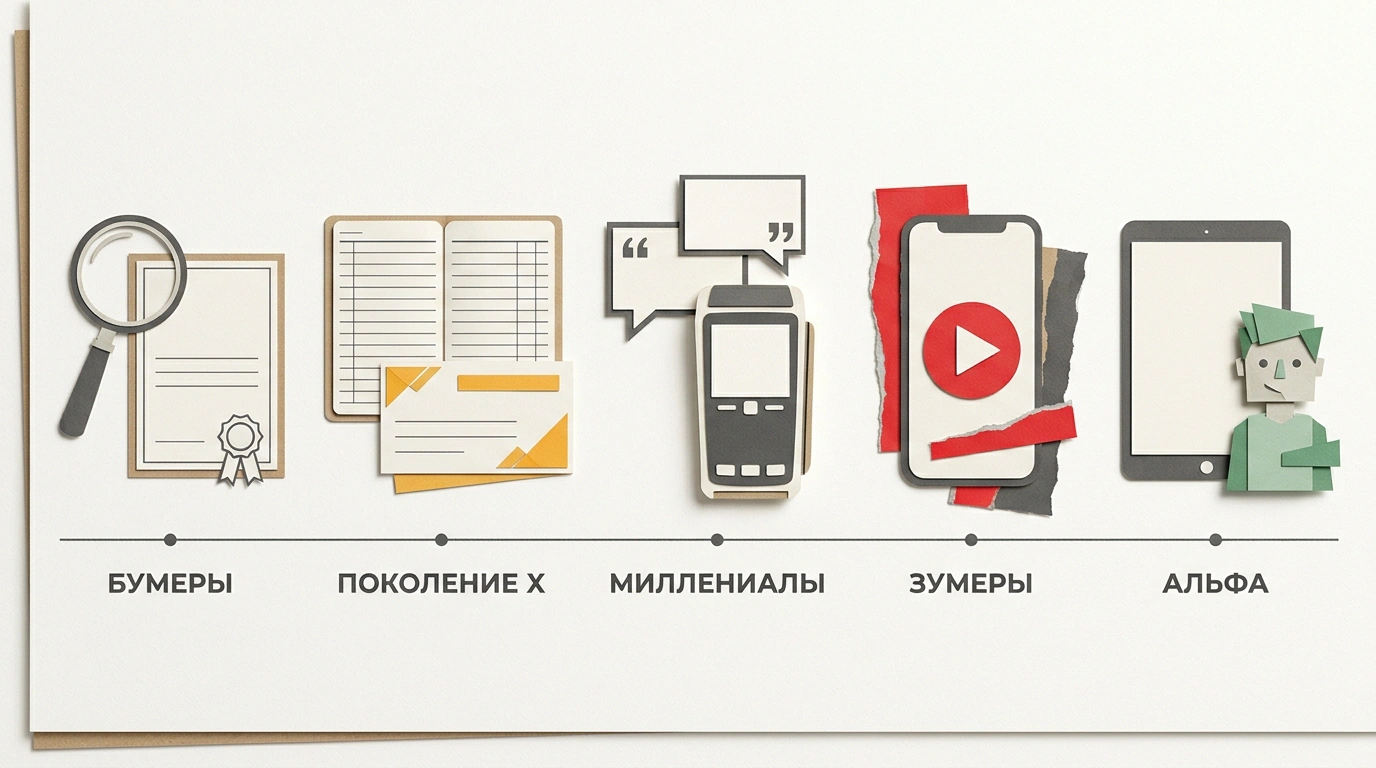
Picture a typical planning meeting before an ad launch. The product is the same, say, solid home appliances or running shoes. A brief sits on the table, and the 'target audience' box holds the classic placeholder: 'men and women aged 25–55, middle income and above.' The ad budget goes into the auction, and the conversion circus begins. One buyer closes the site because they couldn't find a manager's phone number or detailed specs. Another scrolls past polished studio photos to hunt for real reviews on a marketplace. A third skips search altogether and orders a similar model after a 15-second video in their feed.
It's the exact same product, yet three completely different paths to checkout. This is where XYZ generational theory helps. It breaks down a faceless age range into clear behavioral habits: what people trust, where they research a brand, which arguments make them hesitate, and what kind of ads make them cringe. Still, this tool only works as long as you treat it as a hypothesis generator, not a horoscope based on birth years.
Where Generational Theory Came From and Why Russian Dates Are Shifted
In 1991, American researchers William Strauss and Neil Howe published Generations. Their core idea was simple and catchy: people who grow up in the same historical era live through shared crises, technological leaps, and cultural shifts. These shared circumstances shape similar baseline attitudes, from how people view money and risk to whether they trust advertising. In the Strauss–Howe model, a new generation arrives every 20–25 years, and a full cycle of eras takes 80–90 years.
Sociologists call this the cohort effect. It's different from a standard age effect. An age effect is what happens to anyone as they get older: starting a family, earning more, or changing priorities. A cohort effect is baked into the experience of growing up. Someone who stood in line with their parents for scarce sausage at age ten reacts differently to discounts, warranties, and loud slogans than a teenager who has had a smartphone and AI tools since first grade, even if both earn the same salary today.
For business, this has a direct practical use. Instead of an abstract 'woman aged 30–40' persona, you get a starting set of working hypotheses: which channels to test first, what to emphasize in your offer, and what tone to use in messages. It doesn't replace analytics or live customer interviews, but it saves a lot of time at the start.
Here comes the main catch that Russian marketers keep running into. Strauss and Howe built their original theory on American history: the postwar US boom, Vietnam, and Watergate. In Russia and the post-Soviet space, very different events shaped those same decades: the late USSR and shortages, perestroika, the collapse of the country, the turbulent 1990s, the 1998 default, the 2000s boom, the 2008 crisis, and the rapid digitalization of the last fifteen years.
Because of this, two different birth-year scales circulate in the market. The international Pew Research Center standard, used in most Western and many Russian marketing guides, follows the US grid: Boomers (1946–1964), Gen X (1965–1980), Millennials (1981–1996), Gen Z (1997–2012), and Alpha (2013–2025). Meanwhile, the Russian school RuGenerations, led by Evgenia Shamis, adapted the theory to local history back in 2003–2004 and shifted the borders by 3–8 years. According to the Russian scale, deep values form before age 10–12. That puts Baby Boomers at 1944–1963, Gen X at 1964–1984, Millennials at 1985–2003, Gen Z (called Homelanders there) at 2004–2024, with a new wave starting in 2025.
Comparative timeline diagram of two generational theory scales: the international standard and the Russian adaptation with historical milestones.
There's no point panicking over this gap. Border years like 1981–1984 or 1997–2003 easily move from one cohort to the next depending on the chart. In real sales, what matters isn't the number in a passport, but a person's actual life stage and buying habits. You can use the Pew scale as a single reference point for age in 2026, while always keeping the local historical context in mind.
Five Generations on One Map: Who Buys and How in 2026
To avoid getting lost in letters and years, let's put everything into one table. It shows the international Pew borders, the shifted RuGenerations adaptation, buyers' actual ages in 2026, and the backdrop they grew up with in Russia.
| Generation | Years (Pew) | Years (RuGenerations) | Age in 2026 (Pew) | Growing-Up Backdrop in Russia |
|---|---|---|---|---|
| Baby Boomers | 1946–1964 | 1944–1963 | 62–80 years | Late USSR, Thaw, Stagnation, consumer shortages |
| Generation X | 1965–1980 | 1964–1984 | 46–61 years | Perestroika, collapse of the USSR, 1990s crisis |
| Generation Y (Millennials) | 1981–1996 | 1985–2003 | 30–45 years | 1998 and 2008 crises, 2000s growth, arrival of internet and smartphones |
| Generation Z (Zoomers) | 1997–2012 | 2004–2024 | 14–29 years | Smartphones from childhood, social media, digital environment, pandemic |
| Generation Alpha | 2013–2025 | from 2025 (new wave) | under 13 years | Digital from birth, AI, instant content access, remote learning |
The gap between these rows shows up clearly in how people in Russia spend time in front of screens. According to Mediascope, Gen Z spends over five and a half hours a day online, while TV barely runs in the background for about an hour. Millennials show a similar split: roughly five hours online and an hour and a half with TV. Gen X lives in two worlds at once. Internet penetration in the 40–54 age group has reached 96%, and they spend over four hours online, yet they still give TV around three hours a day. And the 55+ audience often breaks stereotypes: in the 55–69 group, over 80% of Russians go online (for 1.5 to 3.5 hours a day), even though TV still holds a solid five to seven hours.
The same pattern appears in online shopping. According to Data Insight and VCIOM estimates, about 92% of Russian online shoppers regularly order on marketplaces, yet they behave like visitors from different planets once inside. Gen Z scrolls marketplace feeds almost like social media for entertainment, latching onto visuals, ratings, and order counts. Millennials arrive with a clear shopping list, compare terms, and drive the core volume of online retail. Older generations start by opening detailed text descriptions of ingredients or specs, reading long reviews, and checking how the seller answers customer questions.
Same store, same product page, yet completely different trust triggers. Let's break down each cohort in detail, starting with the ones marketers underestimate most often.
Baby Boomers and Gen X: The Market's Biggest Spenders Hunt for Facts
Ad presentations love to show young, bold buyers with a trendy coffee shop in the background. Meanwhile, the main revenue in many categories has sat in the pockets of people over forty-five for years.
Baby Boomers (62–80 years old) grew up in the late USSR with lines, shortages, and a habit of inspecting an item by hand before paying. Many still work or only recently retired. They value stability, experience, and clear utility. Impulse buys are rare for them. They adopt new tech not out of curiosity, but when they see a specific convenience: booking a doctor's visit without waiting in line, sending money to grandkids, or ordering heavy groceries to their door.
The biggest mistake that costs businesses Boomers right at the banner stage is age labeling. Words like 'elderly,' 'pensioner,' or 'for seniors' clash directly with how they see themselves. The stats are blunt: 91% of women over 50 don't want to see age stereotypes in ads, and 81% don't recognize themselves in commercials supposedly made just for them. A sixty-five-year-old feels active and capable, not like 'category 60+ with a weekday morning discount.'
The second myth is that Boomers are glued to old brands forever. In reality, across many categories they switch to a new brand even more willingly than younger buyers if they see clear benefits, honest specs, and a fair price. However, pressuring them with countdown timers like '14 minutes left in this sale' backfires. Fake urgency instantly triggers defensive skepticism. A Boomer needs time to read the offer calmly and compare options.
So what actually wins Boomers over? Cite specialists, studies, and company track records. Phrases like 'recommended by doctors' or 'proven over time' still work well here. Show the values and meaning behind the product, then back them up with hard specs. Don't hide the details: this audience actually reads the fine print and checks ingredients, how things work, and warranty terms. Keep visuals easy on the eyes with large, high-contrast fonts and clean navigation without design puzzles. Traditional media like TV, radio, and print still carry high trust for them, and a live phone call or chat with an in-store consultant often closes the deal better than any online form.
Generation X (46–61 years old) is the true financial backbone of today's market. Their youth overlapped with perestroika, the Soviet collapse, and the 1990s crisis. They remember a world without the internet, yet moved effortlessly into banking apps, marketplaces, and messengers. In the global economy, Gen X has held the number one spot for consumer spending since 2021, and that lead keeps growing.
Global Consumer Spending Forecast for Gen X (NielsenIQ and World Data Lab)
The chart above shows why ignoring forty-five- and fifty-somethings is financial suicide for a business. In The X Factor report by NielsenIQ and World Data Lab, Gen X is literally called the 'CFOs of three generations.' Marketing has a precise term for them: the sandwich generation. They are squeezed between two sets of expenses, paying for their kids' education and wants while also supporting aging parents. That means one Gen X buyer in your funnel often makes purchasing decisions for three age groups at once.
By nature, Gen Xers are pragmatic, independent, and can't stand empty ad noise. A loud slogan without numbers, guarantees, or clear specs only gets an eye-roll. They compare prices and look for real value, yet they vote with their wallets for predictability: 72% of Gen X buyers choose well-known brands and walk past nameless store-owned private labels.
That's why trying to wow a Gen Xer with a 'revolutionary new release' just for novelty's sake is a weak bet. It's far more reliable to keep them through a clear loyalty program with tangible perks and honest service. On your website, they want concrete instructions, step-by-step guides, clear directions to the store, sharp close-up product photos, a solid video review, and a no-fluff FAQ. Unlike younger cohorts, Gen X still reads email newsletters. Welcome emails, useful roundups, and post-purchase thank-you notes get strong open rates, and a warm tone with light nostalgia builds trust.
There are two more details where Gen X funnels break down. First is phone contact: three-quarters (75%) of Gen Xers prefer a live call when making a final decision or resolving a dispute. If you hide your phone number in the footer and leave only a chatbot, you're handing the customer to a competitor. Second is caution with personal data. A ten-field form with no explanation will annoy them. Ask only for what you truly need to process the request, and add a short note right next to the field explaining why you need their phone or email.
Millennials and Gen Z: The Economy of Reviews, Short Video, and Authenticity Checks
Moving down the age ladder brings us to buyers where hard-sell ads stopped working ten years ago, and any overly dramatic claim turns into a meme overnight.
Millennials, or Generation Y (30–45 years old), lived through the 1998 default, the booming 2000s, the 2008 crisis, and the moment the internet moved from computer clubs into everyone's pocket. Today they form the core of paying demand for most digital services and Russian e-commerce. Millennials are used to buying online, value their time, and often pay more for experiences, convenience, and emotions than for simply owning an item.
Gen Y has a finely tuned radar for fake messaging. If a brand talks to them like a 2000s press release or uses glossy stock photos of families with blindingly white teeth, trust drops to zero. Instead, Millennials check a company thoroughly before buying. First they read real reviews and watch UGC (user-generated content: real photos, unboxings, and comments from ordinary buyers). Then they check the brand's social media to see if the account feels alive and how managers reply to tough questions or criticism. Silence in the comments or robotic copy-paste replies signal indifference, and the Millennial walks away.
What actually works with Millennials? Storytelling, shared values, and light nostalgia rather than a dry price list. An honest conversational tone where a company isn't afraid to admit a product limitation or past mistake. And, of course, a smooth digital checkout. If the mobile site lags, the cart forces email verification, or payment fails at step three, a Millennial simply closes the tab—even if they liked the product. Personalization walks a fine line here too: relevant recommendations based on past orders feel thoughtful, while aggressive retargeting that chases someone across every site for two weeks with a kettle they already bought is just annoying.
Zoomers, or Generation Z (14–29 years old), don't remember a world without smartphones, algorithmic feeds, and social networks. The older end of this cohort is already working, earning, and spending actively. By the 2030s, they will set the rules of the mass market. Their habits are full of contrasts that can look contradictory at first glance.
Gen Z Consumer Habits and Expectations
Put these numbers together and a vivid psychological portrait emerges. Most Zoomers still have modest financial cushions, yet that doesn't turn them into minimalists. They happily treat themselves to small pleasures and easily place a spontaneous order if a video in their feed hits the right mood. One striking contrast with the previous generation is sustainability: only 10% of Millennials factor it in, whereas for Gen Z, environmental care has become a noticeable filter when choosing brands.
Another major shift in sales mechanics is the move from public threads to direct messages. A Zoomer won't leave an angry comment under a post; they'll send a DM and expect a reply within an hour. Drag your feet until the next business day, and the customer has already cooled off and bought from someone who answered in ten minutes.
On the production side, Gen Z has buried the era of expensive, glossy commercials. A casual phone video in natural light with a slightly shaky camera, behind-the-scenes factory clips, and honest talk about screw-ups builds far more trust than a million-ruble studio shoot. Instead of A-list celebrities, micro-influencers who look like the audience itself perform better, along with a genuine presence in niche communities like Discord or private themed chats—strictly as a helpful member, not a banner-dropping spammer.
Visually, Zoomers comfortably absorb and even enjoy dense 'digital noise': high-contrast neon accents, glitches, and neo-brutalist aesthetics. In positioning, drawing clear lines around who belongs works remarkably well. When a brand states openly who its product is not for, it doesn't scare people off—it pulls its own crowd closer. Add co-creation like voting on a new flavor, picking a print, or joining challenges, and regular followers turn into brand advocates.
Gen Alpha: How to Sell When the Kid Asks and the Parent Pays
The youngest market participants are Generation Alpha (born 2013–2025, under 13 years old in 2026). They were born inside an ecosystem of tablets, vertical short videos, streaming, online games, and AI. The pandemic added habits of remote schooling and screen-based socializing. For them, technology isn't a tool to learn—it's the air they breathe.
The biggest business mistake is brushing Alpha off with 'we'll market to them in ten years when they grow up.' They already steer a noticeable share of the family shopping basket: choosing toys, clothes, gadgets, entertainment, and even groceries on the supermarket shelf. PwC's Generation Alpha Survey polled children aged 7–14 to see what drives their desire to buy most strongly. Social media took first place at 61%, beating influence from friends and peers (56%), physical store displays (53%), and classic TV ads (48%). Still, the wallet sits in someone else's pocket.
Who Pays for Gen Alpha Purchases (PwC)
This split creates the core mechanism of marketing to Alpha: dual communication. You sell one product to two different people with opposite filters. The child wants emotion, story, play, and status among friends—they spark the purchase and bring the idea home. The parent wants safety, usefulness, quality materials, and a fair price—they click 'pay' or put the box in the cart. If you charm the child but forget to reassure the adult, the sale dies at checkout. If you build an ideal 'useful' product that looks boring to a kid, nobody will ask for it in the first place.
How you reach Alpha also looks nothing like traditional ads. Passive video watching bores them in two seconds. You need to deliver the main hook and a vivid demo in the very first frame, or they'll swipe away. Interactive formats work far better: short quizzes, AR filters, game tasks, drawing contests, and character builders where kids assemble something and shape the outcome.
Gaming worlds are another huge layer. Platforms like Roblox and Minecraft have long served as Gen Alpha's main social networks and virtual playgrounds where they hang out and build spaces. Brands enter through virtual items, themed locations, and in-game events. Kids and family creators doing unboxings and reviews also drive strong engagement, with one strict rule: paid integrations must be clearly labeled. And because Alpha grows up surrounded by AI, adaptive challenges, virtual assistants, and character generation feel completely natural to them—provided everything stays safe and age-appropriate.
Kids' attention has a flip side: they get bored with repetition almost instantly. One hit video or collection won't carry a brand all year. You have to keep launching seasonal series, rotating challenges, and fresh reasons to return. And here sits a strict ethical boundary. When working with a young audience, businesses must respect age limits and avoid manipulative mechanics or dark patterns that push kids into impulse spending. Collect minimal personal data, and put clear product info, safety settings, and payment controls where parents can easily see them.
How to Build Generational Theory into Real Marketing
Alright, you have portraits of all five cohorts in front of you. Now the practical question: how do you move this out of a nice slide deck and into your CRM, ad account, and revenue? In real businesses, generational theory plugs into four specific areas.
First is comprehensive audience segmentation. Age should never be your only filter. People born in the same year have wildly different incomes, family setups, and life goals. The right order is the reverse: first split customers by their actual task and behavior (behavioral segmentation), and only then check the age breakdown inside each group.
Take home appliances as a clear example. Instead of slicing your database into 'Gen X' and 'Gen Z' right away, group buyers by four life scenarios: people furnishing their first apartment, families buying everyday appliances, customers replacing a broken unit, and buyers hunting for premium models and fresh tech. Inside those four branches, open your CRM data, purchase history, and web analytics, and run short interviews. You'll see which generations dominate each scenario. Younger buyers show up more often for a first apartment, where compact size, fast delivery, and installment plans win. Gen X and Boomers come to replace a broken machine, so put the warranty, motor lifespan, clear manual, and a live support phone number front and center.
Conceptual diagram of multi-layered CRM segmentation where a primary buying life scenario is enriched with targeted generational offer adaptation.
Second is adapting the product and packaging. You don't need to engineer five separate products for five generations. Changing the packaging, bundle, manual, or presentation angle is often enough. A cosmetics maker can test three bottle designs for the same formula: clean minimalism, bold high-contrast graphics, and an eco-friendly material focus. An electronics brand can test demand for a basic model with simple controls alongside an extended bundle with an app and smart features.
The key is not guessing in a meeting, but testing hypotheses with real money and feedback: run focus groups, ship prototypes, analyze actual reviews and return reasons, compare demand across bundles, and measure upfront whether people will truly pay extra for added features.
Third is choosing promotion channels. Once you segment your audience, figure out where it's easiest and cheapest to reach each group. In Russia, this matrix works as a starting platform map:
| Generation | Starting Channels to Test |
|---|---|
| Baby Boomers | Odnoklassniki, YouTube, email newsletters, TV, niche websites |
| Generation X | VKontakte, Odnoklassniki, Telegram, Max, YouTube, email newsletters |
| Millennials | Telegram, Max, VKontakte, YouTube, social networks, niche blogs |
| Generation Z | TikTok, Telegram, VKontakte, YouTube, niche communities |
| Generation Alpha | YouTube, gaming platforms (Roblox, Minecraft), kids' digital services, family communities |
Treat this table as a starting point, not a rigid rule. Channels overlap heavily: Telegram and YouTube now cover nearly all age groups for both learning and entertainment. In Russian marketing, you also have to keep checking the current local platform map. According to Mediascope data from June 2026, the Max messenger reached 70 million monthly users, while Telegram reached 61.4 million. Odnoklassniki, which digital crowds sometimes joke about, still delivers strong reach across older segments. Only one criterion decides which platform wins: not 'who is supposed to hang out there according to a textbook,' but the real reach, customer acquisition cost (CAC), and sales conversion it delivers in your specific niche.
Fourth is personalized creatives and testing. You don't need five separate ad strategies for one product. Just shift the emphasis in your headlines, visuals, and calls to action. Take an online sneaker store promoting one running shoe model. Start with three ad versions:
| Creative Angle | What the Ad Emphasizes |
|---|---|
| Functionality | Cushioning, fit, durability, and material quality |
| Design | Look, current silhouette, and how it pairs with everyday outfits |
| Value | Price, warranty, delivery terms, and special offer |
Next, run an A/B test and look at CTR, conversion, and final CAC by segment instead of your gut feeling. Real-world data brings surprises all the time: a twenty-year-old buyer might click happily on a dry, rational value breakdown, while a fifty-year-old responds to an emotional story and bold design. When numbers drive decisions, your company gets proven, profitable combinations instead of mythical 'ads for Zoomers.'
Four Mistakes That Make Age Segmentation Burn Your Budget
Even a solid tool breaks easily if you apply it literally. In projects that force generational theory onto sales without checking reality, the same four mistakes pop up again and again.
- Replacing audience research with generational templates. Assuming a customer's behavior purely from their birth year—like thinking young people only buy cheap things or older buyers never switch brands. People of the same age have very different incomes, jobs, and habits. Antidote: treat a generational profile as a starting hypothesis and test it with surveys, interviews, and real purchase analytics.
- Building a product for a stereotype instead of real demand. Spending budget on 'youthful' design or features that seem trendy to the team, even though buyers don't need them. Antidote: test prototypes and demand before scaling—for example, dig into real customer feedback and reviews on marketplaces like Ozon to see actual pain points and willingness to pay.
- Faking someone else's age voice. Forcing awkward youth slang, cringe humor, or outdated references onto a serious brand, or talking down to an older audience. People spot fakeness in a second, and it kills trust. Antidote: keep your brand's own recognizable voice and adapt your delivery selectively, testing creatives on real audiences.
- Setting a strategy once and forgetting it. Consumer habits and platforms shift faster than slide decks get updated. What brought leads two years ago might just burn budget today. Antidote: review your funnels regularly—not by pretty reach or likes, but by inquiries, sales, CAC, and repeat orders.
If you boil the whole working system down to a short checklist before your next launch, you get five simple steps:
Pre-Launch Strategy Check
- Local context adjustment: compare the Strauss–Howe model with Russian realities and check channels against the current platform map.
- Layered segmentation: apply age on top of the customer's life task, income, purchase history, and real CRM behavior.
- Hypothesis over stereotype: put every assumption about generational triggers through a survey, review audit, or A/B test.
- Targeted adaptation: tailor product, packaging, creatives, and channels to real demand without losing your brand voice.
- Regular revenue audit: measure performance by inquiries, sales, CAC, and repeat orders rather than reach.