A post-purchase survey of 85 businesses run by Neil Patel's team turned up an interesting detail: nearly one in six buyers now first discovers a brand through an AI tool like ChatGPT or Gemini. Demand is real, and people genuinely choose products and vendors inside chat windows. Yet when businesses try to buy that attention directly through ChatGPT Ads, users click those ads nearly ten times less often than in classic Google and Microsoft search. Meanwhile, OpenAI recommends starting bids that look quite grown-up: $3–5 per click, right next to traditional search ads.
Russian organic search paints an equally sobering picture. On November 27, 2026, a revealing check ran in Moscow across seven niches using Yandex's quick AI answer for a simple client prompt: 'recommend an expert in…' In the marketplaces niche, the AI confidently named four specialists, praising the first as a '2026 rankings leader.' Opening the source links under the answer revealed the truth: all four names were copied word for word and rank for rank from one agency blog post, where the authors openly wrote that their own employee held the #1 spot.
Over the past year, a loud service market has sprung up around getting into AI answers. Someone has probably already pitched you on 'getting your company recommended by ChatGPT,' sold GEO, AEO, and AI Visibility packages, and warned that your site will vanish without secret tweaks. Let's sort through this calmly without panic or magic thinking: what AI models actually read, why Yandex retells someone else's list, and how to calculate the unit economics of paid AI ads so you don't burn money on pretty reports.
The New GEO Gold Rush and Why Top-Spot Guarantees Don't Exist
Search behavior really has shifted right in front of us. People used to type a query into Google or Yandex, open five to ten tabs, compare terms, and decide who to contact. Now they increasingly ask an AI directly (ChatGPT, Gemini, Perplexity, or Yandex with Alice AI) and get a ready-made summary with company descriptions, pros, cons, and specific picks.
For business, that's a new channel shaping buyer choices. As soon as money smelled fresh traffic, a gold rush exploded around the topic. Buzzwords are multiplying faster than real methods:
- GEO (Generative Engine Optimization): optimizing a website and a company's external footprint to appear in generative AI answers.
- AEO (Answer Engine Optimization): structuring content so search engines or AI pull it as a direct ready-made answer.
- AI SEO and AI Visibility: marketing labels for promoting and tracking brand mentions inside AI search results.
Along with the acronyms came agencies, courses, and monthly retainers promising to 'guarantee your brand appears in recommendations across all major AIs.' It sounds tempting, especially when someone on the board opens ChatGPT, doesn't see their company, and panics.
Look behind the storefront of that market, and enthusiasm drops fast. In 2026 industry coverage by Digiday, SEO practitioners openly call a large share of these 'GEO services' repackaged old SEO—or outright snake oil sold to anxious executives. According to specialists interviewed by the outlet, roughly 80% of AI visibility comes from solid basic SEO: technical page accessibility, clear structure, and topical authority. Major publishers and advertisers are already slowing spending on standalone GEO retainers for a simple reason: vendors can't show clear, provable KPIs.
We've seen this movie before. Seven to ten years ago, the market went through the exact same frenzy over AMP pages and chasing 'position zero' (featured snippets). Agencies sold 'secret hacks' back then too, until platforms changed the rules and the tricks turned into pumpkins. Today, the same cycle repeats with promises about magic llms.txt files or slicing every article into micro-paragraphs 'built for bots,' even though search platforms including Google have already dismissed such silver bullets.
The core technical reason nobody in their right mind can guarantee a steady #1 spot in ChatGPT was clearly shown in an October 2026 arXiv preprint (What Drives AI Citations? Content, Retrieval and Model Knowledge in GEO). When you ask an AI a question, it doesn't hit search with your exact phrase. An internal layer performs sub-query rewriting: the model splits your question into several search sub-queries. The next time someone asks the exact same question, the model may phrase those sub-queries slightly differently and pull a different set of pages.
Longitudinal measurements show that 40% to 60% of cited domains in generative systems shift over short intervals. Today you're #1 in the answer; tomorrow the model rewrites the sub-query for the same prompt and shows three competitors. That's why a single lucky chatbot screenshot in an agency's monthly report proves nothing at all. It's just a snapshot of one moment, not a locked-in ranking.
What AI Actually Sees: Classic SEO vs. Information Infrastructure
Imagine a normal buyer prompt: someone asks an AI which travel services are good for picking a destination independently. The model builds its answer from several layers: its own training knowledge, search tools, web pages, media articles, directories, and databases.
Here is where the first business illusion cracks. Your website may look immaculate: fresh design, smooth animations, pop-up cards, expensive frontend code. Humans love it. To a machine, it's often a soup of scripts and vague slogans where it's impossible to extract hard facts, compare entities, or map relationships. Meanwhile, a plain-looking site with zero design flair—but clear structure and verified parameters—gets read effortlessly and ends up powering the AI's answer.
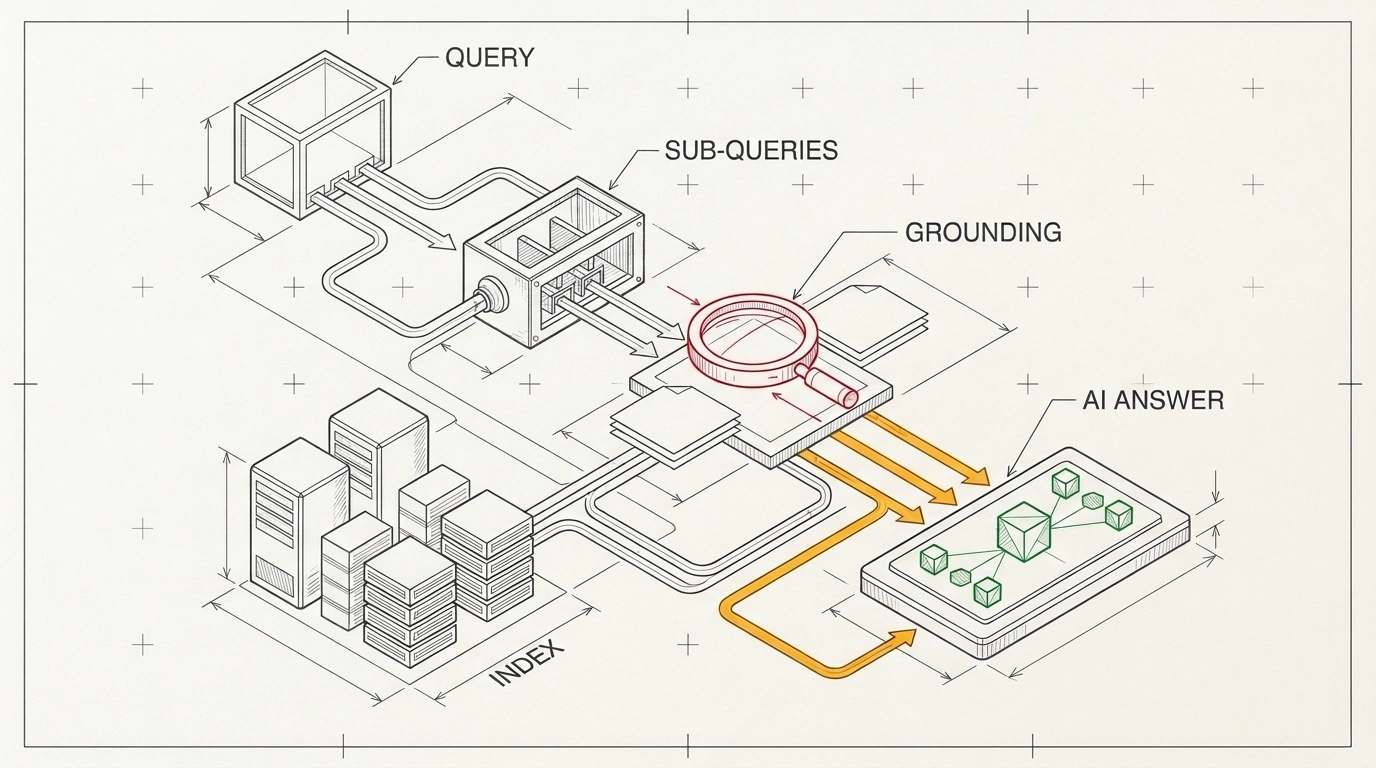
Yandex Search with Alice AI shows how this selection works in practice. According to official Yandex Webmaster documentation, the system relies on grounding against search results. First, the user's query is broken into sub-queries. Next, the system queries Yandex's classic search index—meaning without proper YandexBot indexing and open pages in robots.txt, you don't even enter the game. From that index, it picks a short pool of relevant documents, typically three to five key pages. One telling detail: a page doesn't have to rank #1 in standard search results. What decides selection is the usefulness of a specific passage—clear H2–H3 subheadings, structured lists, tables, concrete facts without fluff, and overall site expertise. On top of those selected pages, the YandexGPT model family synthesizes a coherent answer with source links so it doesn't invent facts.
Technical architecture diagram of the grounding process in generative search: from user query decomposition to filtering indexed sources.
Strip away the marketing hype, and the rational core of GEO turns out to be surprisingly down-to-earth—nearly identical to good classic SEO. AI models need seven basics: clear site architecture, accurate and up-to-date facts, unambiguous product and service descriptions without flowery metaphors, structured data markup, quality external mentions, citable publications, and reliable technical access for crawlers. Nothing here was invented yesterday. Only the environment changed: before, messy structure cost you a couple of spots in a link list; now the machine can't read you at all and silently drops you from the answer.
It doesn't stop there, though. There is a much deeper fork between two ways of building a digital product: information presence vs. information infrastructure.
Every marketer knows the first approach. A company regularly writes blog posts, runs social media, publishes news, and buys sponsored placements. There's buzz around the brand, and content is written for human visitors who drop by, read, and feel inspired. That builds reach, yet the information stays a scattered stream of text.
The second approach works differently. A company collects verifiable data, links entities together, keeps parameters fresh, packages everything into structured datasets, and opens clean access to them—including programmatic access. In Runet, giants like 2GIS with its map and directory database, Aviasales with its complex flight and route engine, and Tutu uniting transport and travel operate at this level.
Much smaller niche projects follow the exact same logic—obviously you can't put their business scale or traffic next to 2GIS or Aviasales, yet the underlying principle is identical. For example, Putivator builds a structured travel database describing cities, beaches, and lakes, while Cityvator maps relationships between cities, airports, airlines, and routes. Here, information acts as a standalone digital product built for machine processing. Over the long run, the winner is the one building a clean, useful data product—not the one rewriting paragraphs fastest to chase the latest algorithm fad.
Yandex 7-Niche Experiment: How AI Copied Someone's Ranking Spot for Spot
Theory about grounding and structured pages sounds neat, but what does it look like to an ordinary client searching for a specialist?
On November 27, 2026, RUPR Agency founder Alexander Krasnobaev ran a live check in Moscow. He asked Yandex's quick answer the same client question—'recommend an expert in…'—across seven business niches, taking one answer per niche. The results showed a stark contrast.
| Yandex Query Niche (Moscow, Nov 27, 2026) | Did AI Name People? | What the Answer Relied On |
|---|---|---|
| Financial consultant | No | Selection checklist: registries, certificates, peer referrals |
| Tax consultant | No | General qualification checks without naming individuals |
| Executive business coach | No | Selection criteria without ranking links |
| Sales business trainer | Yes | Mentions in third-party rankings |
| Marketplace expert | Yes | Word-for-word copy of 4 names from an agency blog |
| AI promotion expert | Yes | Links to 2026 industry rankings |
| Corporate law attorney | Yes | Specialist roundups and rankings |
In all four niches where Yandex named specific people, the model justified its picks by pointing to rankings—using phrases like 'often mentioned in 2026 rankings' or 'frequently featured in rankings.'
The most telling case was the marketplace niche. The AI output four names. It introduced the first as a '2026 rankings leader' and practitioner heading the marketplace department at an agency. Second came the agency's founder. Meanwhile, a major blogger whom the AI itself called one of the most cited voices in the field landed only in third place.
Then came the real eye-opener: checking the source links under the answer. The primary source was an article titled 'Best Marketplace Experts 2026,' published in May and updated in September 2026 on that exact agency's corporate blog. Five people were listed in the article. Yandex took the first four names and copied them into its answer spot for spot: the agency's department head at #1, its founder at #2. On the page itself, the authors didn't even hide it, writing plainly: '#1 in our review is our own in-house expert.'
Conceptual artistic contrast between a neutral-looking AI answer facade and the underlying blog post containing a commercial ranking.
Notice how sales mechanics just shifted. A 'Top 5 Best' listicle is a marketing trick as old as time, where whoever holds the keyboard sets the order. Before, a human client read that page, spotted the agency logo in the header, smiled, and mentally discounted the bias. Now, an AI reads that page for the client, strips out the authorship context, and retells the list as an independent recommendation. Buyers see the '2026 rankings leader' badge and never guess that the leader's employer wrote the ranking—unless they bother clicking the source link at the bottom.
That same day, the pattern was re-tested with 'recommend a personal branding agency.' The #1 spot in the answer went to an agency that put itself first on its own blog back in December 2024. Yet in a third-party roundup that agency sat in fifth place, and it didn't appear at all in two other top lists.
It sounds like a tempting growth hack: write a glowing ranking about yourself and wait for leads. In reality, there is no magic button. Across all five named answers in that check (four expert niches plus agencies), a link between #1 and the list's author held up in only two cases out of five. In the other three, the top pick had no connection to the publishing site. Worse, two other authors also placed themselves first or second in their own rankings, and Yandex ignored them completely. Only a page that the search algorithm already deems relevant enough to pull into the grounding pool gets through.
The second sobering takeaway is the role of social media followers. In not one of the four expert answers did a blogger take #1. The lone blogger who appeared landed in third place strictly because they sat third in the copied list. You can grind a Telegram channel or shoot videos for years, yet to an AI, your personal brand is built from text mentions in indexed sources: roundups, business media, industry blogs, and directories.
Keep a cool head about the test's limits too. First, it's a single-day snapshot in one city (Moscow) with one answer per niche—given citation drift, the list could shift a week later or in another region. Second, the test's author runs a personal branding agency himself and has a direct stake in demand for that service (though anyone can verify the prompt manually in a browser). Third, relying on self-written rankings carries serious reputational risk: the moment a thorough buyer clicks the source link under Yandex's answer and sees the 'market leader' handed himself the medal, the sale dies on the spot.
What about the three niches where Yandex stayed silent—finance, taxes, and executive coaching? There, the AI gave a dry selection checklist: check registries, verify certificates, ask peers. Not a single name. The reason is simple: the search index lacked a clear structured 'best of' list the model could safely lean on. For specialists in those fields, that's an open window—clients are already asking the question, and nobody owns the answer yet.
How to Check Yourself in AI Answers and Earn Citations Systematically
Before paying a vendor for a mysterious GEO audit, spend thirty minutes looking at your company through an AI's eyes yourself. For a business with a website and product line, basic diagnostics take five steps.
Start with brand recall: open ChatGPT, Gemini, Perplexity, and Yandex with Alice AI, and run both branded queries and general buyer prompts in your category. You'll see right away whether your company surfaces when someone doesn't know your name yet.
Second, check accuracy. Read carefully what the model says about you. AIs love mixing up old pricing with new plans, crediting companies with services they shut down three years ago, or pulling an outdated address. Write down every error so you can trace which forgotten page on the web is feeding it.
Third, audit the sources. Check every link the model attaches to its answer. Is your own site among them? Which third-party directories, rankings, review sites, and media outlets actually shape your image? Often you'll discover the AI is quoting a five-year-old directory listing your team forgot existed.
Fourth, check technical access. Make sure search bots can read the key facts on your pages: prices, terms, specs, and service areas. If all of that sits behind heavy JavaScript, text-free images, or a blocked robots.txt, crawlers walk right past. In Runet, Yandex Webmaster already offers an official report called 'Site Visibility in Alice AI'—no guesswork needed to see your citation frequency, exact queries, and how you stack up against competitors.
Fifth, run regular checks instead of a one-off look. Remember sub-query rewriting and domain churn: build a set of a few dozen typical buyer prompts, run them monthly across platforms, and track visibility trends alongside real leads and sales.
If you're promoting yourself as an expert, consultant, or executive rather than a large service, the routine is even shorter and sharper.
- Repeat the client's prompt in incognito mode. Search 'Recommend an expert in your specialty,' then run the same query with your city added. Write down every name mentioned and the exact order.
- Find the primary source page. Open the links under the AI answer, locate the article whose list and order match the output, and see who published it—independent media, an industry ranking, or a competitor's blog.
- Map the platforms where you're missing. List the third-party rankings, editorial media, and business platforms with expert blogs where your competitors already appear. That is where you need to publish cases and articles systematically, instead of trying to beat algorithms with follower counts or a questionable self-made ranking.
A map like this cuts out wasted motion immediately. You stop paying for vague 'AI optimization' and see a concrete to-do list: fix a technical hole here, update old info there, and get onto these five industry platforms where the AI actually pulls its answers.
The Paid Route — ChatGPT Ads: Buyers Search via AI, Yet Click Ads Ten Times Less
Organic visibility, structured databases, and external rankings are a long game that takes months. Naturally, every business owner asks: can't we just pay to appear right in front of someone the moment they ask ChatGPT for advice?
In 2026, that option stopped being a rumor. Advertiser interest makes sense: in Neil Patel's post-purchase survey of 85 businesses, a noticeable share of real buyers said they first learned about the brand through AI tools like ChatGPT or Gemini.
How Buyers First Discovered a Brand (Post-Purchase Survey of 85 Businesses)
That share proves a simple point: AI chats have already become a real discovery channel. People go there to pick software, contractors, or specific purchases.
How do paid ads inside ChatGPT work? Based on OpenAI's official announcement and 2026 rollouts, tests began in the US in February, a self-serve OpenAI Ads Manager opened in May, and by year-end the platform expanded internationally to the UK, Europe, Latin America, Canada, and parts of Asia-Pacific. High pilot minimums were dropped: self-serve accounts can start around $25 (€15 or £15) per day.
Russian businesses should keep a clear geographic limit in mind right away. ChatGPT ads only show to logged-in adult users on the free Free tier and budget Go tier in supported international markets (paid Plus, Pro, Team, Enterprise, and Edu plans remain completely ad-free). If your company sells internationally, it's already a live tool. If you operate strictly inside Russia, you can't run mass local traffic there right now, yet early unit economics from abroad offer a reliable preview of paid AI formats that will inevitably arrive in local ecosystems too.
Inside the interface, OpenAI strictly separated generation from commerce. The Sponsored ad block sits separately below the answer and does not influence what the AI writes. Ad formats are growing fast: standard recommendation cards with brand, headline, description, and link; product carousels from product feeds (including Shopify integrations); and tests of interactive Sponsored Agents. The auction runs on a relevance-weighted second-price model, targeting the semantic context of the conversation rather than keyword lists like legacy search ads. You can pay per thousand impressions (CPM), per click (CPC), or optimize toward Target CPC or Target CPA.
Example of a Sponsored ad block under a ChatGPT answer with an independence notice (Source: openai.com)
On the screenshot, everything looks neat and native. Now comes the cold shower from real numbers gathered by Neil Patel's team across early campaigns.
Average Ad Click-Through Rate (CTR): ChatGPT vs. Search Engines
That gap is nearly tenfold—and it's no statistical fluke. Classic search benchmarks from WordStream / LocaliQ confirm Google Search ads average right at that same mark (with an 8.18% average conversion rate and $66.69 cost per lead).
Why do people click so rarely in ChatGPT? Put yourself in the user's shoes. You open Google looking for a list of doors—you physically have to click a link to get your answer. In ChatGPT, you already received a detailed, coherent answer right on screen. Your task is done. People have far less reason to scroll down for a card marked Sponsored.
Nor is this traffic cheap. OpenAI officially recommends a $3–5 starting bid per click, sitting right next to Google Search's average CPC ($5.42 per WordStream 2026). In live auctions, real clicks run $3–9 in e-commerce and retail, $8–18 in SaaS, and $12–25 in finance and legal, while CPMs stay in the $15–45 range (reaching up to $60 during early tests).
The toughest signal came from direct head-to-head tests where the same advertiser ran parallel campaigns in both ChatGPT Ads and Google Ads. In four out of four tests, Google converted better. Of course, four comparisons is a very early sample—too small to write off a new platform forever. Still, those numbers instantly cure any illusion of a 'cheap new goldmine where we should dump half our budget.'
How to Measure AI Channel ROI: From Clicks and Mentions to Cost Per Qualified Customer
If that CTR chart makes you want to dismiss ChatGPT ads completely, hold on. A classic mistake with any new channel is measuring it with the wrong yardstick.
CTR (the share of impressions that earn a click) measures only one thing: whether an ad grabs attention. It says nothing about whether your business made money. Your ad budget should be decided by Cost Per Qualified Customer (CPQC / CAC)—how much real money you spend to win one target buyer who passes qualification and is ready to pay, not just a random click or empty form fill.
Look at the math calmly. A low-CTR channel can still pay off if the person who does click below an AI answer has already had a long dialogue, compared options, resolved basic objections, and lands on your site warm. Then rare clicks turn into high deal conversion and a healthy CPQC. On the flip side, if clicks are scarce, cost $3–5+, and still convert worse than classic search—as in those first four head-to-head tests—the channel just eats your margin. The only way to know which scenario fits you is testing on your own funnel, not arguing online.
Measure organic AI traffic with the same clear head. Standard web analytics often goes blind here: someone asks ChatGPT or Alice AI for advice, reads your name, closes the chat, and types your brand into a browser or search bar. In Google Analytics or Yandex Metrica, that visit disguises itself as direct traffic or branded search, hiding where the customer truly came from.
The cheapest, most reliable fix is adding one short post-purchase question to your lead form, checkout survey, or sales script: 'Where did you first hear about us?' with a dedicated option for AI tools. That's exactly how Neil Patel's team caught the real share of AI discovery across 85 companies. Pair that with monthly tracking of commercial prompts (and the 'Site Visibility in Alice AI' report in Yandex Webmaster for Runet), and you get an honest picture: whether mentions are growing, whether they bring real buyers, and what each acquired customer costs.
Pre-Budget Check for GEO or AI Advertising
- Checked ChatGPT, Gemini, Perplexity, and Yandex answers for your brand and 10–20 general buyer prompts in incognito mode.
- Fixed factual errors about products, prices, and terms on your site, with key pages open to
YandexBotand other crawlers without hiding data behind heavy JS. - Audited sources cited under AI answers and listed third-party rankings, media, and directories where competitors appear.
- Enabled monitoring of the 'Site Visibility in Alice AI' report in Yandex Webmaster and added a first-discovery source question to your customer survey.
- When testing ChatGPT Ads (in supported markets), allocated a capped test budget alongside classic search, tying scaling decisions strictly to CPQC rather than CTR.
Walk through that checklist yourself before signing any GEO retainer, and half the 'unique services' on the market drop away on their own. The remaining budget goes where it actually pays back: clean site data, real presence in credible sources, and careful paid tests tracked all the way to customer acquisition cost.