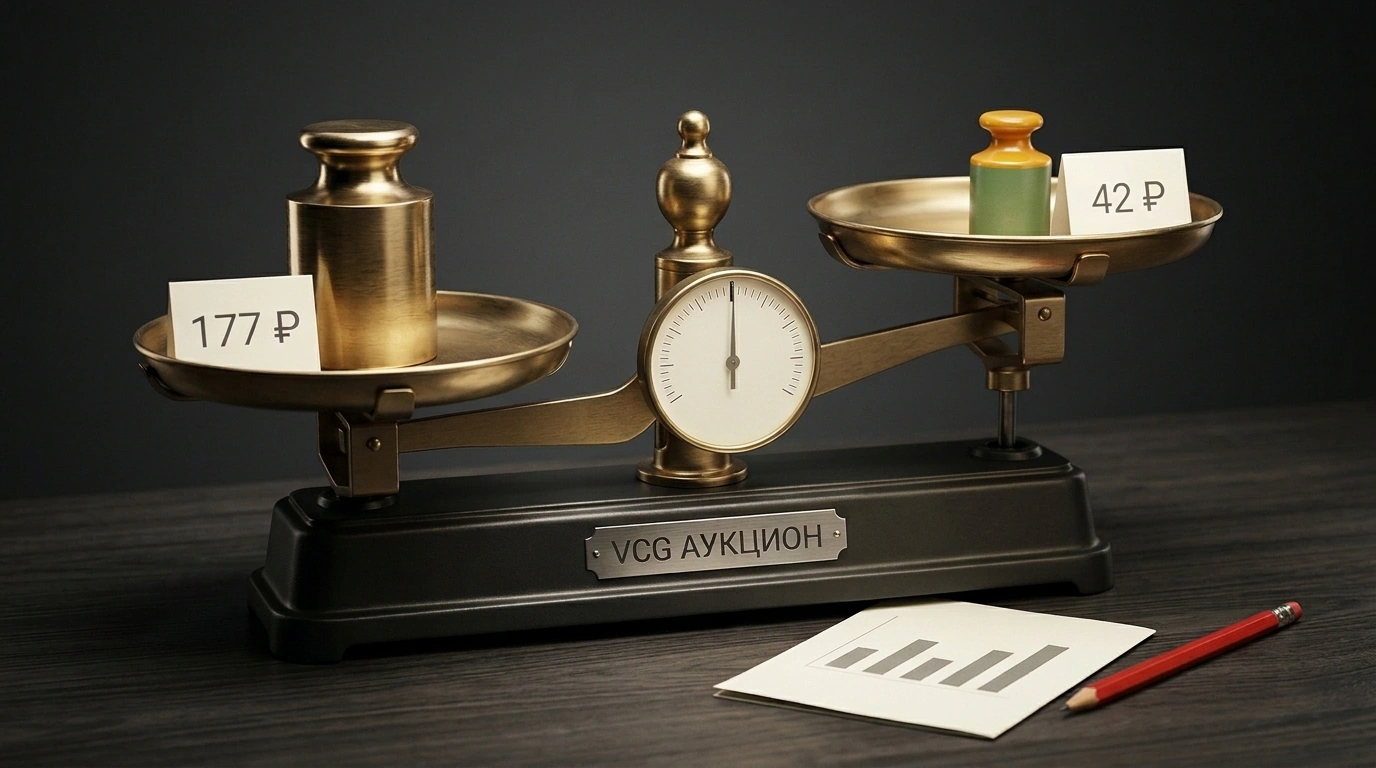
You open the bidding table for 'how to set up yandex direct yourself' and see the system asking for 177 ₽ to take the first spot above organic results. At that number, first-time business owners often close their ad account, convinced search ads are too expensive. Yet right in the next column, the forecast for what you'll actually pay per click sits around 42 ₽.
A month later, the opposite mystery pops up. Your strategy has a 210 ₽ CPC cap, nobody has touched ad copy or budgets for five weeks, and your average position stays steady between second and third place. Yet your average cost per click crept from 47 ₽ up to 82 ₽. When an agency sends that report, your first instinct is to ask what they broke.
Both situations confuse people for one reason: they treat a bid like a store price tag. Set 177 ₽, pay 177 ₽. In reality, your bid and your actual charge in Yandex Direct almost never match. Let's trace what happens in the half-second between a search query and a click, and how to spot the reason behind a price spike in five minutes.
Half a Second of Page Load: One Impression's Path to Billing
Someone types a query and hits Enter. While the results page loads, Yandex Direct runs through six steps:
- The query string is sent along with city, device, and time of day.
- The system selects ads whose keywords or autotargeting match the query.
- Candidates enter an auction for spots above and below organic search results.
- The algorithm ranks positions by weighing bid, ad-and-site quality score, and predicted click-through rate.
- The user sees the block and decides whether to click or scroll past.
- Money is charged only at step six—the moment a click happens under pay-per-click billing.
The first confusion starts right at step two, when advertisers mix up a keyword in their account with a live search query. Imagine one ad group holds a broad phrase about buying an iPhone at a 100 ₽ bid, and a narrow phrase for a black iPhone at 50 ₽. What gets charged? Automatically neither 100 ₽ nor 50 ₽. Direct bids on the specific user query against everyone competing for that exact impression. In a working search campaign, ~70 keywords generate around 3,000 impressions across nearly 1,900 distinct queries in a month.
Autotargeting—a mode where Direct matches semantically similar queries based on your ad text and landing page—spreads the range even wider. Competition is tightest in those broad auctions: over a month, autotargeting became the priciest line in the campaign (averaging a 156 ₽ bid and 109 ₽ per click), while exact keywords brought visitors for 34–75 ₽.
Step six clears up the fear of 'paying just for being shown.' Out of 3,000 impressions, around 200 clicks reached the site, and billing happened only for those—the other 2,800 impressions cost 0 ₽. If you get zero impressions at all, raising your bid won't help: your ad isn't even reaching the auction, so check campaign status, moderation, and balance.
How a 177 ₽ Bid Turns Into a 42 ₽ Charge
Seeing a 161 ₽ or 177 ₽ requirement makes people apply gavel-auction logic to ads: shout 200 ₽, pay 200 ₽. On Yandex Search and search-partner sites in RSYa (Yandex Advertising Network), the system runs a VCG auction (Vickrey–Clarke–Groves).
Up to four ads fit above organic search results. Instead of rigid '1st or 2nd place,' Direct uses traffic volume—a position clickability scale where top-block steps run 65, 75, 85, and 100 (and even higher with ad extensions). You pay in tiers. All four winners pay for the base flow (65% volume) at the bid of the fifth competitor who missed the top block. Then for each extra step up (+10%, +10%, and +15%), you pay the bids of the neighbors directly below you.
Yandex Direct's help docs illustrate this with five bidders at 10, 7, 5, 3, and 2 ₽ of equal quality. The winner at 10 ₽ gets 100% of clicks, yet pays 2 ₽ for the first 65%, 3 ₽ for the next 10%, 5 ₽ for the next 10%, and 7 ₽ for the top 15%—averaging 3.15 ₽ instead of 10 ₽.
Diagram of click cost calculation across traffic volume tiers in the Yandex Direct VCG auction (Source: yandex.ru/support/direct)
Your bid is simply an upper ceiling Direct won't cross, while your bill is built from the bids of competitors you outranked. On a daily snapshot of a real campaign, the gap between the top-spot entry ticket and the actual charge stands out right away.
Bid for First Place vs. Actual Cost Per Click
Every query shows the same pattern: entering the very top requires a high ceiling, yet the real bill stays several times gentler.
You see the same on the position ladder within a single phrase like 'how to set up yandex direct yourself.' For the bottom spot below organic results, the system asks for a 28 ₽ bid and charges around 8 ₽; for fourth place above organic results, 49.40 ₽ and 14.80 ₽. At the very top, the bid ceiling climbs steeply while the actual click price rises much more calmly.
Why can a click still cost more than your stated bid? Three practical reasons apply. First, in automated strategies like 'Maximize Clicks' with an average CPC target, the algorithm can pay above your target for a single click with high conversion odds (it holds the weekly average across calendar weeks with at least 100 clicks). Second, upward bid adjustments for audience, age, device, or region raise your ceiling—multiple modifiers multiply together. Third, after you lower a bid manually, the old price remains active for up to 30 minutes. Also remember that reports default to pre-VAT amounts while billing includes VAT, and balance updates lag behind stats differently.
Watch out for one more trap: the 'Bid' column. In EPC (Unified Performance Campaign with flexible settings, unlike Campaign Wizard), when using 'Maximize Clicks' with a 210 ₽ cap, the number shown next to a keyword doesn't enter the auction at all—the strategy cap sets the ceiling while the algorithm picks each bid dynamically. And before switching to pay-per-conversion, clean up your Yandex Metrica goals first so you don't pay for accidental taps on a messenger icon or page scrolls.
Also, never mix Search with RSYa content sites. On ad networks, the VCG ladder doesn't apply—they use a GSP auction (Generalized Second-Price), where the winner pays the next-lowest competitor's bid for all clicks. At those same bids of 10, 7, 5, 3, and 2 ₽, the top bidder pays 7 ₽ per click across the board instead of 3.15 ₽.
Diagram of a GSP auction: paying the nearest lower competitor's bid for all click volume, unlike tiered VCG on Search (Source: yandex.ru/support/direct)
Same Bid, Two Different Spots: How Copy and Quality Change Entry Price
The second myth is even simpler: whoever bids more ranks higher. Take that same snapshot for 'how to set up yandex direct yourself' and look at a 49.40 ₽ bid. In the auction window, it appears twice: once taking fourth place above organic results at 14.80 ₽ actual CPC, and a line lower putting an ad in first place below all organic results at 13.90 ₽.
The exact same ceiling lands on different floors because three factors build your position: bid, ad quality coefficient, and predicted CTR.
The quality coefficient isn't shown as a number in your account, yet it works behind the scenes constantly: evaluating how well your ad text matches the query, ad and domain history, landing page quality and speed, and filled-out extensions (sitelinks, callouts, business card). Predicted CTR is the estimated odds of a click from this specific user: machine learning estimates it for new ads, then leans increasingly on actual click-through rate as impressions build.
Yandex loses money keeping a generous bidder at the top if their weak copy gets scrolled past—the platform earns on clicks, not empty impressions. A sharp ad with a lower bid earns clicks readily and easily outranks a pricey competitor. That explains a common headache: after a clumsy headline edit, CPC spikes even though bids stayed untouched. The new copy matched the query worse, predicted CTR dropped, and holding the same spot now costs more money. Before raising your bid, re-read your ad through the eyes of someone who just typed that query.
Clicks Got Pricier While Nothing Changed: Why Spikes Happen and Three Audit Questions
Back to the second mystery. In a Search EPC running 'Maximize Clicks' with a 210 ₽ cap, nobody touched copy, keywords, or limits for five weeks. Average position held between second and third place, and the 210 ₽ cap never even kicked in.
Yet average CPC climbed from 47 ₽ in late October to 57 ₽, then 55 ₽, and hit 80–82 ₽ in the second half of November. Without knowing the VCG ladder, it's easy to assume prices are set by mood or an agency rewired the account. In reality, competitors entered the auction ahead of seasonal sales and December, pushing up the lower steps of the ladder. Your settings stood still—your neighbors below got more expensive.
To separate a settings mistake from a heated market in five minutes, check your account and Report Wizard with three questions.
- Which strategy is active and what are you billed for? Check whether you pay per click, conversion, or impression, and what real ceiling sits in strategy settings (the number in the 'Bid' column doesn't participate in automated strategies).
- What is the gap between bid and actual CPC per keyword? Check the autotargeting line separately—actual charges creep closest to the bid ceiling there.
- What changed during this period—your settings or the auction? If ad copy, landing page, strategy, and average position stayed put while CPC climbed, competitors stepped in below you. Tweaking a working campaign blindly at that moment is the fastest way to reset learning and make clicks even pricier.