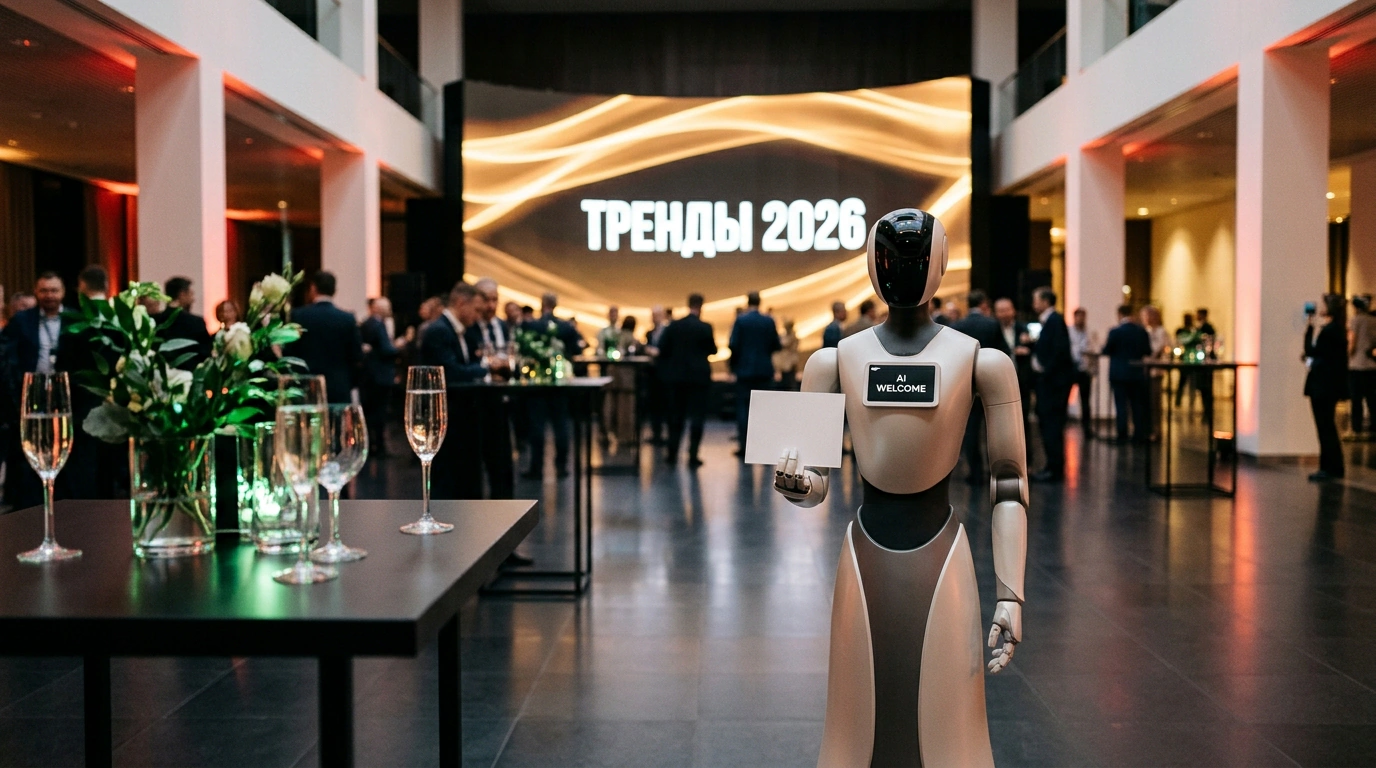
Picture a banquet hall twenty minutes before showtime. The emcee is backstage, musicians are finishing soundcheck, and guests trade polite small talk at tables. Suddenly a robot rolls between the tables, pulls up to a group, and strikes up a conversation. Small talk stops in one second—everyone reaches for their phone and starts filming. That scene at an event by Aventura agency showed clearly where room attention has shifted.
Over sixteen years—growing from a single Omsk office in 2010 to four branches in Moscow, St. Petersburg, Tyumen, and Omsk running over a hundred events a year—Mikhail Glushenkov's team has produced hundreds of classic banquets. Today, event marketing (promoting a brand and company values through live events and personal guest experiences) has hit a wall: the old script simply doesn't hook people anymore.
Why 'Emcee Plus Cover Band' Stopped Holding the Room
The 'buffet, emcee, cover band' template has been running out of steam for five years. Guests arrive, eat dinner, dance to a couple of songs, and head home. A week later, half the team can barely recall how this year's party differed from last year's.
The biggest enemy of emotion is predictability. The moment someone reads the entire evening's arc in the first ten minutes, their brain switches to autopilot and their eyes drop to their smartphone. Room attention works like a campfire in the wind: tossing logs on at the start while people sit down isn't enough anymore. You have to win the room back every 30 minutes with a fresh twist or unexpected program turn.
The market already feels that fatigue in budgets. Analysts of Russia's MICE industry (MICE Excellence, R&C Research Center, NAOM) estimate the corporate event segment at 130–170 billion ₽ a year (with 85–90 billion ₽ going through major agencies), while growth has cooled to 0.3–8%. Companies are cutting checkbox banquets and expecting clear returns in employer branding and team engagement.
Trying to 'buy a trend' without an idea breaks even faster. A robot silently waving in a corner and a screen spinning a corporate logo are forgotten in ten minutes. Zero live reaction means that budget line got wasted.
Scripted Robot vs. a 300,000-Ruble Prop
Here is a common story: a client rents a robot and parks it by the photo wall. The plan sounds simple—guests see a novelty and feel impressed. In reality, people shoot two quick stories at the entrance, and for the next four hours an expensive machine sits in the corner like furniture.
Real impact happens when you give the robot a scripted role: greeting guests at the doors, delivering drinks during cocktail hour, or hosting a program segment with prepared lines. At one Aventura event, a robot 'walked' a guest around the venue, guiding them through zones and commenting on the action. A bigger crowd gathered around it than at the main stage during a performer's set.
Unitree robotics for interactive shows and corporate events (Source: unitree.com)
The budget breakdown is telling. In a turnkey agency estimate, one robot for an evening costs 150,000–400,000 ₽ depending on the city and scope. In open rentals, base rates are lower: a service Promobot V.2 or V.4 starts around 35,000–70,000 ₽ per shift with an operator, while a Unitree Go1 or Go2 robot dog runs from 25,000 ₽ per hour (four-hour minimum) or 30,000–50,000 ₽ per day basic. The gap up to agency pricing pays for building the show: custom company lines, knowledge-base setup, branding, logistics, director and engineer time, or stepping up to complex humanoids like the Unitree G1.
It makes more sense to judge that cost per minute of attention. When three hundred people film an interaction and post clips with your event location, the event earns free organic social reach.
This tactic has a clear limit. At an intimate 30-person dinner, a mechanical waiter kills the mood and interrupts conversation—live music, warm lighting, and table service win there. At venues with 300+ guests, a scripted robot holds focus well, provided it stays locked to the schedule and doesn't steal attention at the wrong moment.
LED Screen Geometry and Giving Your Own Team the Stage
The same shift hit stage design—shaping the venue with light, sets, and screens to guide guests' eyes. A flat rectangular LED wall behind a speaker has turned into visual wallpaper: eyes tune it out within ten minutes, and events from different companies blur into one template.
Usually teams throw money at the problem and rent a bigger rectangle. In practice, changing geometry beats extra square meters. At one event, Aventura ditched the single rectangle and built stage 'wings': several narrow vertical LED strips angled like theater portals. Light spilled between the panels, the speaker stood inside a 3D frame, and hardware costs stayed exactly the same.
Unusual layouts like curved arcs or vertical strips give budgets a bonus: 3D depth looks expensive on its own, so simple gradients or clean branding look great without heavy video production. The rule stays simple: script and person in frame first, geometry second. Keep a calm backdrop behind speakers without jumpy animations, and save bold layouts for show segments.
Music follows the exact same rule. Booking 'emcee plus cover band' takes two clicks, and after five identical parties in one season, guests can't tell one from another—same jokes, same hit songs, only the backdrop logo changes.
Recognition hooks a room far harder. Handing the stage to insiders—an in-house rock band of engineers, a director's stand-up bit, or an accounting choir—may lose to pros on vocal polish, yet lands squarely with the crowd. People laugh and wipe away tears recognizing coworkers and their own office stories. Invited artists still have a role: a headliner warms up the crowd before the team's centerpiece act or closes the night after the company story.
The trade-off is obvious: getting employees on stage, easing nerves at rehearsals, and smoothing awkward pauses takes two to three times more producer hours than hiring a cover band.
Knowing Your Audience and Budget Economics
In corporate events, budget size barely predicts emotional impact. You can spend 5 million ₽ and get polite applause, or spend a third of that (1.5–1.7 million ₽) to create a moment the team retells for months. A million-ruble cover band easily falls flat if it misses the room's taste.
Solid event planning starts with studying your people, not flipping through artist catalogs. Before writing a script, handle three tasks: gather the year's inside memes and topics from work chats, gauge team fatigue and pain points (never drag staff exhausted by year-end reporting to a weekend business conference), and match the tone to the group's profile. Adrenaline-driven sales reps love pace, noise, and competition, while executives after a strategy offsite want quiet, unhurried conversation, and room to exhale.
| Event Element | Checkbox Template | Working 2026 Setup | Main Limitation |
|---|---|---|---|
| Robots & interactivity | Parked in a photo zone waving | Greets guests, leads zone tours, plays a scripted role | Wrong for small dinners; needs tight timing |
| LED screens | Flat rectangle with a logo | Curved panels or angled vertical 'wings' | Pick shape after scripting so it won't upstage speakers |
| Music & stage | Cover band as the sole centerpiece | Employee acts plus pros for warm-up or finale | Demands more producer time for rehearsals and direction |
| Planning start | Booking talent to fit a budget | Audit team memes, fatigue, and personality type | Needs HR and leadership buy-in before scripting |
Overspending at events usually comes from trying to cover an empty script with sheer scale—extra screen square meters, a pricey headliner, or tech bought just for slides. Hitting your team's real context delivers a far higher emotional return on every ruble spent.
In a turnkey agency quote, one robot for an evening runs 150,000–400,000 ₽ including scripting, customization, and logistics. Basic rental without show direction starts around 35,000–70,000 ₽ per shift. Judge ROI by cost per minute of attention and organic social reach from guest videos.
Give the center of the program to your own team: an internal rock band, a manager's stand-up set, or a department choir guided by a producer. Keep professional artists for the warm-up or dance finale.
Non-standard geometry wins—curved panels or vertical angled 'wings' rather than maxing out a flat rectangle. A 3D layout looks pricier even with a simple gradient when designed around the speaker.
Because the 'emcee, cover band, buffet' formula is completely predictable. To keep the room engaged, introduce an unexpected element or program turn every 30 minutes.
Start with an audience audit—collect the year's inside jokes, factor in team fatigue, and match their language—and only then pick the venue, tech, and performers.