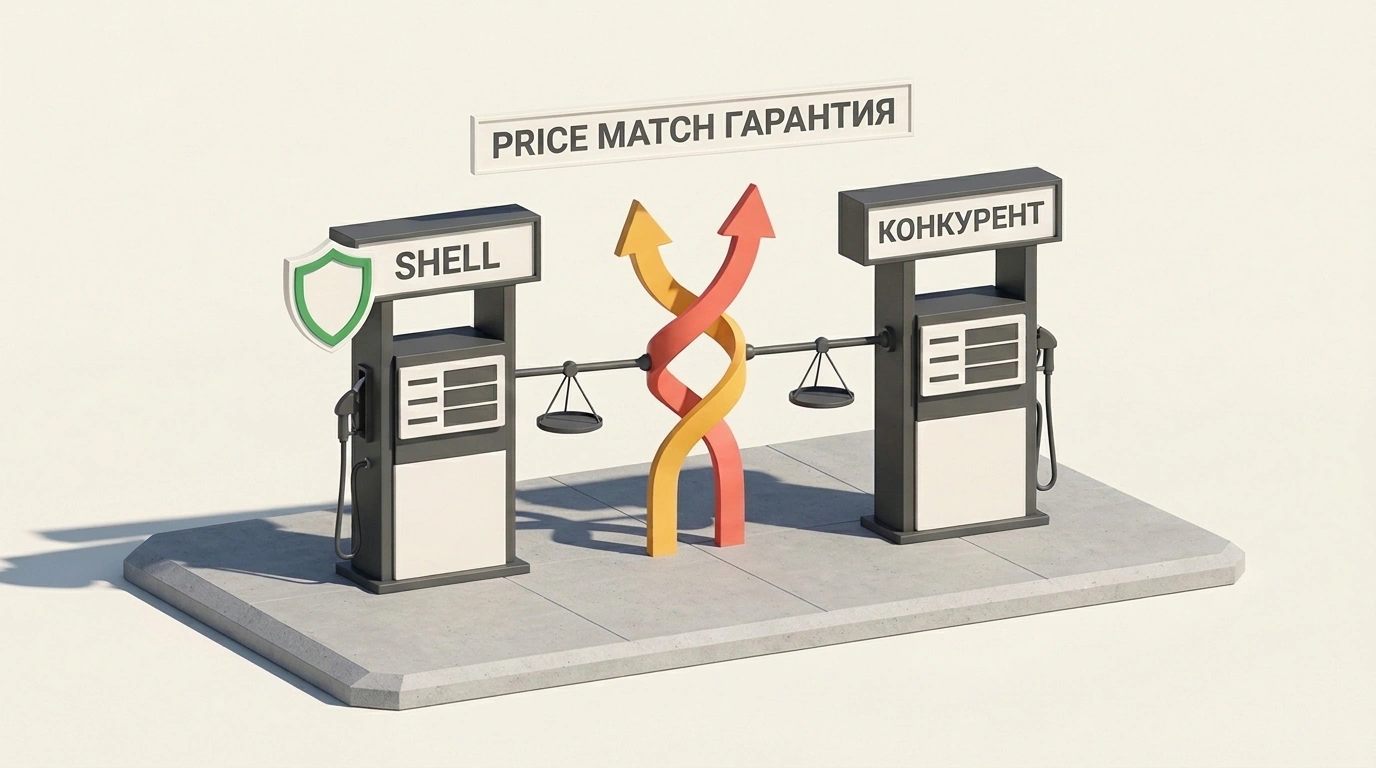
On May 27, 2015, Shell launched a German promo that looked like a gift to drivers. Loyalty cardholders got an automatic discount at the register whenever nearby stations sold gas for less. It sounded like the opening shot of a price war that should push fuel prices down. One month later, prices at German stations climbed instead.
How did promising to match a rival's price end up raising bills market-wide? Let's run the numbers from German price boards and see why a 'best-price guarantee' often protects margins better than sales.
How ClubSmart Worked—and What Changed at Noon
Shell's ClubSmart Preisgarantie covered regular fuels: Super E5, E10, and diesel. Drivers didn't need to argue with cashiers. Since December 2013, Germany's Bundeskartellamt has run the MTS-K transparency system, where every station reports prices in real time. Shell's register automatically checked up to ten nearby branded competitors. If Shell's liter sat more than 2 cents above the cheapest neighbor, cardholders paid 'lowest neighbor + 2 cents.'
Run the math on a 40-liter tank. You sell gas at €1.40; Shell's sign reads €1.46. Without a card, filling up with you saves €2.40, so drivers pull into your lot. With ClubSmart, Shell charges €1.42. Your price edge shrinks threefold to 80 cents—even though you didn't touch your sign.
Economists Luís Cabral, Niklas Dürr, Dominik Schober, and Oliver Woll tracked what followed in Price Matching Guarantees and Collusion: Theory and Evidence from Germany (CEPR DP15823, 2021). Before the promo, gas in Hagen typically dropped toward 17:00–18:00 and rose around 20:00. On May 28, 2015, one Hagen Shell station still drifted down until evening. By July 2, prices suddenly jumped 3 cents around 12:00 and stayed above morning levels.
Across chains, a schedule emerged. On June 24, 2015 at 12:01, 150 of 254 sampled Aral stations raised prices; within three hours, 168 of 189 Shell stations followed. Soon both networks regularly hiked prices right after noon, with rivals matching by 12:30.
Why Undercutting Stops Making Sense: The Neighbor's Logic
Picture two coffee shops across the street. You slash cappuccino prices to steal guests. If the barista opposite automatically gives loyalty-card regulars the same cut, you burned margin while the line stayed next door. On highways, a price-matching guarantee killed the incentive to undercut in the exact same way.
- Before the promo: cut your price—you pull cars from Shell and make up the discount on volume. Raising prices alone is risky.
- After the promo, cutting prices: drop your board—Shell's register instantly matches down to 'your price + 2 cents' for its members. Your margin drops with zero extra cars.
- After the promo, raising prices: bump your liter from €1.40 to €1.43—Shell's card ceiling rises from €1.42 to €1.45. Shell now has a direct cash reason to hope your sign isn't too cheap.
In game theory, this is a repeated game: prices sit in public view every day. On day one, the neighbor doubts whether Aral and Shell's noon hike will hold. By day three, the pattern is clear, and by 12:30 matching the hike beats subsidizing someone else's discount. That creates tacit collusion without a single phone call: +2 cents lived in card rules, while +3 cents at noon emerged on price boards as a shared signal. The authors note one data limit: lacking exact cardholder counts per station, they tested western Germany indirectly via proximity to Shell and demographics. Results fit theory closely, though proving explicit manager coordination isn't possible.
Where This Tactic Works Today—and Where It Fails
The tactic moved into retail and e-commerce long ago. UK chain John Lewis dropped its century-old 'Never Knowingly Undersold' pledge in February 2022 due to online competition, then brought it back in September 2024 using AI tracking across 25 major rivals (including Marks & Spencer, Boots, Currys, and Amazon on tech) with 7-day price-difference refunds.
It holds up only under three conditions. First, the rival list: leave out a discounter, and their price cuts still pull buyers away. Second, price transparency: without live public pricing like MTS-K and dominant leaders, price matching just bleeds the initiator's margin. Third, reputation and regulators: higher base prices punish non-cardholders, and the Bundeskartellamt plus EU competition law (Article 101 TFEU) view such guarantees as tools that facilitate coordination. Shell eventually wound down classic Preisgarantie in favor of direct discounts and V-Power SmartDeal subscriptions.