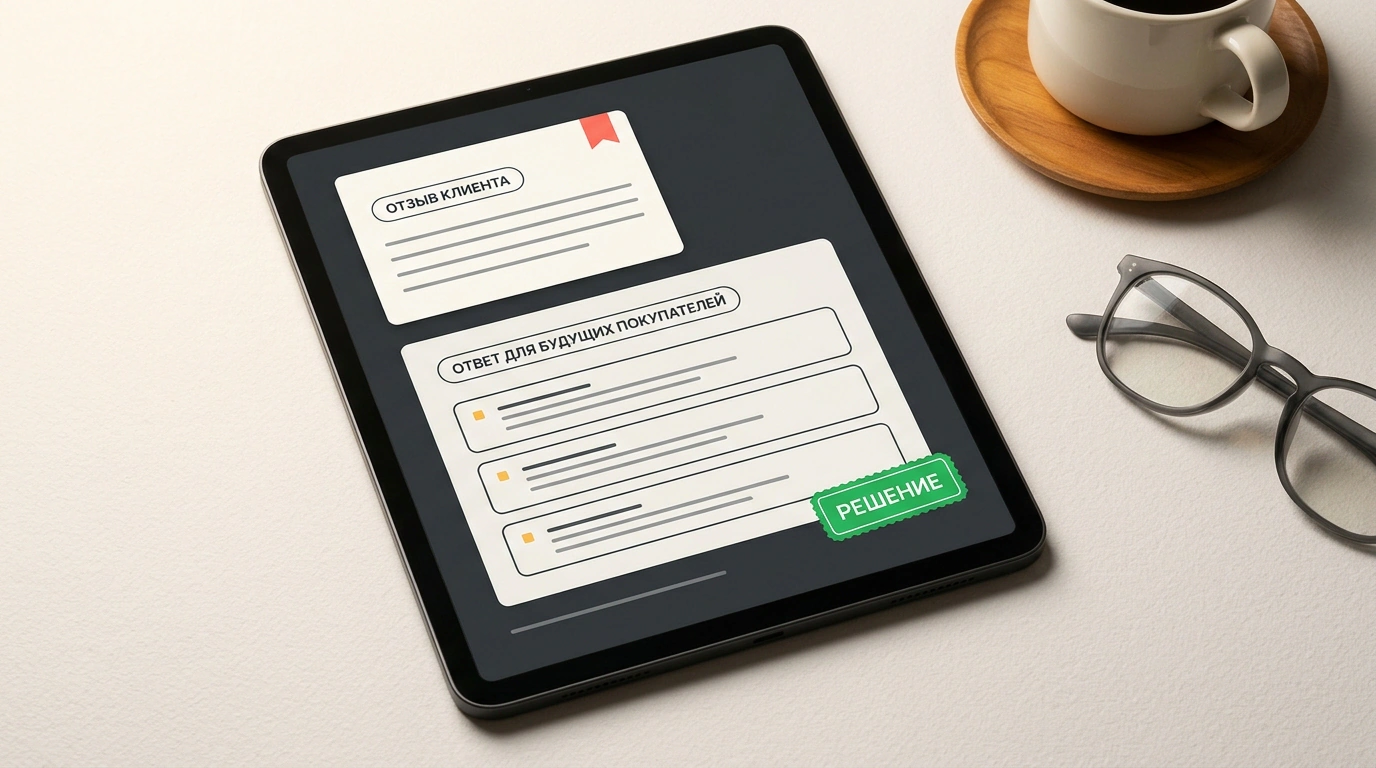
A customer leaves a complaint on your profile: after cleaning, streaks remained on kitchen cabinets, spotted that evening under indoor lighting. A service owner's first instinct is to defend the team. The crew handed over the apartment with zero complaints on site! Your fingers itch to mention the signed walk-through and state that staff followed standards. Feels like justice served—yet you just scared away a slice of future leads.
Who You Are Actually Answering on Your Profile
A reply under a negative review has two readers. First is the author waiting for a fix on their order. Second is the person opening your Yandex Maps, 2GIS, or Avito profile tomorrow to pick a contractor. That's social proof in action: someone else's experience helps buyers judge risk before paying. A new prospect puts themselves in the reviewer's shoes. Seeing an argument over a walk-through sheet tells them the exact excuse they'll hear if they spot a flaw after the crew leaves. So they quietly pick a competitor.
On map platforms, mistakes cost even more. On Yandex Maps via Yandex Business, a company gets exactly one public reply per review—there is no back-and-forth thread. You have a 2,500-character limit, and moderation strips rudeness, all-caps, and external links. Flagging a review only removes spam, insults, or fakes; platforms won't arbitrate disputes over service scope. Waste your lone reply on a defensive spat, and you can't fix the impression.
Publicly addressing complaints (openly resolving issues right on the profile) changes the review stream itself. In a 2017 study, Davide Proserpio and Georgios Zervas compared hotels on TripAdvisor and Expedia. Where businesses started replying, ratings rose by 0.12 stars and review volume grew 12%. One fair caveat: they studied hotels and counted replies to all reviews, so for a cleaning or repair shop it's a directional benchmark rather than a guarantee. More interesting is the mechanism: once people see thoughtful, matter-of-fact replies, short angry rants drop off and remaining complaints become far more specific.
One Complaint, Three Reactions
Back to those streaks on kitchen cabinets after a post-renovation clean. Your profile reputation—the gut sense of whether you can be trusted when something goes wrong—hangs on a single paragraph.
Three Ways to Reply to One Complaint
The defensive reply (breaks trust):
At handoff you said everything looked fine. Our crew cleaned strictly to standards.
The canned reply (gives buyers nothing to go on):
Thank you for your feedback. Your opinion matters greatly to us. We will certainly take action.
The fact-checked reply (wins sales):
Hello! We're sorry streaks remained on your cabinets after cleaning. We checked your order: cabinet fronts were included in the service. We can send a cleaner back to remove the streaks at no extra charge. We'll message you in your order chat to arrange a time.
In option one, the streaks stay put while outside readers immediately spot a 'blame the customer' stance. Option two sounds polite yet empty: nobody knows whether a human even read it or what happens next. Option three removes a new buyer's biggest fear—if something goes wrong, there won't be a fight; the company checks the order and fixes its mistake free of charge.
A Four-Step Reply Formula
To keep your team from snapping into defense mode, a short four-step rule is enough.
First, name the exact issue from the review—such as those cleaning streaks. That proves right away a real person read the complaint. Second, check the facts: pull the order, verify what was paid for, and ask the crew what happened. Third, offer a doable next step: a concrete fix, or a clear timeframe for getting back with answers. Never overpromise—a broken public promise hurts trust worse than silence. Fourth, move personal details into DMs or order chat so addresses, phone numbers, and order IDs stay private.
What if no matching order turns up? Don't accuse the writer of faking it upfront, yet don't promise freebies blindly either:
Hello! We'd like to look into this, though we couldn't match an order from your review yet. Please send us a direct message with your cleaning date or order number. We'll check what was included and follow up.
The easiest way to test this today: open your company profile, pick one old unanswered negative review, pull the facts, and write a reply with a concrete next step. Before hitting publish, read it through the eyes of someone hearing about you for the very first time—they should see immediately what you'll do if the same snag happens to them.