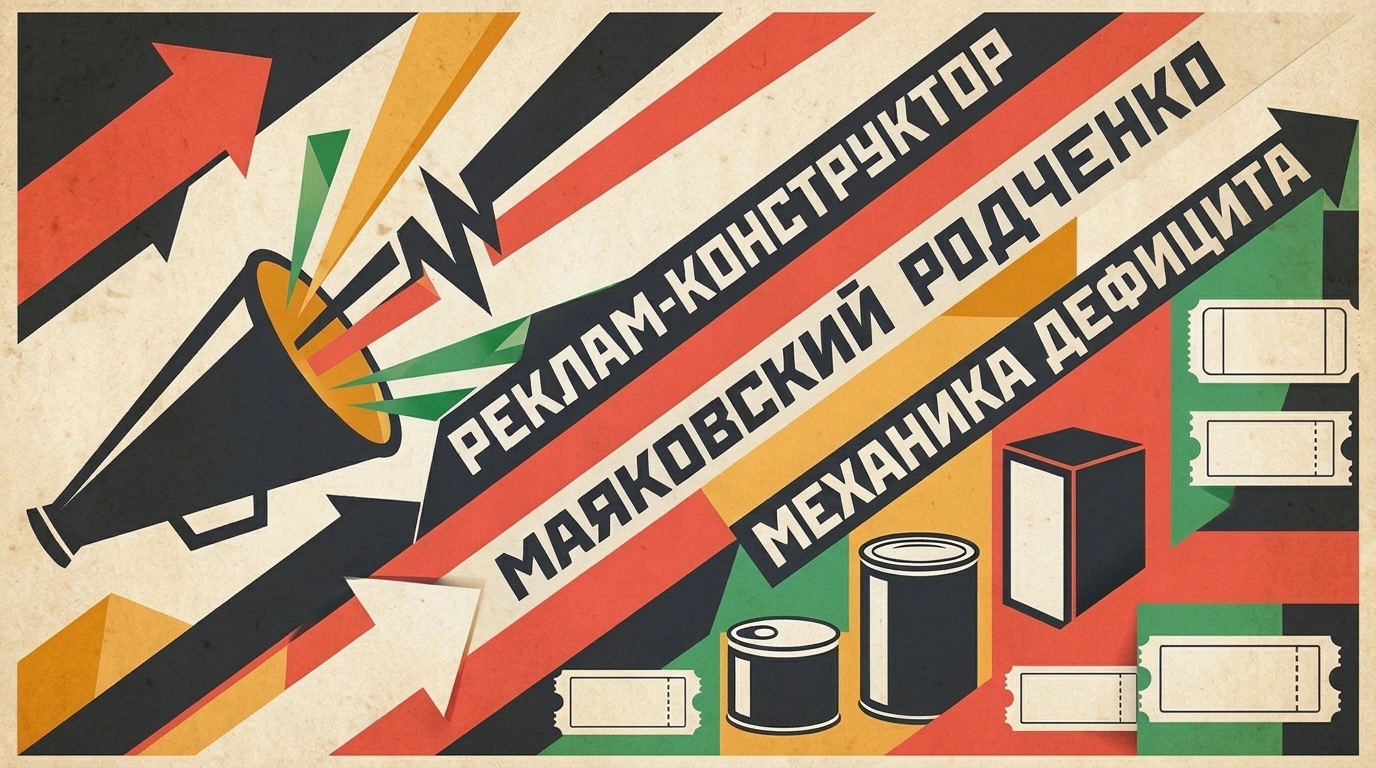
In October 1923, an informal agency called 'Reklam-Konstruktor' opened in Moscow. Vladimir Mayakovsky wrote slogans and rhymes, while Alexander Rodchenko and Varvara Stepanova handled graphics and layout. Russia's New Economic Policy (NEP) had briefly brought back trade and competition, and state trusts needed sales. Over two years, the team produced up to 50 posters, around 100 signs and mockups, plus stacks of labels for Mosselprom, GUM, Rezinotrest, and Mospoligraf. In 1925, their work won a silver medal at the Paris International Exhibition.
'Reklam-Konstruktor': A Super-Collab a Century Before Marketplaces
Imagine today's biggest rapper writing marketplace slogans while a famous street artist designs the banners. That's roughly what that duo looked like. The line 'Nowhere else except Mosselprom' hung on posters and right across the trust's Moscow building facade—its punchy rhythm and sharp geometry stuck in memory instantly. By the late 1920s, NEP ended, real competition vanished, and the agency closed with it.
The style survived. Red-and-black poster graphics and clipped chants still pop up in bank campaigns, TV shows, and ice-cream packaging. Nostalgia marketing saves warm-up budget: a familiar code registers instantly and borrows the aura of 'authentic GOST quality.'
Quasi-Advertising, the Quality Mark, and Secret Kotler
By the 1930s, only one producer remained in the country: the state. Advertising Brand A against Brand B stopped making sense. That gave rise to quasi-advertising: posters promoted entire categories ('Ice Cream!', 'Sausages!', 'Soviet Champagne!', crab). Today we call that category marketing—building the habit of buying a new product class first, then dividing shelf space.
In January 1936, Food Industry Commissar Anastas Mikoyan (who studied US food manufacturing that same year) framed the rules before the USSR Central Executive Committee: capitalist ads exist to 'push stale junk,' whereas Soviet ads inform and cultivate tastes. In practice, irony crept in: posters promised fresh fish above empty store counters.
Branding was replaced by the USSR State Quality Mark—a pentagon holding a rotated 'K' (GOST 1.9-67, active from April 20, 1967 to 1987). Certified for 2–3 years, it could be revoked if quality slipped. At retail, that pentagon worked just like a 'Marketplace Choice' badge. Price tiering ran in reverse too: 'Soviet Champagne' launched in the 1930s as mass-market sparkling wine, while 'aged collector's' bottles cost two to three times more.
Meanwhile, classic marketing stayed alive in exports: selling oil, timber, and machinery abroad required real demand analysis, handled by V/O Vneshtorgreklama. In 1980, Ekonomika Publishers released an abridged translation of Philip Kotler's Marketing Management wrapped in a preface 'critiquing bourgeois concepts'—specialists took notes on everything except the preface. In apparel, Art Councils and Fashion Houses acted as focus groups, evaluating factory samples on buyers' behalf.
Scarcity as a Sales Team—and the Line Before Dark Patterns
When goods are scarce, the best sales funnel is a line. A department store 'drops' a batch of boots, word of mouth spreads, and a two-hour queue forms. Anyone who already invested two hours standing in line checks out at nearly 100% conversion—walking away empty-handed feels unbearable.
In 1975, psychologists Stephen Worchel, Jerry Lee, and Akanbi Adewole tested this with cookie jars. People rated identical cookies tastier and more valuable in a jar holding 2 cookies than in a full jar of 10—and perceived value peaked when cookies visibly dropped from 10 down to 2. In 1984, Robert Cialdini cemented the scarcity trigger in Influence.
| Soviet Mechanism | How It Worked Then | Digital & CRM Equivalent |
|---|---|---|
| 'Reklam-Konstruktor' | Star copywriting + Constructivist design | Celebrity collabs & brand design systems |
| 1930s Quasi-advertising | Promoting an entire category | Category marketing by market leaders |
| Quality Mark (GOST 1.9-67) | 2–3 year certification with revocation | 'Marketplace Choice' trust badges |
| Queues & sudden 'drops' | Real shortages & word of mouth | Limited drops & CRM launch emails |
| Art Councils & Fashion Houses | Sample review on buyers' behalf | Focus groups, pre-tests & customer discovery |
That Soviet legacy has a flip side: audiences still stockpile 'just in case' and view hard-sell ads with suspicion. Back then, shortages were real. When an online store today slaps a resetting countdown timer or eternal 'Only 2 left!' onto a full warehouse, those are dark patterns that buyers spot quickly and punish with distrust. Limited drops in CRM only work when the cap is genuine: a numbered batch, seasonal release, or hard sales cutoff with no surprise extensions.