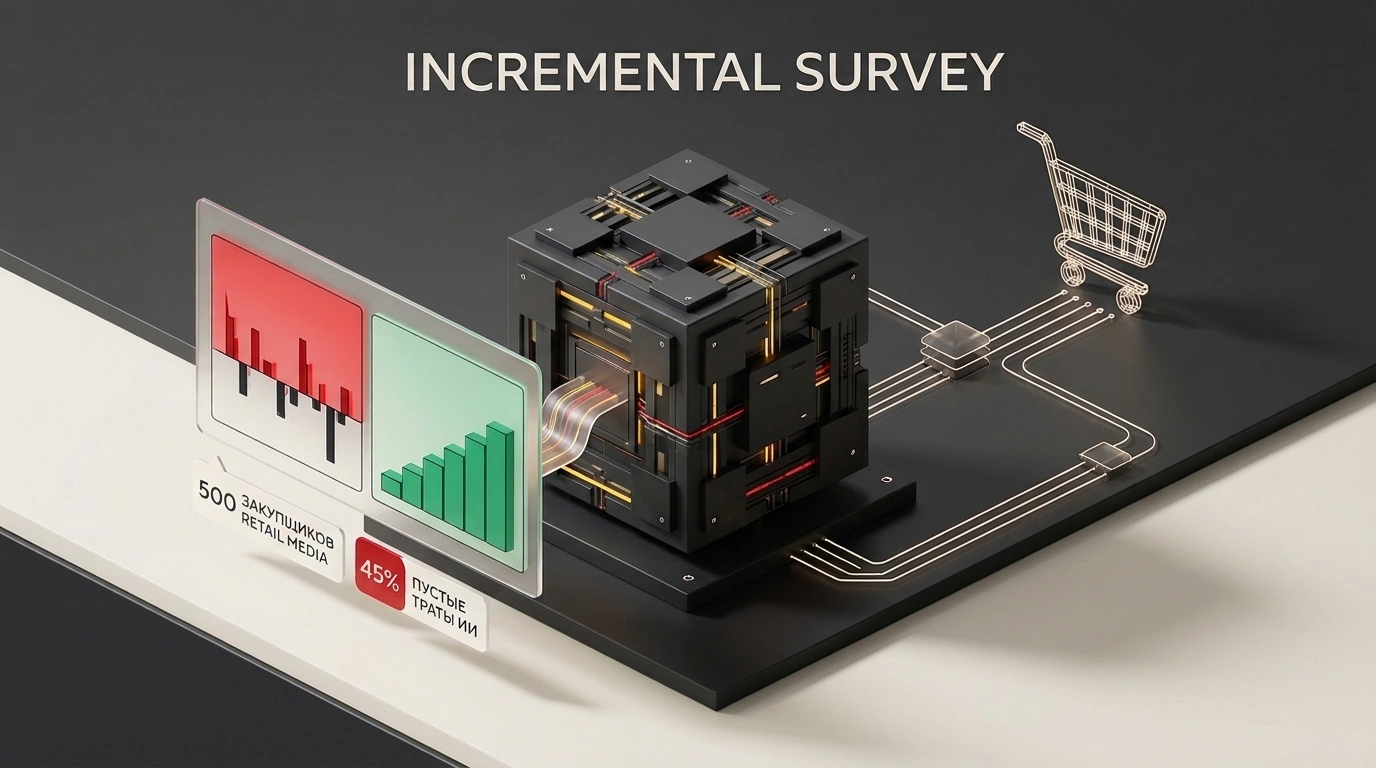
You'd think getting burned by automated bidding would make teams hit pause and take the credit card away from the algorithm. In a survey of 500 retail media buyers (Incremental's Ready or Not: Agentic Readiness in Retail Media), the exact opposite happened. Teams that already lost money to AI mistakes are 67% more likely than peers to expect AI to move budgets autonomously within a year.
This covers retail media—ads inside marketplaces and retailer websites where the shelf and cash register share one system. Although the poll covered Western markets, automated bidding on Ozon, Wildberries, Yandex Market, or networks like X5 Media and Magnit runs by the exact same rules.
Green Dashboards, Missing Cash
Over half of respondents (55.4%) trust algorithms strongly or completely—even without checking first. On paper, analytics look solid, and teams feel ready to defend any AI move to leadership. In reality, nearly one in two has already hit an unexplainable AI decision and caught the system burning money.
Survey of 500 Retail Media Buyers: Team Confidence vs. AI Failures (Incremental)
That gap only surprises people until they look inside an ad account. As long as the platform dashboard shows strong return on ad spend, nobody digs deeper. The breakdown surfaces later—when finance closes the books and sees ad spend climbed while total revenue stayed flat.
Why Last-Click Turns AI Into an Organic Demand Vacuum
Picture a shopper who buys the same coffee on a marketplace every month. They type the brand into search, tap the top sponsored card out of habit, and check out. Last-click attribution credits 100% of that basket to the ad. The dashboard flashes a gorgeous ROAS, even though that buyer came specifically for that coffee and would have clicked the organic listing one line below.
A human media buyer mentally discounts repeat regulars; an autonomous AI agent has no such skepticism. Give it a goal to maximize last-click sales, and it immediately buys impressions for your warmest audience. Convenience turns into a hidden tax: your business pays to intercept its own organic demand.
That's why the market is pushing for incrementality—measuring additional sales that wouldn't have happened without the ad. Among brands and agencies, 58% want optimization tied to incremental sales versus 23% favoring last-click (a gap wider than 2.5 to 1). Retailers agree too: 54.4% of inventory sellers back incremental return versus 16.7% for last-click. True, Incremental sells an incremental ROAS (iROAS) platform, so criticizing last-click serves its business. Yet when both sides of the ad trade vote against the old yardstick, you can't chalk the numbers up to vendor bias.
Where to Draw the Line on Autonomy
Only a small minority give AI full freedom today: 44.1% run 'AI recommends, human approves,' 18.5% allow budget moves with post-audit checks, 12.8% use strict rule guardrails, and 11.3% skip AI altogether. Without sign-off, 46.7% will let AI shift spend between campaigns, 35.4% allow pausing weak ads, and only 11.3% delegate nothing.
The biggest risk is letting AI raise total budget on its own. Brands hand over that switch more willingly than retailers, where only 25% agree. The logic is simple: pausing a weak ad is safe, whereas raising spend under flawed attribution just accelerates buying up organic traffic.
A working setup uses two-tier control. Keep day-to-day tactics on last-click for speed, then calibrate quarterly with a geo-lift or holdout test: pause ads in control regions for 4–8 weeks and compare total store revenue. If real incremental lift delivers 40–60% of reported ROAS, multiply daily dashboards by that 0.4–0.6 factor. Small sellers with a couple of SKUs can't afford regional holdouts—week-on/week-off toggles and Total Advertising Cost of Sales (TACoS) against all revenue work better there. Before widening automated bidding rights, lock in three safeguards: a hard ceiling on unapproved budget increases, separate campaigns for branded keywords, and a change log showing why the algorithm raised a bid.