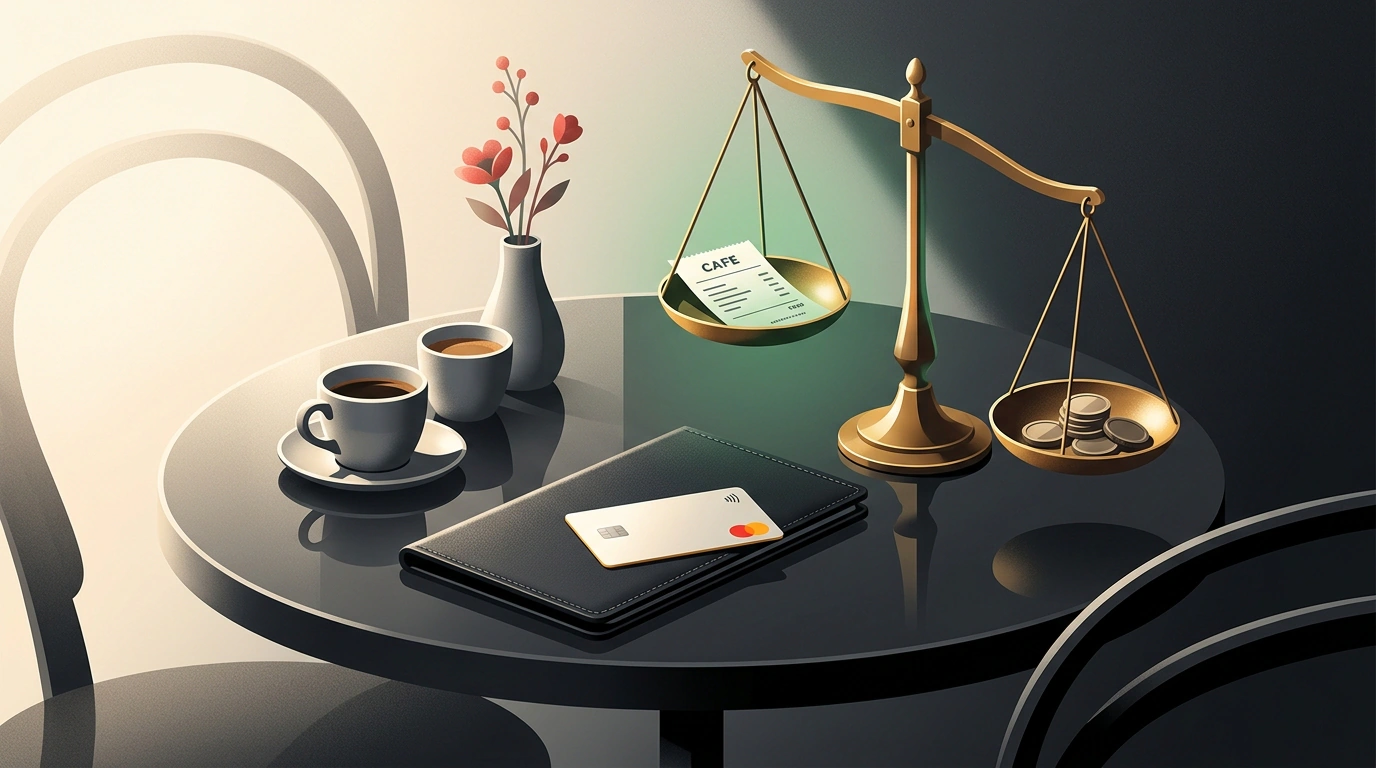
Know that silent scene at the end of a first evening? The waiter quietly places the leather bill folder on the edge of the table, and a heavy pause hangs in the air for a split second. Inside a guy's head, a roulette wheel starts spinning: grab the check first, suggest splitting it 50/50, wait it out, or casually toss down a platinum card? One clumsy move, and the romantic mood shatters into petty stinginess or tacky showing off.
Money on early dates scares a lot of guys because social media has piled mountains of nonsense around it. Some preach aggressive alpha posturing with rented sports cars. Others pull out a calculator to split a cappuccino down to the last cent. Let's look at this from the perspective of a calm, confident man who respects both his wallet and the person across from him.
The awkward check: why money freezes guys up
A Chapman University study led by sociologist David Frederick, surveying over 17,000 people, revealed an interesting picture: 84% of men and 58% of women consider it normal for the man to cover the main expenses at the start of dating. Yet behind that surface agreement lies a deeper dynamic. Around 64% of men expect the woman to show initiative and chip in as things progress, and 44% admit they'd stop seeing someone if she never once offered to pay for even a coffee after a couple of months.
Money on a date isn't just paper or digits. It's a marker of your willingness to take the lead, and on her side, an indicator of how she sees you: as an interesting partner or as a free ATM for expensive venues.
Date one: calm masculine leadership without the show
One simple gentleman's rule applies here: whoever invites, pays. You picked the spot and asked her to share the evening with you, so you calmly cover the bill.
The real secret of a first date is choosing a casual, cozy, atmospheric place: a stylish coffee shop, a wine bar, or a scenic riverside walk. Never drag a woman you barely know to a pretentious white-tablecloth restaurant. First, an astronomical check puts unnecessary pressure on your budget. Second, you risk creating a sense of obligation that makes her want to bolt.
When the check arrives, take it with a calm, confident motion—no theatrical flourishes. If she makes a polite move for her bag (the classic "wallet reach"), catch her eye, smile warmly, and say, "I invited you, so it's on me. All good." That settles the moment in three seconds and shows you're steady and reliable.
Dates two and three: checking for maturity and mutual effort
By the second and third dates, courtship should naturally shift into mutual interest between two adults. That's where your date's true character shows up.
You can cover the main dinner again, but watch her reaction. If you grab coffee afterward and she says, "Let me get the coffee and desserts this time," or she buys exhibition tickets while you park the car, you're with a mature person who thinks like a partner. She values your effort and doesn't assume the world revolves around her.
If by the third date she pointedly looks away whenever any check arrives, expects you to pay for a business-class ride across town, and doesn't even say a simple "thank you" for dinner, you're looking at pure entitlement. Don't lecture her. Just take note of her values and don't build illusions about a future together.
What to do if she firmly insists on splitting the check
Sometimes a woman says firmly, politely, and clearly: "No, I want to pay for myself." Some guys panic at that moment, start arguing, try to prove they can afford it, and practically wrestle the waiter for the receipt.
Don't do that. If it's a matter of personal boundaries and independence for her, respect her choice. Smile, say, "Deal, no problem," and split the bill calmly. Your masculinity isn't measured by the thickness of your wallet. It's measured by your inner calm, tact, and ability to read the room.