Do you know which part of a man's outfit women check first when you meet? Not the logo on your T-shirt and not the cut of your jacket. Their eyes drop almost instantly to your shoes. You can wear an impeccable wool coat, a fresh haircut, and great cologne, yet if you're wearing beat-up gym sneakers or shapeless faux-leather boots from a discount bin, the entire look collapses on the spot.
Shoes are the foundation of your appearance. And if there's one pair capable of carrying your whole autumn and spring wardrobe—making you look taller, leaner, and sharper—it's classic Chelsea boots. They pair just as easily with worn-in jeans as with tailored flannel trousers. There's a catch, though: fast-fashion stores are flooded with cheap knockoffs that fall apart in two months and torture your feet. Let's break down how to choose real Chelsea boots that will last a decade and become your smartest wardrobe investment.
Royal roots and rock 'n' roll: where the iconic boot came from
The Chelsea boot story began in London in 1851. Queen Victoria's personal shoemaker, J. Sparkes-Hall, wanted to design a riding boot without the hassle of laces. Right around then, American inventor Charles Goodyear patented vulcanized rubber. Sparkes-Hall used that breakthrough to stitch thick elastic side gussets into a leather ankle boot. The Queen loved them: they slipped on in seconds, hugged the ankle cleanly, and looked effortlessly sharp.
The style got a second life in the 1960s. Rebellious youth and artists in London's Chelsea neighborhood—which gave the boot its name—adopted them as an unofficial uniform. Once The Beatles and The Rolling Stones started performing in them, Chelseas locked in their place among classic menswear icons. They carry a rare mix: aristocratic polish paired with rock-'n'-roll edge.
Sole anatomy: Goodyear Welt vs. Blake Stitch vs. glued mass-market
When you pick up a boot, the very first thing to inspect is how the sole attaches to the upper. That single detail separates one-season disposable shoes from real craftsmanship built to last for years.
Detailed comparative diagram of three footwear constructions in cross-section: Goodyear Welt, Blake Stitch, and cemented mass-market.
There are three main constructions:
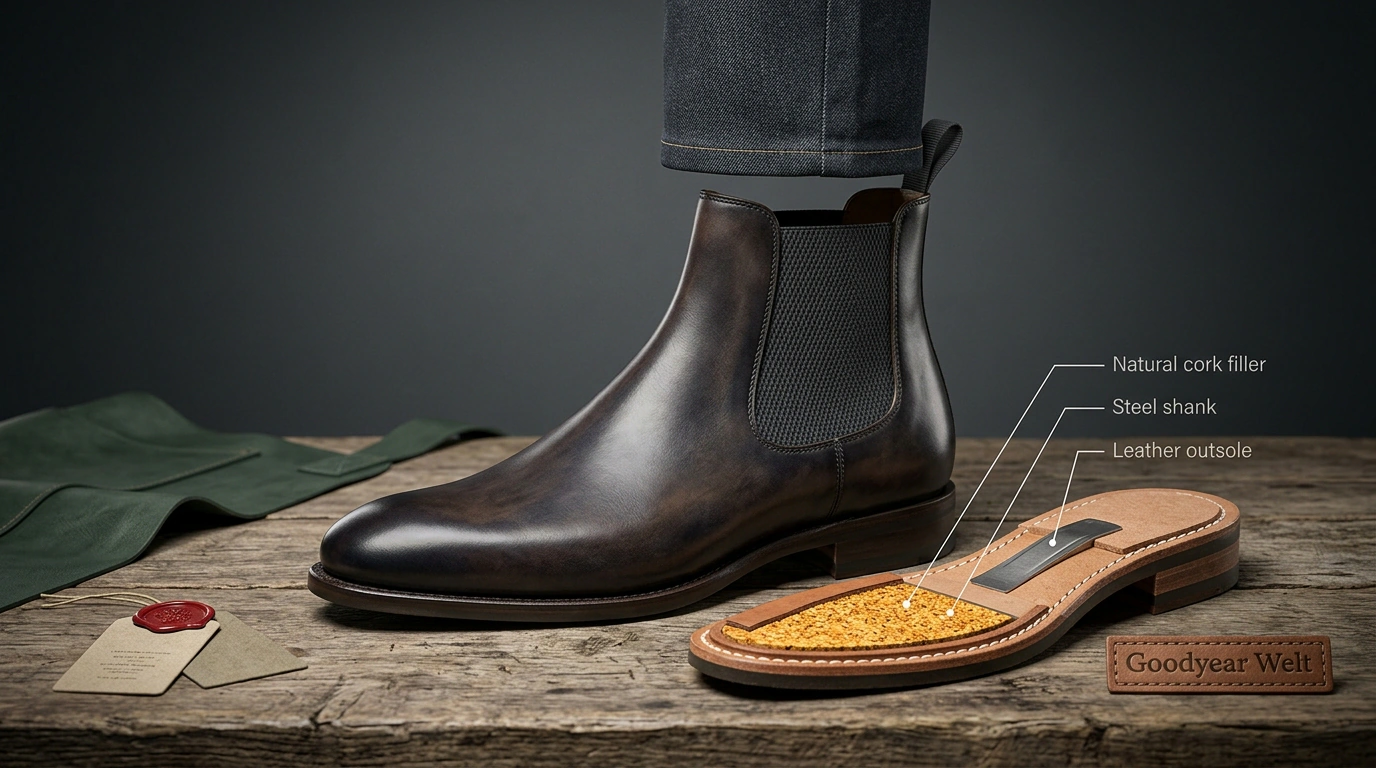
- Goodyear Welt (the gold standard). Developed by Charles Goodyear Jr. in 1869, this method stitches the upper and insole not directly to the outsole, but to a sturdy leather strip called a welt. The outsole is then stitched to that welt, and natural cork fills the cavity between insole and outsole.
- Why it's unbeatable: Within two weeks, body heat and weight mold the cork layer to your exact footprint, so the boots fit like a second skin. The welt creates a strong barrier against puddles and street grime. Best of all, they are fully resoleable. When the sole wears down after three or four years, any skilled cobbler can stitch on a fresh one without harming the leather upper. A pair like this easily lasts 10–15 years.
- Blake Stitch. An Italian method patented by Lyman Blake, where one continuous stitch runs straight through the insole, upper, and outsole from the inside out.
- Pros and cons: The boot comes out lighter, more flexible, and sleeker, with no projecting welt edge—ideal for dry autumn days. Just remember that the stitch passes straight through the bottom, so in heavy rain water can seep up along the thread. Blake-stitched boots aren't built for deep puddles.
- Cemented construction (glued). The cheap fast-fashion method filling most mall shelves. The sole is simply glued onto pressed or corrected-grain leather.
- The verdict: No cork, no shock absorption, zero repairability. As soon as moisture or road salt dries out the glue—usually within two or three months—the sole peels right off. Buying cemented Chelseas is throwing money away.
Choosing the leather: from smooth calfskin to rugged waxed hide
Your second key decision is the upper material. It shapes both durability and where you can wear the boots:
- Smooth box calfskin. Timeless in black or dark brown. It holds a rich, low-key sheen and handles city weather easily with minimal care (cream and wax every couple of weeks). It fits right into smart-casual looks with an overcoat, knitwear, dark denim, or wool trousers.
- Genuine suede. Chelsea boots in tobacco, chocolate, or sand suede are an instant magnet for compliments. Suede brings rich texture, softness, and relaxed elegance. Just treat it with respect: apply three coats of waterproofing spray before your first wear and skip heavy slushy downpours.
- Waxed leather (Pull-up). Leather infused with natural waxes and oils shrugs off rain, snow, and salt. It develops attractive tonal shifts along creases, and light scuffs buff out with a finger. Ideal for rugged outfits with field jackets and heavy raw denim.
Toe shape and the sneaky gusset: details that make or break the look
Details decide everything. Watch two elements inexperienced buyers often miss:
- Toe shape. Make this rule permanent: skip clunky square toes straight out of 90s crime dramas and skip overly long, pointy "elf" toes. Your best bet is a classic almond toe or a subtly rounded toe. It looks natural, masculine, and never goes out of style.
- Elastic side gusset. Cheap boots use thin synthetic elastic. Within a month it stretches into wavy ripples, the ankle opening flares out like a fire hose, and your heel slips. Quality Chelseas use dense, multi-layered elastic that snaps right back and hugs your ankle snugly. Always use a shoehorn, and never kick your boots off by stepping on the heel.
How to style Chelseas: silhouette and trouser length rules
The real magic of Chelsea boots is how they lengthen your frame—provided your pants cooperate:
- Leg opening width. Aim for 18–20 cm at the hem. Wide bootcut pants swallow the boot and make it look like an ordinary dress shoe, while ultra-tight skinny jeans bunch awkwardly over the shaft.
- Length and break. Your hem should lightly kiss the top of the boot (no break) or rest with one soft crease (slight break). Never tuck your pants inside Chelsea boots—it looks sloppy. Let the fabric drape cleanly over the ankle.
Put together your first foolproof outfit: dark brown suede Chelseas, straight dark-indigo jeans with a single neat cuff, a chunky grey knit sweater, and a short wool coat or bomber jacket. That combination projects taste, pedigree, and quiet confidence. Invest in quality once, and you'll feel your posture and stride change immediately.