Step into any gym during the evening rush and you'll see the same painful scene. A guy grabs dumbbells far too heavy for him and starts violently rocking his entire body, heaving the weight up with his knees and lower back. It looks more like a dance routine than strength training. He thinks he's "destroying his biceps," while momentum steals all the tension and his elbows and lower back scream for mercy. The result is predictable: skinny arms and nagging joint pain.
In a candid conversation with Chris Williamson, modern fitness phenomenon Sam Sulek breaks arm training down to the basics. Building thick, powerful arms isn't about doing ten exercises or cheating crazy weights. It comes down to clean biomechanics, locked-in joints, and controlling the lowering phase.
The weight illusion: why body swinging steals your arm growth
Ego lifting is the number-one mental trap for guys in the gym. We want to look strong, grab the heavy dumbbells, and drop the bar loudly. Yet your muscles have zero idea what number is stamped on the plate.
Muscles grow from mechanical tension inside the target fibers. When you heave with your hips and back, tension at the bottom stretch of the curl drops near zero—you're just launching iron through the air. As Sam Sulek stresses: pin your elbows in place, take your back out of the lift, drop the weight by a third, and you'll feel blood flooding your arms like never before.
Triceps rule the sleeve: 60% of arm size and three-head anatomy
Most guys chasing big arms obsess over biceps curls while ignoring basic anatomy. Remember this: your triceps make up around 60% of your upper-arm muscle mass. Those three heads are what give your arms real thickness, width, and presence in a T-shirt.
The triceps have three heads: lateral (outer), medial (middle), and long.
- The lateral and medial heads attach to the upper-arm bone and fire hard on standard cable pushdowns.
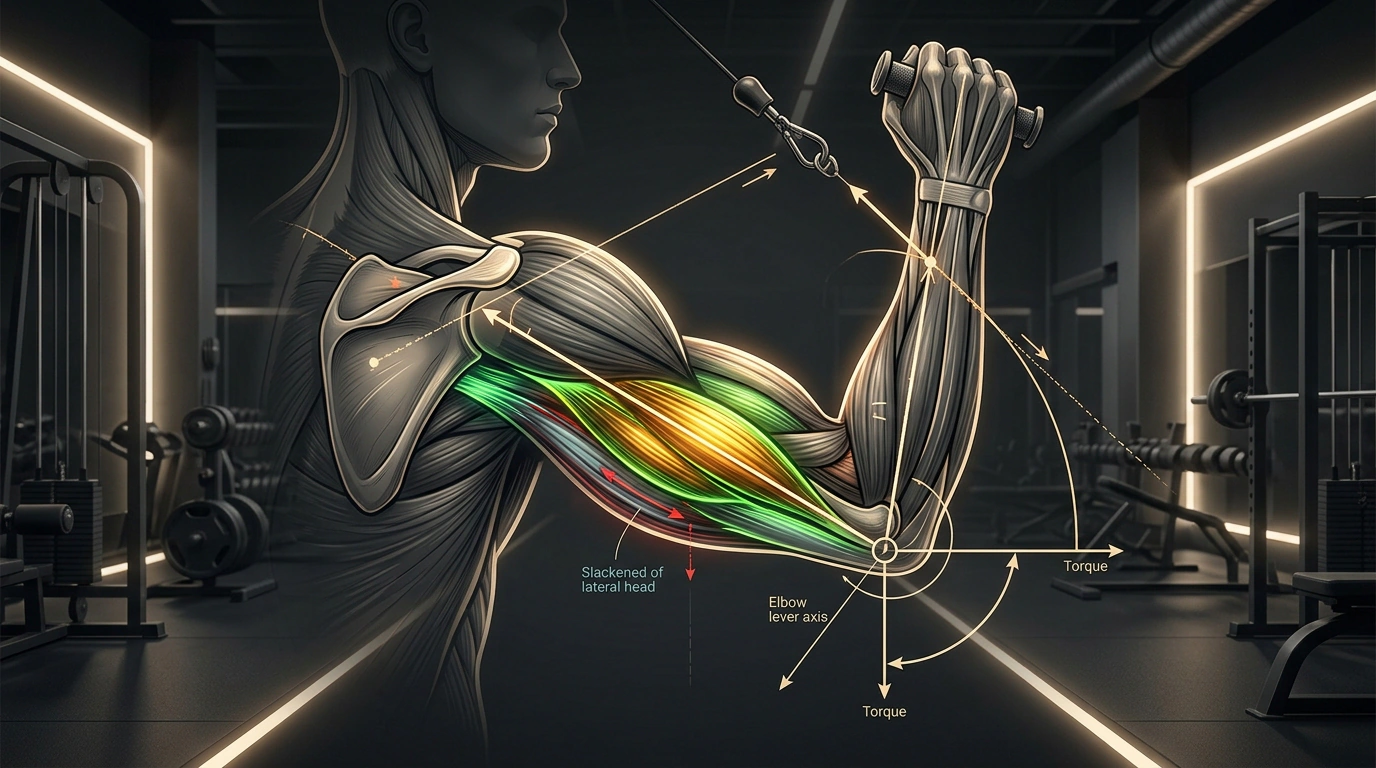
- The long head—the largest, meatiest part of the triceps—attaches directly to your shoulder blade. That means you can only stretch it completely and load it 100% when your elbow is raised overhead.
Maeo's study: why overhead extensions beat standard pushdowns
This isn't gym folklore; it's proven science. In a 2022 study by Dr. Maeo and colleagues in the European Journal of Sport Science, researchers directly compared overhead triceps extensions against neutral-arm cable pushdowns.
Ultrasound scans showed the overhead protocol grew the long head of the triceps by 28.5%, compared to just 19.6% for standard pushdowns. That's a massive gap. High mechanical tension in a deep stretch (stretch-mediated hypertrophy) triggers a superior growth response.
Sam Sulek's practical takeaway: make seated overhead dumbbell extensions or overhead rope cable extensions your cornerstone triceps move. Then finish off the lateral head with rope pushdowns, flaring your hands apart at the bottom and holding a crisp one-second squeeze.
Biceps and supination: building a tall peak with 3-second negatives
For biceps, keep their dual anatomical job in mind: the biceps don't just bend the elbow—they also supinate the forearm, rotating your palm outward and upward.
- Incline Dumbbell Curls. Set a bench to 45–60 degrees and let your arms hang straight down. Your elbows sit behind your torso, creating a deep stretch on the long head—the part responsible for your biceps peak. As you curl up, actively twist your pinkies outward through the top third of the rep.
- Control the negative (3 seconds). Don't drop the weight. Muscle micro-damage and growth signaling peak during the eccentric phase as the muscle resists gravity. Lift in one smooth second, then lower for three full seconds.
Two smart triceps movements and two strict biceps movements—executed cleanly and pushed within one or two reps of failure—will add more size in two months than years of sloppy swinging. Lift smart.