Know that sinking morning feeling? You're in the shower, run a hand through your hair, look at your palm—and see way too many strands. Or under bright fitting-room lights, you notice your part looks wider and your temples have crept back. For any guy under 25, early hair loss feels like a direct hit to attractiveness and confidence.
In a panic, guys buy useless "pepper shampoos," swallow handfuls of questionable supplements, or stumble onto futuristic red-light laser helmets and caps costing hundreds of dollars. At first glance, glowing helmets look like pure late-night infomercial snake oil. Is there actually anything behind them?
Board-certified dermatologist Dr. Dray breaks down the clinical evidence behind Low-Level Laser Therapy (LLLT) and shows where real medical physics ends and marketing hype begins.
Mirror panic: why early thinning hits confidence hard
Roughly 90% of hair thinning in young men comes from androgenetic alopecia (male pattern baldness). Driven by the hormone dihydrotestosterone (DHT), hair follicles on the crown and temples gradually shrink—a process dermatologists call miniaturization. Each new hair grows back thinner, shorter, and weaker until the follicle shuts down.
Most over-the-counter products fail because they never reach the root of the problem. Low-level laser therapy, however, is one of the few device treatments cleared by the FDA and supported by meta-analyses in PubMed Central.
Photons in the mitochondria: how 650 nm red light wakes follicles up
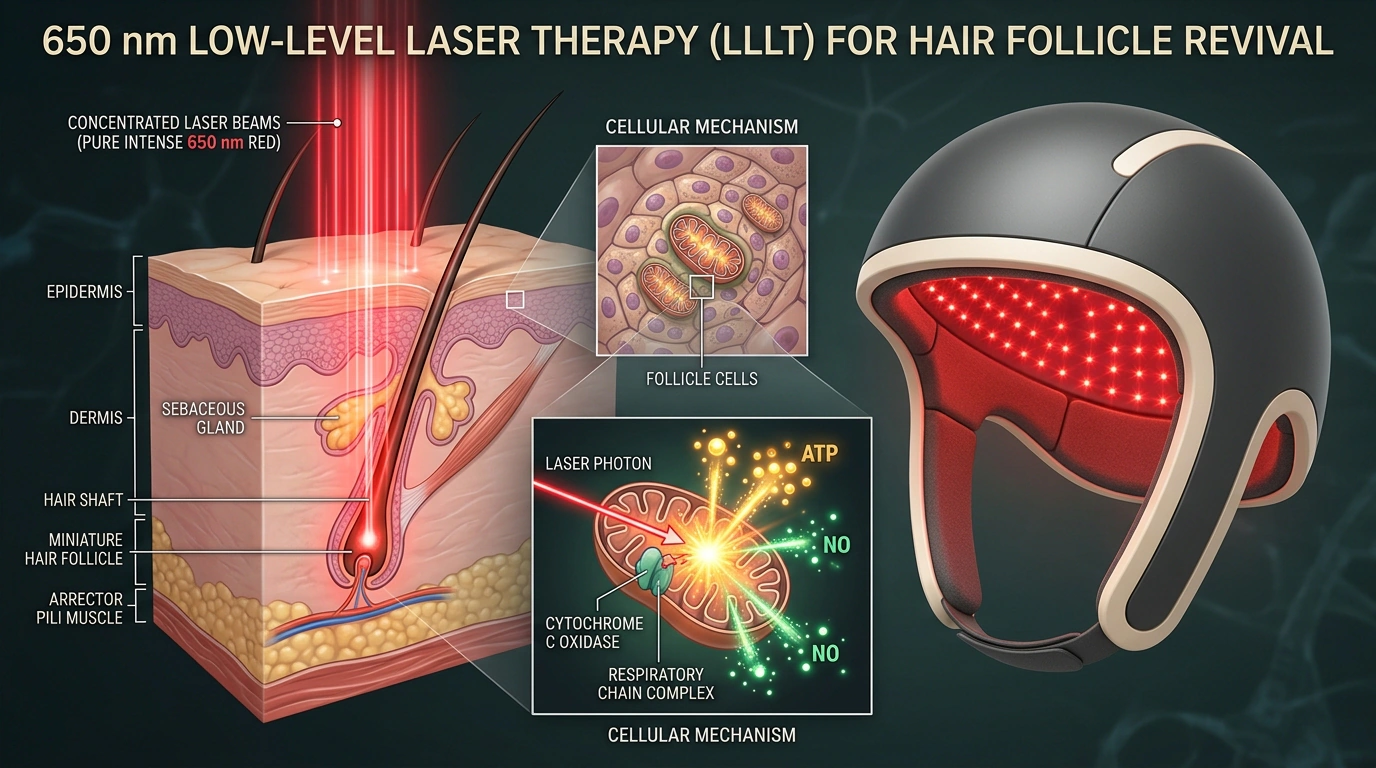
There's no magic here—just cellular biology and photobiomodulation:
- The 650–655 nm optical window. This specific red-light wavelength penetrates cleanly through the scalp's outer layers up to 5 millimeters deep—right where the hair follicle bulb sits.
- Charging cellular power plants. Light photons are absorbed by cytochrome c oxidase inside the mitochondria. Cells get an energy boost: ATP production rises and nitric oxide (NO) is released.
- Better blood flow and longer growth. Tiny blood vessels around sluggish follicles widen, bringing more oxygen and nutrients. That nudges hairs out of the resting phase back into active growth (anagen), slowing DHT's shrinking effect.
Real limits: who lasers help and where they fail
A laser cap isn't a magic wand. Dr. Dray highlights strict clinical boundaries:
- Where it works: LLLT shines in early to moderate stages (Norwood II–IV), when hair is thinning but follicles are still alive. Meta-analyses show thicker hair shafts and a 15–20% bump in density.
- Where it fails: If an area has already turned into a completely smooth, shiny bald spot where follicles have been replaced by scar tissue (fibrosis), red light can't bring dead follicles back. At that stage, only a hair transplant works.
Avoiding cheap LED knockoffs and sticking to a six-month plan
If you decide to test LLLT, watch out for cheap imitations. Online marketplaces are full of inexpensive glowing caps fitted with ordinary indicator LEDs. They shine red, sure, but lack the coherent beam, power output, and exact wavelength needed. Real therapeutic results require medical-grade laser diodes calibrated for proper energy density (J/cm²).
Consistency matters most:
- Sessions run 20–25 minutes, three to four times a week.
- Real results—less shedding and fuller roots—take 4 to 6 months of steady use.
- Combining laser therapy with proven topical treatment like minoxidil delivers the strongest mutual response.
Your hair is a big part of feeling sharp and youthful. Don't wait until follicles shut down for good: act early, stick to proven medicine, and stay consistent.