Let's be honest: a well-cared-for face without oily shine, blackheads, or flaking gives you a huge confidence boost. When you walk up to meet a woman or sit across from her at a coffee shop, your skin speaks louder than words about your lifestyle and self-respect.
Walk into a cosmetics aisle, though, and you're hit with a wall of jars costing tens of thousands of rubles: 'caviar cream,' 'glacier serum,' and ten-step routines. It's easy to assume clear skin costs as much as a used car.
Here's the good news from practicing dermatologists: most of the price tag on luxury skincare pays for heavy glass jars and advertising. The industry runs on contract manufacturing (white-labeling), where the same factories pour identical base formulas for affordable pharmacy brands and high-end lines. Let's break down where you can comfortably save and which active ingredients actually justify spending more.
Where to Save: The Basic Foundation That Shouldn't Cost a Fortune
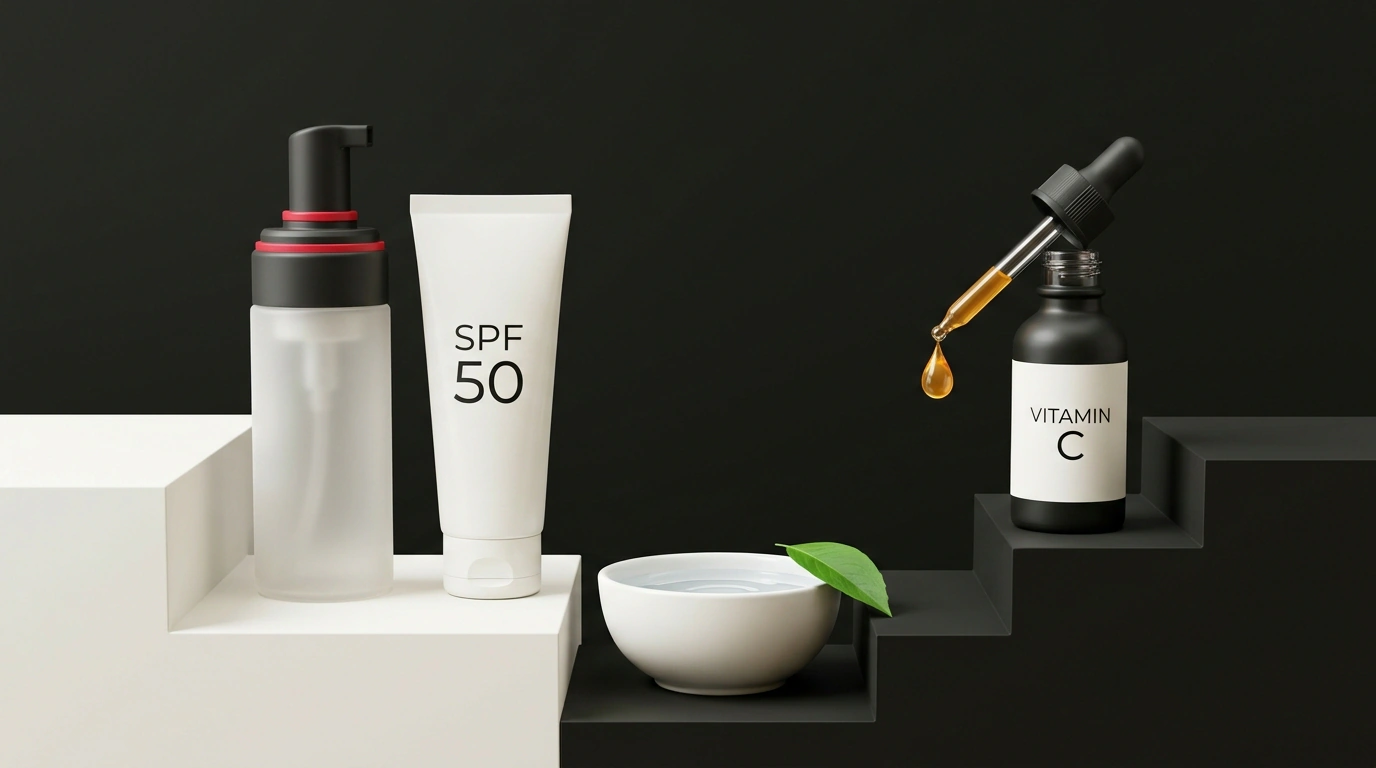
Dermatology rests on three pillars of basic care: cleansing, moisturizing, and sun protection. None of them require overpaying.
1. Facial Cleanser
A face wash stays on your skin for 40–60 seconds before you rinse it off with water. Its only biological job is to dissolve built-up sebum, dust, and leftover cream without stripping your protective lipid barrier.
Gentle surfactants like cocamidopropyl betaine or glucosides are inexpensive. Pharmacy brands like CeraVe Hydrating Cleanser, Cetaphil, or mild Korean gel cleansers handle this job effortlessly. There is no medical reason to spend more than 1,500–2,000 rubles on a face wash. As we noted in our guide on switching to science-based minimalism, harsh 'squeaky-clean' washing only pushes your oil glands into overdrive.
2. Basic Moisturizer
A moisturizer's job is to seal water inside the epidermis and stop it from evaporating. The most thoroughly proven hydrators in science are glycerin, hyaluronic acid, squalane, and ceramides.
Making these ingredients is a solved science. Paying extra for 'rare sea algae extracts' makes no sense—plant fragrances are more likely to trigger allergies than help your skin. A reliable basic pharmacy cream under 2,000 rubles will cover everything men's skin needs.
3. Sunscreen (SPF 50)
UV rays are the main cause of early wrinkles and sagging skin. Here, a strict volume rule applies: to actually get the labeled SPF 50 protection, you need to apply about 1/4 teaspoon to your face and neck every morning.
If your sunscreen costs 6,000 rubles, you'll subconsciously skimp and spread a tiny drop, cutting your protection down to almost nothing. SPF filters are strictly regulated by FDA and ISO standards, so affordable sunscreens protect against photoaging just as well as luxury emulsions.
Buy an affordable, lightweight sunscreen with modern chemical filters and apply it generously every morning. It's the best anti-aging investment you can make, and it will save you thousands of rubles on dermatologists later.
Where to Splurge: High-Tech Active Ingredients
While we save on the basics, active serums are pure biochemistry. Here, cheap formulas often turn out to be useless.
1. Stabilized Vitamin C (L-Ascorbic Acid)
Pure vitamin C stimulates collagen production and fades post-acne marks. However, the molecule is very unstable. It oxidizes almost instantly when exposed to light and air, turning into a useless brown liquid.
A Duke University study (Lin, Pinnell et al., Journal of Investigative Dermatology, 2005) proved that for vitamin C to work, the solution needs an acidic pH below 3.5 and a strict pair of stabilizers: 1% vitamin E (tocopherol) and 0.5% ferulic acid. This combination doubles the skin's photoprotection, but it requires airtight packaging. Cheap mass-market serums often oxidize while still sitting on the store shelf. Here, a quality formula is worth every ruble.
2. Topical Retinoids and Retinal
Retinol and retinaldehyde are the top proven fighters against breakouts and signs of aging. In crude formulas, though, they cause peeling and irritation.
Quality products use micro-encapsulation technology. The molecule releases gradually overnight, working deep in the dermis without irritating the surface layer. If you want to choose actives wisely, check out our breakdown on how active ingredients work together—introducing retinoids properly takes consistency.
Your Everyday Working Protocol
Stop overcomplicating things and start with a clear, steady routine:
- Morning: Rinse with cool water or a gentle cleanser → vitamin C serum → SPF 50 sunscreen.
- Evening: Gentle cleanser to wash off city dust and sunscreen → retinal or retinol serum (every other night) → basic ceramide moisturizer.
Stick to this simple routine for two weeks, and you'll see an even, fresh skin tone in the mirror that feels great to the touch. No magic—just clean science and a smart budget.