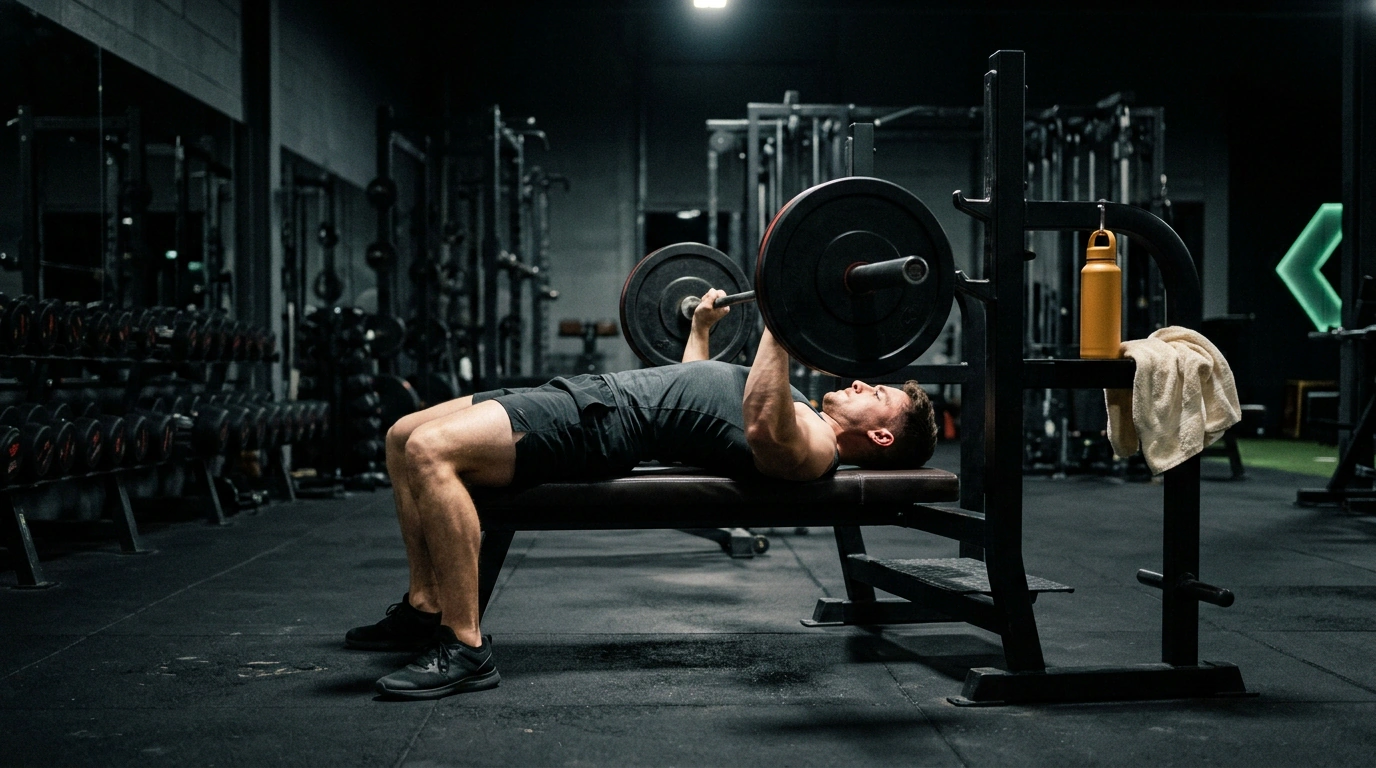
When you want to build a solid upper body, you usually hit a fork in the gym. Path one: copy flashy moves from social clips and wrestle huge dumbbells so people glance over. Path two: press the same familiar exercises on autopilot for months and wonder why your T-shirt fits just as loosely across the chest as six months ago. Both stall when tension misses the target muscle fibers.
Broad shoulders and a well-built chest change your posture and frame fast. Let's look at five popular chest exercises that deliver plenty of fatigue for very little growth, and see how to fix them.
Three rules that actually make your chest grow
Any press in your program is easy to grade against three standards.
First is rock-solid stability. A muscle recruits maximum fibers when your torso is firmly braced against a bench or machine pad. The second your body has to fight for balance, your nervous system dials down power.
Second is tension in a deep stretch. Sports science calls this stretch-mediated hypertrophy. Systematic reviews by Milo Wolf, Brad Schoenfeld, and colleagues confirm that strong mechanical tension while a muscle is fully stretched sends the strongest growth signal. For your chest, that's the bottom of a press when your shoulders pull back.
Third is an honest range-of-motion standard. A rep needs clear start and finish points; otherwise, tracking progressive overload becomes guesswork.
Alternating dumbbell press and Hammer lever machines: where effort leaks
First trap: the alternating (one-at-a-time) dumbbell bench press. You lie back, press both dumbbells up, then press with one arm while the other holds a heavy weight straight toward the ceiling as a counterweight.
Two things break immediately. First, your center of mass shifts: your torso twists on every rep, the working pec loses stability, and peak force drops. Second, energy leaks out fast. While your right arm presses, your left arm spends 30–45 seconds holding a heavy dumbbell at lockout. That shortened position gives almost zero growth stimulus while tiring out your chest, triceps, and shoulder before their turn even starts.
The fix is simple: press both dumbbells together. If you genuinely want unilateral work, hop into a plate-loaded machine with independent arms. Load both sides, grip the stationary handle firmly with your free hand to lock your torso in place, and press. Stability stays high, and wasted static holding disappears.
Second culprit: Hammer Strength-style lever chest presses. Loading plates onto them feels great, yet the lever geometry works backward. At the bottom stretched position, the arm hangs nearly straight down, so resistance drops off. At the top lockout, the lever swings against gravity and peaks. For chest growth, you want the exact opposite resistance curve.
You can fix this machine two ways. First, place a firm pad a couple of inches thick behind your upper back: your torso shifts forward, your hands travel deeper behind you, and tension returns at the bottom. Second, run lengthened partials—pressing halfway to two-thirds up and lowering right back into the stretch without locking out. If you'd rather not fiddle with pads, switch to a machine with even resistance throughout the press or one that loads the bottom hardest.
Floor press and half-rep push-ups: cutting off the range
Third candidate for a swap is the barbell floor press. You lie on a mat, lower the bar, and your elbows hit the floor long before the bar nears your chest. The floor chops off the bottom quarter to third of the movement—the single most productive stretch zone for growth.
Comparative infographic diagram of two barbell press paths: cut-off range from the floor versus full stretch on a bench
The swap is obvious: move to a standard bench so your elbows travel freely below your torso. For an even deeper stretch (assuming healthy shoulders), use a cambered bar—a barbell with a U-shaped cutout in the middle that lets your hands drop below chest level. It works great for rows, squats, and good mornings too.
Fourth problem move: mid-range "half" push-ups, where you pulse rapidly through the middle 50% without touching your chest to the floor or straightening your elbows at the top.
Again, you lose the stretch and wreck your tracking. When you do 15 strict push-ups—chest touching the floor and elbows locked at the top—both endpoints are fixed. Next week you hit 16, then 17. Pumping in the middle is pure guesswork: 8 inches deep today, 10 inches tomorrow. That's like tracking calories by ice cream scoops—250 calories on Monday, 350 on Tuesday, yet your log just says "one scoop."
Easy fix: lower until your chest clearly taps the floor with a brief pause, then press all the way up. An acceptable variation is stopping two-thirds up—tracking is slightly looser, though your pecs stay under constant stretch.
Ultra-heavy incline dumbbells: why ego loses to the barbell
Number five often stings the ego. Two spotters hand you 130–180 lb (60–80 kg) dumbbells, setup takes longer than the set, and then come 5–8 jerky half-reps. For muscle growth, this loses on four counts.
First, injury risk shoots up: kicking heavy dumbbells up with your knees and especially lowering them puts real strain on your biceps and shoulders. Second, massive pre-set fatigue. Sports scientist Dr. Mike Israetel noted from his own lifting that with 130–140 lb (59–64 kg) dumbbells, just hoisting them into position burned so much energy he lost 3–5 working reps. It's like sprinting for 30 seconds right before heavy squats.
Third, oversized plates block depth. In a clean dumbbell press, your hands go wide and deep until the inner plates nearly brush your upper biceps. Huge plates hit your chest and shoulders early, turning the set into partial reps. Fourth comes the instability paradox: you pick extreme weight to create high force, yet wobbling prevents your pecs from producing it. A classic stick in your own spokes.
To fix incline dumbbell presses, drop the weight to a clean 10–15 rep range, lower wide and deep, and add a short pause at the bottom. For heavy 5–8 rep work, switch to the incline barbell press. You get total stability, repeatable depth, safer setup, and zero wasted energy getting started if a partner hands off the bar. The plates might look less dramatic, yet your chest grows faster.
| Exercise | What Steals Gains | How to Fix It | Smart Swap |
|---|---|---|---|
| Alternating dumbbell press | Torso twist and static arm fatigue | Press both dumbbells together | Unilateral machine holding the fixed handle |
| Hammer-style lever press | Heavy at lockout, light in the stretch | Pad behind back + bottom partials | Machine with even or bottom-heavy resistance |
| Barbell floor press | Floor blocks elbows and cuts bottom third | Move the press onto a bench | Flat bench press or cambered bar press |
| Half-rep push-ups | Zero stretch and impossible to track | Touch chest to floor, lock out or stop at 2/3 | Any press or push-up with a fixed bottom touch |
| Ultra-heavy incline dumbbells | Injury risk, setup fatigue, plate bulk, wobble | Drop weight for 10–15 deep paused reps | Incline barbell press for 5–8 reps |
No dogma: when an 'imperfect' move still earns a spot
None of these exercises are banned. Your main filter is your personal stimulus-to-fatigue ratio (SFR): how much productive chest tension you get per unit of overall fatigue and joint wear. If a movement feels smooth on your shoulders, gives a massive pump, stretches your pecs, and lets you add weight steadily, keep it happily.
Personal enjoyment counts too. If you love Hammer-style presses on occasion and don't mind adding an extra set or two to match the stimulus, go for it. Finally, rotation matters: hammering the exact same three presses year-round gets stale, so swapping in a "less optimal" move for a month refreshes your head before returning to your core staples.
Loading the very bottom of a press creates a strong growth signal, yet it raises mechanical stress on your shoulder joint and tendons. If you're used to shorter reps, don't dive into full depth with your old working weight on day one. Lower the weight, get used to a smooth descent with a brief pause and zero front-shoulder pain, and build back up gradually.
Grading any press in practice is simple: your torso stays locked down, your pecs stretch hard at the bottom, your shoulders feel fine, and every rep counts honestly in your log. Everything else comes down to your preferences and training block.