One of TikTok and Amazon's biggest skincare hits—bought by the thousands for "a heavy dose of vitamin C and even skin tone"—actually contains just 0.001% of a vitamin C derivative. Even the brand's own study posted on its website showed dark spots improving by a whopping... 2%.
Pretty funny number, right? Usually companies bury results like that instead of putting them in the storefront. At first glance, it's tempting to write off Eqqualberry Vitamin Illuminating Serum as just another short-video hype bottle. Yet when you inspect the formula calmly, the real story is smarter than that.
Viral bottle vs. the actual label
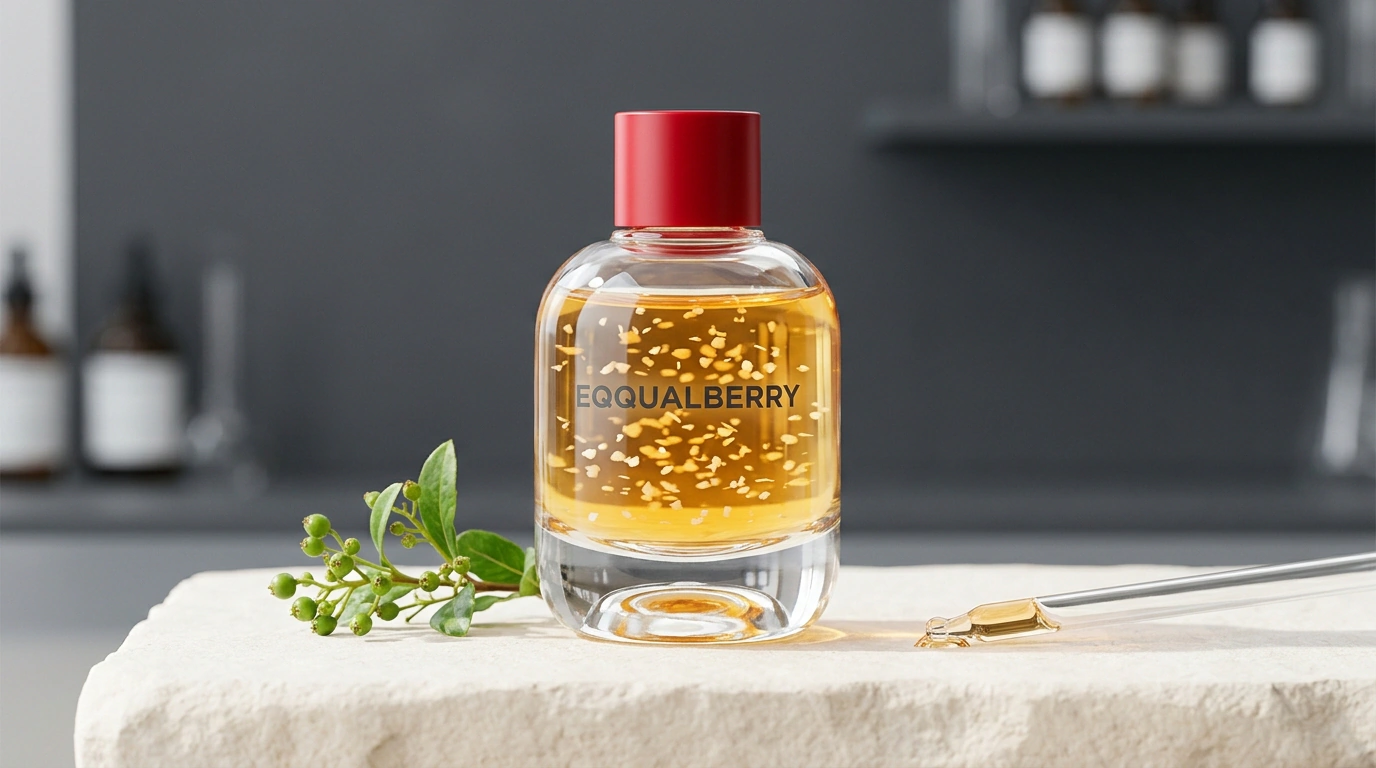
On the outside, Eqqualberry grabs attention right away. Heavy oval clear glass, a bright red cap, yellow liquid, and floating white flakes. Thanks to a separate glass base at the bottom, it looks like a rare two-phase lab elixir. On a shelf or on camera, it looks great.
Social media marketed it as "Korean vitamin C for glow." Read the label closely, though, and the trick vanishes: the brand itself carefully named it Vitamin Illuminating Serum—just "vitamin," with no letter C.
The base is 40% acerola fruit water. The berry itself is rich in vitamin C, yet fruit water is a black box: you have no way of knowing how much actual vitamin C survived into the bottle, how stable it is, or whether it reaches your skin.
The ingredient list does include 3-O-ethyl ascorbic acid—a stable vitamin C derivative gentler than acidic L-ascorbic acid, which still needs a real working dose. Here it sits at just 0.001%, less than a hundredth of a percent. Physically, this serum cannot replace a true vitamin C product.
The only major active with a disclosed percentage is 4% niacinamide (vitamin B3). That's a reliable everyday workhorse: it helps control shine, strengthen your skin barrier, and gently even out tone. Nearby on the list sit arbutin, tranexamic acid, ferulic acid, glutathione, and vitamin E (tocopherol), though none of their percentages are listed, making their real impact impossible to verify.
The iodine test and that 2% claim
To check whether the yellow liquid carries any real antioxidant punch, the serum was put through an oxidation-reduction test with iodine. The setup is simple: mix the serum with brown iodine in a vial, and if the liquid turns clear, antioxidants are neutralizing oxidation.
Eqqualberry passed briskly—the iodine faded noticeably. That confirms real antioxidant activity in the bottle, likely driven by acerola extracts, vitamin E, and supporting ingredients.
Still, a test tube proves only so much. Reacting with iodine doesn't measure vitamin C percentage, nor does it guarantee an active works inside living skin (some forms need conversion in tissue first). And the brand's own website data—that tiny 2% improvement in dark spots and tone—settles the question. Buying this bottle to fade stubborn post-acne marks or sun spots makes no sense.
What people actually praise it for—and where it fits
The bottle's real secret weapon hides in those floating white ceramide flakes. These are suspended lipid particles packed with five types of ceramides (NP, NS, AS, AP, EOP), cholesterol, and squalane. Ceramides act like skin-identical "mortar" between outer skin cells, locking in moisture and shielding your barrier from wind, shaving, and harsh cleansers.
In most formulas, rich cream lipids and light watery serums don't mix neatly. Here the texture engineering works nicely: you feel the flakes under your fingers for a split second before they melt right in. Your skin gets the light slip of a serum alongside solid hydration from panthenol and hyaluronic acid—with zero stickiness or sting.
Another plus is the lack of synthetic fragrance or harsh scent, though if you're prone to allergies, that long list of plant extracts is worth patch-testing inside your elbow first. And go easy on the amount: slathering on a thick layer of the yellow base can leave a slight yellowish cast.
If you already use a real vitamin C serum, don't swap it out. A clean morning order is simple: wash → your usual vitamin C → a moderate layer of Eqqualberry for 4% niacinamide, ceramides, and extra antioxidant backup → sunscreen (SPF).
Used that way, this Korean bottle earns its spot: it hydrates smoothly, supports your barrier, and keeps skin calm—as long as you don't expect miracles on dark spots.