Gyms and calisthenics parks are full of tough-sounding rules that actually slow you down. The floor steals the bottom of your press, a weak muscle pretends to be "tight" and laughs at your stretching, and grinding every set to failure fries your nervous system faster than it builds muscle. Here are five clean fixes across technique, effort, and scheduling that save months of wasted work.
Deficit pike push-ups: building bigger shoulders without weights
Floor pike push-ups are only good at the start. Your head taps the floor and cuts the rep short right where it gets interesting—like doing an overhead barbell press and stopping at the top of your skull.
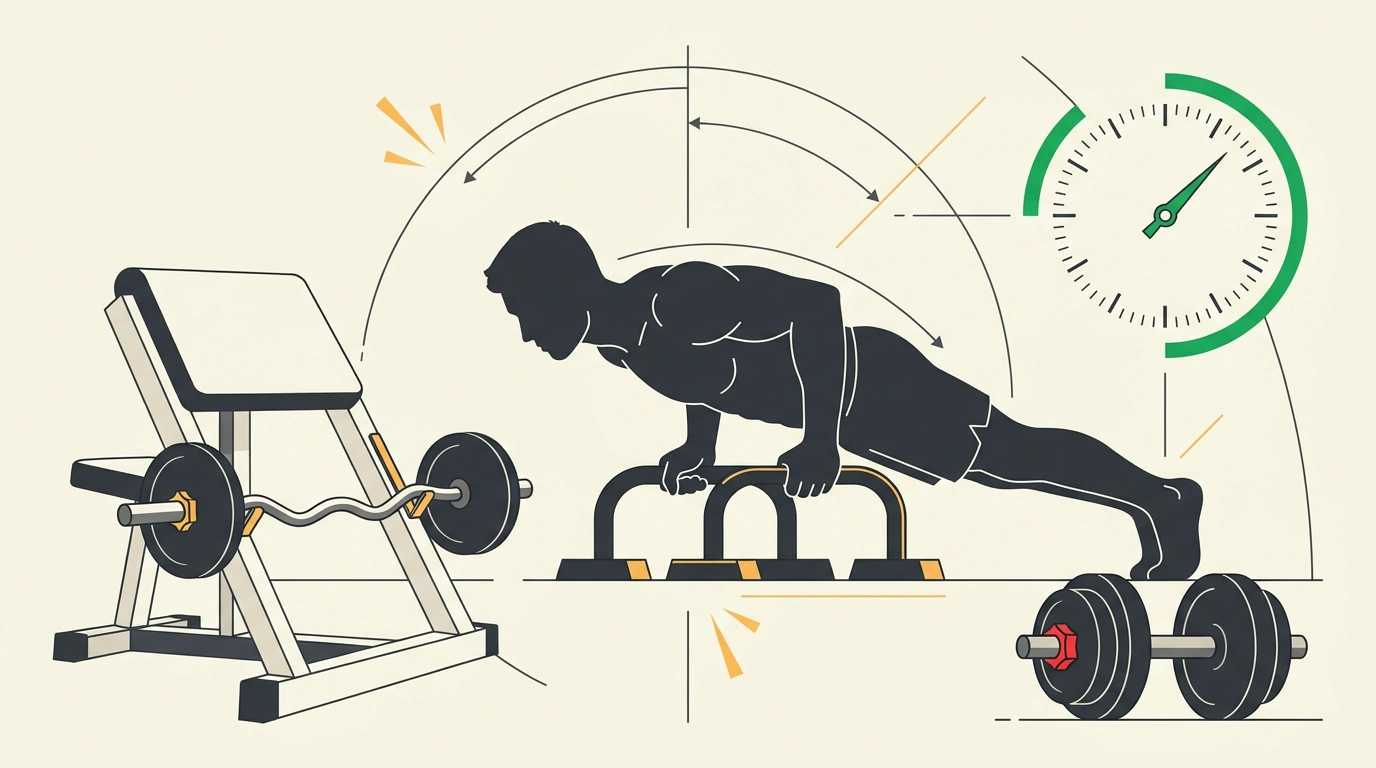
Once you can hit around five clean floor reps, move into a deficit. Skip the heroics: don't jump straight onto tall dip bars. Progress in steps—low push-up handles first, then parallettes (portable mini-bars so your head drops below your hands), and finally parallel bars.
The magic is in the bar path. As you lower down, lean your head forward past your hands to form a clear triangle. From the bottom, press up and back in one smooth arc, extending your elbows and flexing your shoulders together. A common mistake is shoving your torso straight up first and snapping your shoulders open afterward.
To make it harder, walk your feet closer to your hands: reps will drop, yet your shoulders will light up. If tight hamstrings pull at you, bend your knees slightly. This move hammers your front and side delts plus upper chest, pairs well with dips, and builds directly toward wall handstand push-ups where you press 100% of your bodyweight.
'Tight' hip flexors: why strength loosens them better than stretching
Your front hips feel tight after a day at a desk or heavy squats, so you head back to the mat. You hold deep lunges, endure the stretch, and feel temporary relief. An hour later, your hips feel like wood again.
The catch is that chronic tightness often masks muscle weakness, not shortness. When your hip flexors lack strength, your nervous system keeps them locked in protective tension to stabilize your pelvis and lower back. Stretching temporarily quiets the sensation, yet the root cause stays put.
The counterintuitive fix actually works: train your hip flexors directly with strength work. As the muscle gets stronger, that nagging tightness lets go on its own, and you move more freely both in the gym and day to day.
Keep one clear boundary: if you feel sharp pain in your groin or deep inside the hip joint, never push strength work through it. Get the pain checked before loading the area.
Preacher curls and the 'constant tension' myth
Dorian Yates famously tore into free-weight preacher curls: brutal tension on the tendon at the bottom, zero tension at the top—dangerous and pointless.
Let's check the logic. On a preacher bench with a barbell or dumbbells, peak load really is in the bottom half while gravity takes weight off at the top. Yet if that makes an exercise broken, you'd have to throw out almost every staple lift in the gym.
| Where Tension Peaks | Example Exercises |
|---|---|
| Bottom of the range | Free-weight preacher curls, squats, bench presses, leg presses, Romanian deadlifts |
| Top of the range | Lat pulldowns, free-weight bent-over rows, back extensions, hip thrusts |
| Middle of the range | Some free-weight curls and flyes |
True constant tension from start to finish barely exists anywhere. Biceps grow from hard work and steady progressive overload, not a flat resistance curve. Preacher curls work great under two rules: lower the weight under control without dropping into the bottom, and add weight gradually. If your elbows or tendons ache, lower the load or pick another curl.
Do you have to train to failure? Lessons from '90s pros and reps in reserve
A stubborn gym myth says real pros push every set to absolute failure, while "reps in reserve" was invented by academics. Training footage from the 1990s sets the record straight.
Take Lee Priest—a guy with some of the biggest arms in bodybuilding history. His workouts barely show sets taken to true failure; he routinely stopped with 4–5 reps left in the tank. He built massive volume through plenty of crisp, high-quality sets, which was standard among early-'90s pros.
Science backs up what they did. A 2024 meta-regression by Robinson et al. (Sports Medicine, covering over 55 studies) and research by Refalo et al. (2024) show that training with 1–3 RIR (Reps in Reserve—clean reps left before failure) produces nearly identical muscle growth to 0 RIR. Meanwhile, neuromuscular fatigue stays much lower, so you recover faster.
Save true failure for the last set of safe isolation moves. Dragging 0 RIR into every set of heavy squats, deadlifts, or presses is a fast track to a fried nervous system and sloppy form.
Gym at 2 a.m.: how your body adapts to late-night workouts
24-hour gyms are everywhere now. If you've trained afternoons for years and suddenly hit the weights at midnight—or fly across time zones and train on local time—your body will feel flat. Weights feel glued to the floor, and power drops off.
Yet your body adapts. You run on circadian rhythms—24-hour internal clocks governing body temperature, strength peaks, and sleep. Sports chronobiology calls this time-of-day specificity: train consistently at the same hour, and your muscular "clocks" shift to peak inside that window.
If late nights fit your schedule and you feel sharp then, train away. One rule matters most: keep your training time consistent, rather than bouncing from 8 a.m. one day to midnight two days later.
There is a trade-off. Sleep biometric research (Nature Communications, 2025) shows that hard training within 3–4 hours of bedtime often keeps nighttime heart rate elevated, lowers heart rate variability (HRV), and delays sleep due to higher body temperature and adrenaline. Finish late, and help yourself cool down: take a cool shower, dim the lights, and wind down slowly. If sleep debt starts piling up, move heavy sessions earlier.