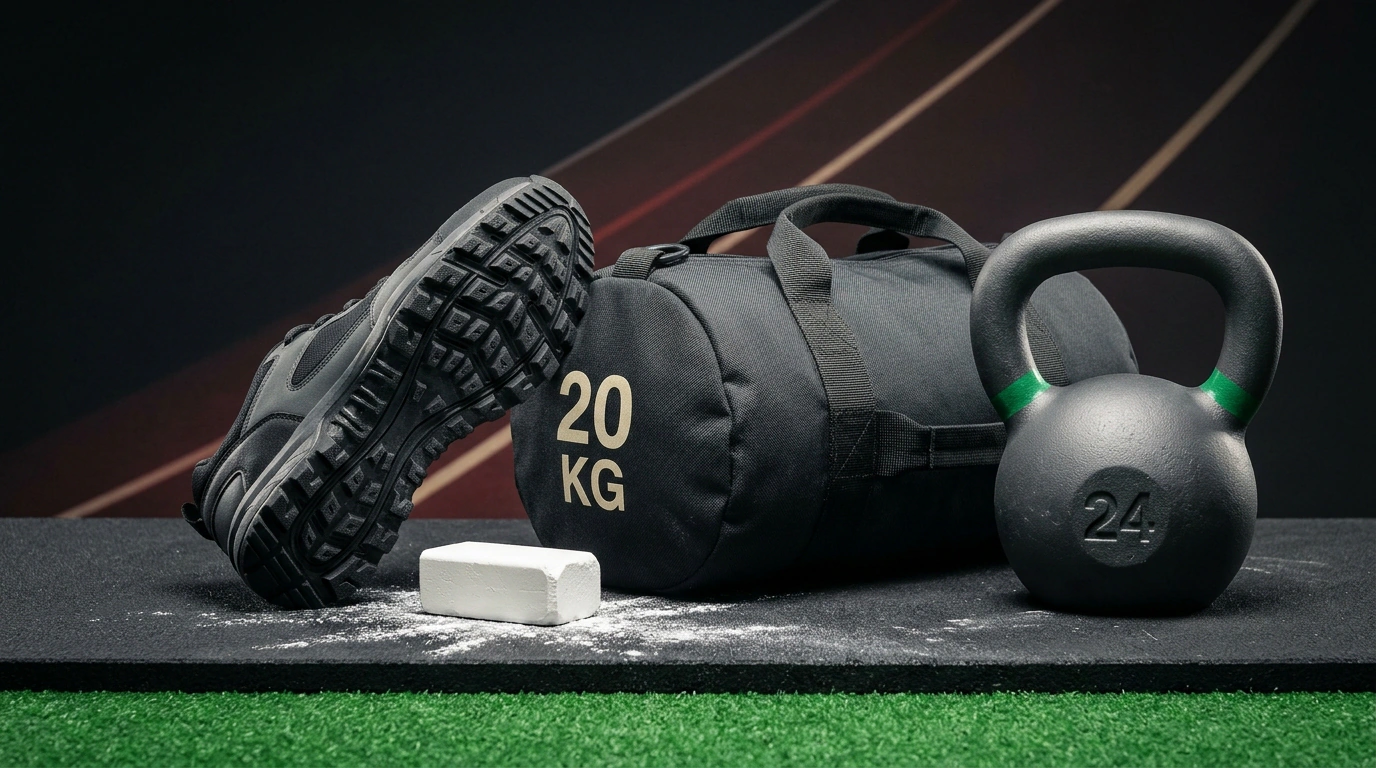
You step onto the start line of an indoor arena. Music is blasting, rows of ergs line the running track, and green turf lanes with loaded sleds stretch down the center. For the first 1,000 meters, your legs feel effortless. Your heart rate looks fine, adrenaline is high, and you want to pass everyone right away. But if you push too hard on the first two stations, your legs turn to concrete by the halfway mark, and your run becomes a slow zombie shuffle.
This is how both strong gym regulars and lean competitive runners break down. HYROX is an international indoor hybrid race where you run 8 kilometers across eight laps and complete eight functional stations without stopping the clock. Similar events like Craze and Triathlon Federation formats already exist in Russia, while HYROX itself has set the global standard with fixed distances and weights. Let's break down how the race works, where athletes lose their energy, and how to finish all eight stations solo or in doubles without crashing in the second half.
How the HYROX Format Works and Why Running Is the Main Station
The race structure is identical across all divisions: run 1,000 meters, complete station one, run another kilometer, complete station two, and repeat eight times. Between the running track and the workout floor sits the Roxzone, a transition corridor with water and chalk stations. The clock never stops there, so fumbling at water tables or hunting for the right lane adds straight to your finish time.
To avoid confusion on race day, keep the official HYROX station order and weights handy (per hyrox.com). In training, people often mix up the machines, but in the arena the sequence is strictly fixed.
| # | Station | Distance / Reps | Men Open / Men Doubles | Men Pro / Pro Doubles | Women Open / Women Doubles | Women Pro | Mixed Doubles |
|---|---|---|---|---|---|---|---|
| 1 | SkiErg | 1,000 m | bodyweight | bodyweight | bodyweight | bodyweight | bodyweight |
| 2 | Sled Push | 50 m (4 × 12.5 m) | 152 kg (incl. sled) | 202 kg (incl. sled) | 102 kg | 152 kg | 152 kg |
| 3 | Sled Pull | 50 m (4 × 12.5 m) | 103 kg (incl. sled) | 153 kg (incl. sled) | 78 kg | 103 kg | 103 kg |
| 4 | Burpee Broad Jumps | 80 m (4 × 20 m) | bodyweight | bodyweight | bodyweight | bodyweight | bodyweight |
| 5 | Rowing (RowErg) | 1,000 m | bodyweight | bodyweight | bodyweight | bodyweight | bodyweight |
| 6 | Farmers Carry | 200 m | 2 × 24 kg | 2 × 32 kg | 2 × 16 kg | 2 × 24 kg | 2 × 24 kg |
| 7 | Sandbag Lunges | 100 m | 20 kg | 30 kg | 10 kg | 20 kg | 20 kg |
| 8 | Wall Balls | 100 reps | 6 kg, 3.00 m target | 9 kg, 3.00 m target | 4 kg, 2.70 m target | 6 kg, 2.70 m target | 6 kg (W — 2.70 m, M — 3.00 m) |
Looking at those numbers, it is easy to assume the strongest lifter in the gym will dominate. In reality, the opposite happens. Experienced racers call running the ninth and most important station. If your running base is weak, no sled or rowing PR will save your finish time.
In 2025, Frontiers in Physiology published the first peer-reviewed physiological study of HYROX (Brandt et al., 2025). Researchers put athletes through a full Open race simulation, with an average finish time of about 86.5 minutes, and tracked where every minute went.
Breakdown of Total Finish Time in a HYROX Open Race
You spend more than half the race on the running track. The study found that the biggest predictors of a fast finish were not one-rep max strength, but aerobic capacity (VO2max), weekly running volume, lactate threshold speed, and lower body fat. Pure strength athletes fly on the sleds and then trudge through the runs. Pure runners hold pace between stations, but without solid technique on sleds, lunges, and wall balls, they blow up their quads and collect penalties.
In terms of total physical demand, HYROX feels closest to a half marathon. Top pros finish under an hour in both. Running your 1 km splits at your favorite 10K pace is a sure way to burn out before the halfway mark. For a first Open or Doubles race, plan for roughly 90 minutes and treat it like your first marathon. Your goal is to pace evenly and learn the course, not to chase a record.
Shoes, Turf, and Sleds: Where Legs Burn Out on Sled Push and Sled Pull
The first big mistake happens before you even leave home: choosing the wrong shoes. For HYROX, pick footwear built to grip artificial turf during the sled push. Everything else comes second.
Trendy carbon-plated racing shoes with smooth outsoles turn into ice skates on the arena carpet. They feel fast on the track, but on the green turf under the sled they start slipping. You push with everything you have, your feet slide back, your quads catch fire, and the sled barely moves. You need a grippy outsole with real traction that bites into artificial grass. Losing two seconds per kilometer from slightly firmer foam is much better than wasting half your energy spinning your wheels on the turf.
Athletes pushing a weighted sled on artificial turf during a HYROX competition (Source: Wikimedia Commons)
Station two is the Sled Push: four 12.5-meter lengths. It is very easy to get carried away here. Obstacle-course medalist Vitaly Dobryakov entered his very first HYROX straight into the Pro division at 202 kg without specific sled prep. He pushed the sled faster than anyone at the start, then paid for it by hobbling through the next kilometer on wooden legs. Later, after two months of targeted prep and smarter pacing, that lesson helped him take second place in Pro.
How do you push the sled without destroying your legs? Do not push with straight or half-bent arms held out in front of you. Drop into a deep forward lean, press your forearms or elbows firmly against the vertical poles, and let your torso fall forward. It should feel like you are constantly leaning your body weight into the sled. That way, gravity and body mass do part of the work for your quads, and your arms stay relaxed.
Do not be afraid to break the distance into chunks. Even world-class pros push the first 12.5 meters smoothly and then split the remaining lengths in half, taking quick 2 to 5-second pauses as soon as their thighs start to burn. Pushing through that burn to save five seconds on the turf often forces you to walk the next kilometer.
Right after the push comes the Sled Pull, pulling the sled by a rope for the same 50 meters. Technically, this is one of the trickiest stations in the race. Behind the start line, you get a narrow lane about 1.5 to 2 meters wide. You cannot step outside it, and at the end of each length the sled must cross the line completely.
The classic beginner mistake is standing in one spot and pulling hand-over-hand with just your arms. Within thirty seconds, your forearms, biceps, and upper back lock up, making it hard to even hold a water cup later. Top athletes work differently. They grab the rope with straight arms, sit back like a deadlift, engage their legs and core, and take powerful steps backward to the back edge of the box. At the end of each step, toss the slack rope cleanly to the side instead of dropping it under your shoes, or you will tangle your feet on the next pull. Heavier athletes sometimes lean back and use body weight, but for lighter runners, stepping back is much more efficient. Done right, you run out onto the next lap feeling like you barely dragged 100 kg across the carpet.
Cardio Without Burning Out: SkiErg and Rowing Technique
Stations one and five are classic 1,000-meter Concept2 ergs. Both look familiar to anyone who visits a gym, but small details on race day decide how much energy you keep for the finish.
The SkiErg opens the workout floor right after your first kilometer run. You set the damper resistance yourself. It usually starts at 6, and experienced racers often move it up to 7 or 8. At a similar stroke rate, higher drag racks up meters faster than level 1, as long as you do not set it so heavy that your arms gas out ten minutes into the race.
Standing too far from the machine hurts you: the cables pull you forward, forcing you to waste energy balancing and overloading your lats. Step a bit closer so you can finish each pull cleanly with your triceps and core. Choosing between quick short strokes and long powerful pulls at 22 to 25 strokes per minute is personal. Test both in training by watching your wattage, and pick the rhythm that keeps meters ticking without frying your shoulders. On race day, watch two simple rules: never step off the platform or marked zone while working, and never let the handles snap back freely—place them neatly in the holders or hand them to your partner.
Row of Concept2 rowing ergometers with footplates and straps, the standard setup for HYROX Rowing (Source: Wikimedia Commons)
Rowing (station five) hits you right after burpees, when your heart rate is already sky-high and coordination gets sloppy. Experienced racers use one clever trick here: do not tighten the foot straps. Just slide your feet into the loops, drive hard through your legs, and pull back lightly with your heels on the recovery. When fatigued, even seasoned athletes fumble with tight straps and lose precious seconds getting off the rower. Without tight straps, you simply slip your feet out and sprint into the transition zone.
In Doubles, split the 1,000-meter row into short 250-meter intervals (or 200 to 300 meters) instead of suffering through 500 meters at a time. A fast transition costs less than a lactic-acid-flooded partner slowing down. As soon as you see the split pace drop on the monitor, switch. Before handing off, the working athlete warns their partner, takes one strong final stroke, guides the handle safely into the dock so it does not whip back, and hops off. While the second athlete sits down, the spinning flywheel keeps adding meters on momentum.
In competitive rowing, athletes take three or four explosive strokes at the start to gain about five free seconds. On your first HYROX, skip that sprint and save it for later when you chase personal bests.
The Halfway Point: Surviving Burpee Broad Jumps and Sandbag Lunges
Station four, Burpee Broad Jumps for 80 meters (usually four 20-meter lanes), is the true midpoint and the biggest breaking point of the race. Up to the burpees, beginners often run on adrenaline; during the burpees, they burn out completely and limp through the entire second half on willpower alone. Strong athletes share one rule: blow up on burpees, and your race is over.
The smart tactic is simple: run the entire first half before station four under control, with energy in reserve. On your first two 20-meter burpee lanes, check in with your body, gauge your stamina, and only then decide if you can speed up.
You have two main ways to get up from the push-up: hop both feet forward at once into a squat, or step one foot up efficiently before jumping forward off both feet. The step-up saves your heart rate and lower back. Adding even 10 centimeters to each jump cuts several reps over 80 meters, though reaching too far forward can feel awkward when tired. Dial in a stride length that fits your height and mobility in training.
In Doubles, agree on a short verbal cue like 'last one!' or 'switch!' before your final jump so you do not stall in silence. The incoming partner must stand right at the line where the previous jump ended and start their rep by dropping chest-to-floor, not by jumping forward first.
Station seven, Sandbag Lunges (100 meters with a sandbag on your shoulders), arrives when your legs already feel like lead. After the first 50 meters, most athletes admit they are just grinding out one step at a time. The bag itself can also surprise you: some venues have soft bags that drape nicely over your shoulders, while others use stiff, dense cylinders (especially the heavy 30 kg Pro bags) that try to roll off your traps. Another practical detail: on hard concrete venues like parking garages, touching your knee to the floor on every step leaves bruises afterward, even if race adrenaline hides the pain.
In Doubles, the resting partner must walk strictly behind the working athlete, never beside them. In crowded lanes, walking side-by-side blocks faster teams and draws judge warnings, though tired athletes often forget this rule. Also practice the sandbag handoff (back-to-back, face-to-face, or grabbing the end handles) ahead of time. Dropping the bag during a switch is a painful way to earn a penalty.
- Burpees: movement order and the 30 cm rule. Every rep must begin by lowering your chest to the floor, not with a forward jump. When you land, your hands cannot be placed more than 30 centimeters (about one shoe length) behind your feet. At international events, judges sometimes check this with an actual ruler. At a race in Turkey, for example, a judge called out Egor Korneev on nearly every step, so keep your technique clean with zero gray areas.
- Lunges: alternating legs and knee touch. Stepping forward with the same leg twice or bringing feet together without alternating is banned. Your back knee must clearly touch the floor on every rep, or the judge will send you back.
- Lunges: full lock-out and no dropping the bag. At the top of each lunge, fully extend both knees and hips—no half-bent walking. Dropping the sandbag onto the floor is forbidden and brings a time penalty or disqualification on repeat offenses. You may only rest while standing with the bag on your shoulders.
The Final Stretch: Farmers Carry and 100 Wall Balls
Between rowing and lunges sits station six: the Farmers Carry, 200 meters with two kettlebells (24 kg each in Men Open, 32 kg in Pro). From the sidelines it looks easy: pick them up and walk. That apparent simplicity is the trap.
Athlete performing the farmers carry with two kettlebells during a HYROX race (Source: Wikimedia Commons)
In his debut race, Vitaly Dobryakov fell into the classic trap here: he ran stiffly with his shoulders shrugged up toward his ears and burned out his traps and upper body within two minutes. Proper mechanics are the opposite: consciously relax your shoulders and let them hang down away from your ears.
A second useful trick is grip placement. Do not grab the dead center of the handle—slide your hand slightly toward the front corner. That shifts the center of mass slightly back so the kettlebells stop swinging like pendulums and banging against your thighs when you walk fast or jog. Use chalk freely: world-stage events place whole buckets at the station, and bringing your own is allowed. Sweaty palms break your grip long before your forearms give out.
In Doubles, pros sometimes pass kettlebells mid-stride to save two seconds. Beginners should skip that risk: tired hands can easily miss, drop a weight, or hit a partner's shin. It is much safer to set the kettlebells cleanly on the ground so your partner can pick them right up.
The final boss of the race is station eight, Wall Balls: 100 medicine-ball squats thrown to a 3.00-meter target for men (2.70 meters for women). According to Brandt et al. (2025), blood lactate and perceived exertion hit their absolute peak of the entire race right here. On fresh legs in the gym, fit athletes knock out 100 unbroken reps in 3:30 to 4:40. After 8 kilometers of running and seven strength stations, it is a completely different story.
Judges watch two standards: your hips must drop below your knees at the bottom of the squat (below parallel), and the ball must hit the center of the target. Squat too high or miss low, and the rep does not count. Strong athletes briefly drop and shake out their arms while the ball is in the air to give their shoulders a split-second break. Beginners often find that motion throws off their rhythm, so test it in training first. A sweaty, slippery ball also ruins focus—a pinch of chalk on your hands solves it.
In Doubles, two costly mistakes happen on wall balls. First is handoff safety: the resting partner stands clear of the throwing lane, and the working partner calls out loudly and steps aside right after releasing the ball. Otherwise, a 6 kg or 9 kg ball can drop straight onto your partner's head. Second is losing count. At one event, a woman got so locked into her pace that she missed the finish cue and threw 104 reps instead of 100. Those four extra reps cost her team a spot right before the finish arch.
Lactic Acid Physiology and Doubles Team Strategy
Why is it so easy to hit the wall in HYROX even if you run 10Ks easily and bench your body weight? It comes down to your lactate threshold—the intensity where lactate and hydrogen ions build up in your muscles faster than your body can clear and recycle them. Cross that line two minutes too early, and your legs fill with lead, your stride shortens, and your speed never recovers.
Heart-rate data from Brandt et al. (2025) shows how relentlessly intense an Open race really is.
Time Spent in High Heart-Rate Zones During a HYROX Race
The numbers are clear: almost the entire race happens at a high heart rate, so expecting the running laps to feel like an easy recovery jog is a mistake. Strength stations trigger sharp spikes in muscle acidity: average peak blood lactate hits 8.5 ± 5.4 mmol/L (RPE 18 out of 20), while on the runs it drops slightly to 7.7 ± 4.6 mmol/L (RPE 16 out of 20). That means the run between stations is an active working phase where your body must catch its breath and clear excess lactate.
Experienced racers hold their runs at roughly 84% of their second ventilatory threshold (VT2) speed. Start faster than that on the early laps, and running stops clearing lactate. Wave after wave builds up, and by mid-race your pace collapses.
In Doubles, team math sits right on top of physiology. In every pair, one partner is slightly faster and fitter on the run, and the other is slightly slower. Since you must run all 8 kilometers together, the slower runner sets the pace—meaning the fitter partner arrives at every station noticeably fresher.
That leads to the golden Doubles rule used by Vitaly Dobryakov: the stronger partner always starts each station and finishes each station. Why? When the stronger athlete goes first, the more fatigued partner gets an extra 20 to 40 seconds to catch their breath after the run. And when the stronger partner closes the final stretch of the station, they head back onto the next kilometer more tired—evening out both partners' fatigue so you hold a steady running pace together.
Inside each station, frequent short switches (like 250-meter rowing splits or sets of 10 to 15 wall balls) beat pushing to failure. Short sets keep both partners from sinking deep past their lactate threshold. Practice your verbal handoff cues ahead of time: at a heart rate above 170 bpm, your brain slows down and it is too late to improvise.
How to Peak for Race Day in a Few Weeks: Training Plan
Training for HYROX like a standard chest-and-biceps gym split won't work, and just logging slow park miles isn't enough either. Your body must learn to switch smoothly between heavy muscular burn and steady running.
Build your base around running, just like half-marathon prep. Most of your volume should be easy aerobic runs, paired with 1 to 2 km tempo and threshold intervals right around your lactate threshold. That raises the steady pace you can hold without locking up.
The second layer is HYROX-specific 'quarter-distance' circuits, which Vitaly Dobryakov uses in his prep. Run a shorter distance (like 300 meters) and go straight into a shortened station: 20 meters of sled push instead of 50, two sled pull lengths instead of four, and so on across all eight movements. Run 2 to 3 rounds back-to-back. Your body learns to run on heavy legs right after strength work without frying your central nervous system.
To build confidence on the sleds, training overload works wonders. Dobryakov loaded about 280 kg on the sled—well above the 202 kg Pro race weight—and did explosive 12-meter pushes straight into a run. After that, official race weight feels noticeably lighter both physically and mentally.
Two weeks before race day, you can run a tune-up test following Egor Korneev's approach: complete exactly half of a full HYROX race distance using slightly heavier weights than your division—for example, 50 wall balls with an 8 kg ball instead of 100 with a 6 kg ball. After that check-in, take a two-week taper: no max-effort PRs or training to failure, just light sharpness, clean technique, and recovery.
Pre-Race Checklist: 2 to 6 Weeks Before HYROX
- Test your race shoes specifically on heavy sled pushes over artificial turf to make sure the sole doesn't slip.
- Practice Sled Pull technique by stepping backward in a narrow lane and tossing the slack rope cleanly to the side.
- Dial in your SkiErg damper setting and stroke rhythm, and practice Rowing without tightening the foot straps.
- Complete 2 to 3 'quarter-distance' circuit sessions (short run + shortened stations) to train running on heavy legs.
- If racing Doubles, rehearse verbal switch cues, sandbag handoffs, burpee transitions, and safe wall-ball exits.
- Finish a heavier half-distance tune-up 14 days out, then spend the last two weeks tapering and reviewing the race briefing (including Roxzone water stations).
When the starting horn sounds in the arena, stick to your half-marathon rhythm until station four, hold back your ego on the sleds, and skip wasted motion where bodyweight and clean form do the work. You will reach station eight with enough legs left to finish those final 100 wall balls and cross the finish arch strong.